By: Frank P. Martin
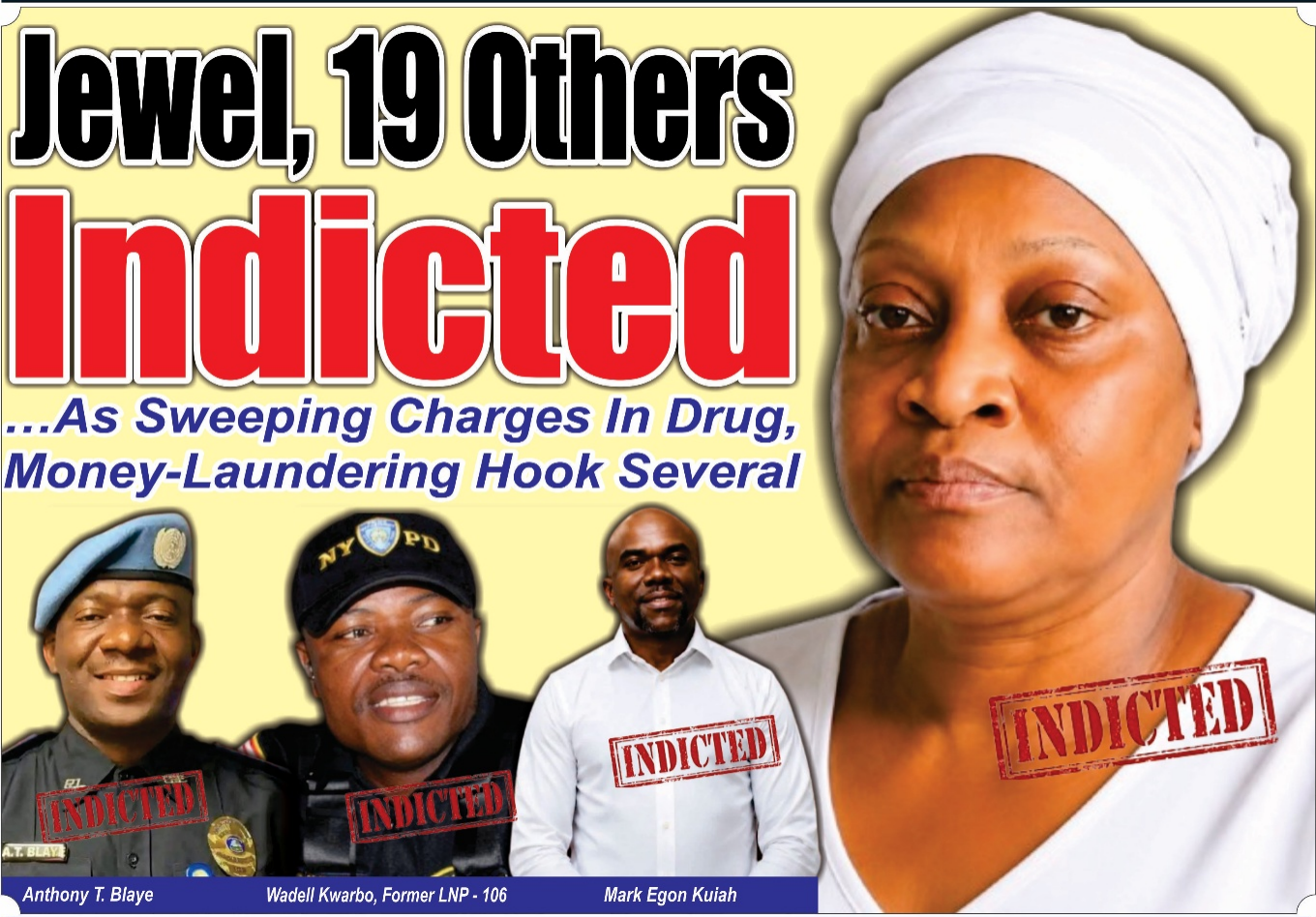
MONROVIA: The government of Liberia has finally indicted former Vice President Jewel Howard-Taylor, former National Security Agency (NSA) Deputy Director for Administration Gerald Foley Smith, former Liberia Civil Aviation Authority (LCAA) Deputy Director for Operations Mark Quiah, two serving police officials and several foreign nationals over allegations ranging from illicit drug trafficking and money laundering to criminal conspiracy and weapons-related offenses.
The indictment, issued by the First Judicial Circuit, Criminal Court “C” for Montserrado County, during its August Term 2026, contains 11 counts against the defendants.
The writ of arrest, signed on October 7, 2026, by J. Amos F. Gbowah, Clerk of Criminal Court “C,” directs the Sheriff of Montserrado County or his deputy to arrest the named defendants and bring them before the court to answer to the charges.
At the center of the case is an alleged network involving controlled substances, with prosecutors accusing the defendants of offenses that include the unlicensed possession, importation, exportation, sale, distribution and transportation of controlled drugs or substances.
The charges also include illicit trafficking, criminal conspiracy, criminal facilitation, criminal solicitation and money laundering, as well as offenses involving the possession and sale of physical objects allegedly intended for lethal use.
The indictment names 20 defendants, including “others to be identified.”
Among those named are Nikola Ivancic, also known as Nikolas Ivancic, a foreign national; Taras Zadereiko, also known as Tony, a Ukrainian national; Mihovil Vrovac, also known as Michael, a Croatian national; Srdan Seles, a foreign national; John David Garces, a foreign national; Sheik Bashiru Kante; Gerald Foley Smith, former Deputy Director for Administration of the National Security Agency; Edison M. Brown; Mohammed Alpha Bah; Jammel V. Jallah; Christian L. Nyantee; Christopher Saryeecee; Cayce L. Nelson; DCP Anthony T. Blaye; ACP Wadell W. Kwarbo; Albenigo Janior; former Vice President Jewel Howard-Taylor; former LCAA Deputy Director for Operations Mark Quiah; Sekou Nana; and others yet to be identified.
The court document identifies the Republic of Liberia, through the Ministry of Justice and the Minister of Justice and Attorney General, as the plaintiff in the case.
Howard-Taylor, who served as Liberia’s Vice President from January 2018 to January 2024 under former President George Manneh Weah, became the country’s first female vice president following the 2017 presidential election. Her inclusion in the indictment represents a significant development in a case that has already attracted intense public and political attention.
The first count of the indictment concerns the alleged unlicensed possession of controlled drugs or substances, while the second alleges unlicensed importation of controlled drugs or substances. The third count accuses the defendants of unlicensed exportation of controlled drugs or substances.
A fourth and particularly broad count alleges the unlicensed sale, trading, administration, dispensation, delivery, distribution, dispatch in transit and transportation of controlled drugs or substances.
The fifth count charges illicit trafficking, while the sixth alleges criminal conspiracy. The seventh count concerns criminal facilitation, followed by criminal solicitation under the eighth count.
The ninth count is money laundering, adding a financial dimension to the prosecution’s allegations. The final two counts concern the possession and sale of physical objects for lethal use and the possession of physical objects for lethal use.
Taken together, the charges portray a broad alleged criminal operation involving controlled substances, financial transactions and other activities that prosecutors contend constitute serious violations of Liberian law.
The writ of arrest issued by Criminal Court “C” formally commands the Montserrado County Sheriff to arrest the “living bodies” of the defendants named in the indictment and bring them before the First Judicial Circuit, Criminal Court “C,” where they are expected to answer to the charges.
The sheriff is also required to make an official return to the court indicating the manner and form in which the writ of arrest was served.
The document was issued under the hand and seal of the court on October 7, 2026, giving the arrest order formal judicial authority.
The issuance of the writ marks a critical procedural development, moving the matter into formal criminal prosecution based on an indictment returned by a duly constituted grand jury.
The indictment follows a wider national security and law-enforcement investigation into an alleged international cocaine trafficking network.
The investigation has been linked to the seizure of approximately 4.2 metric tonnes of cocaine, which authorities have estimated to be worth hundreds of millions of United States dollars.
The alleged operation has drawn the attention of Liberian law-enforcement and security agencies because of its reported international dimensions and the identities of some of the individuals now named in court proceedings.
Several foreign nationals are among those indicted, reinforcing the prosecution’s allegation that the suspected criminal activities extended beyond Liberia’s borders.
Authorities have previously alleged that the wider network operated across multiple jurisdictions and involved individuals suspected of facilitating the movement and distribution of controlled substances.
The indictment now places a number of Liberian public figures and officials within the formal scope of the criminal proceedings.
Howard-Taylor has previously denied allegations connected to the drug-trafficking investigation. Her legal representatives have maintained that she is innocent and have questioned aspects of the government’s case and the manner in which the proceedings have been conducted.
The former vice president’s lawyers have also emphasized the distinction between a criminal complaint, an indictment and a conviction.
That distinction remains central to the unfolding case. An indictment is a formal accusation that a grand jury has found sufficient basis for criminal charges to proceed; it is not a conviction and does not, by itself, establish the guilt of any defendant.
The prosecution will ultimately be required to prove its allegations before a court of competent jurisdiction, while each defendant is entitled to the constitutional protections afforded under Liberian law.
The naming of a former vice president alongside former security and aviation officials and serving police officers is likely to intensify scrutiny of the government’s investigation and the institutions involved.
Howard-Taylor remains a prominent political figure, having served six years as vice president and previously holding significant influence within Liberia’s political landscape.
Smith’s inclusion is also notable because of his former position within the National Security Agency, while Quiah’s name places a former senior official of the civil aviation sector in the middle of an investigation involving allegations of international drug trafficking.
The indictment also names Deputy Commissioner of Police Anthony T. Blaye and Assistant Commissioner of Police Wadell W. Kwarbo, bringing serving law-enforcement personnel into the case.
The allegations therefore raise questions not only about the movement of controlled substances but also about whether individuals with access to sensitive state institutions may have been involved in, facilitated or otherwise connected to the alleged criminal network.
Those questions, however, remain allegations to be tested through judicial proceedings. The latest development follows weeks of heightened public interest surrounding the investigation.
Earlier reports indicated uncertainty over whether a Montserrado County grand jury had formally returned an indictment against Howard-Taylor.
That uncertainty has now been overtaken by the issuance of the October 7 writ of arrest, which identifies the indictment as the basis for the court’s order and formally places the named defendants before the criminal justice process.
The development is expected to trigger further legal proceedings as defense lawyers challenge the government’s allegations and prosecutors seek to establish the evidentiary basis for the extensive charges.
The case could become one of the most closely watched criminal proceedings in Liberia in recent years, given the identities of the defendants, the scale of the alleged drug operation and the potential implications for the country’s security and political institutions.

Towards Economic Empowerment And Reconciliation