CAPE TOWN/MONROVIA: Multiple media reports indicate that Liberia’s oil and gas sector is nearing ready for drilling as Harper Basin is emerging as one of West Africa’s most compelling frontier exploration opportunities, attracting investments from TotalEnergies and BluEnergies as advanced subsurface studies progressively reduce geological uncertainty across three deepwater offshore blocks.
According to reports, the basin remains undrilled despite sharing geological characteristics with some of Africa’s largest and latest deepwater plays.
As seismic, geochemical and seabed datasets converge, the question now is whether the technical progress will translate into a commercially viable petroleum province?
The Harper Basin covers Blocks LB-26, LB-30 and LB-31 under Reconnaissance License RL-003, spanning approximately 8,924 km2 offshore Liberia.
TotalEnergies operates the project with a 65% interest alongside BluEnergies, which retains 35%.
The partnership formalized in January 2026 through a joint study and application agreement after BluEnergies secured an early position in the basin during 2023 and advanced independent prospect evaluation.
An independent prospective resource assessment completed in March 2025 estimated unrisked prospective resources of approximately 17.9 billion barrels of oil and 28.8 trillion cubic feet (tcf) of natural gas across seven mapped basin-floor fan systems.
Current work centers on reprocessing 6,167 km2 of legacy 3D seismic data using energy data and intelligence firm TGS.
The program recently surpassed 50% completion, delivering improved subsurface imaging and enhanced amplitude versus offset analysis to identify potential hydrocarbon-bearing reservoirs.
Parallel offshore operations began on June 19, 2026, with subsurface specialists GeoPartners deploying the research vessel R/V GYRE, operated by TDI-Brooks, to survey approximately 4,045 km2 in water depths between 500 and 3,500 meters.
The campaign combines multibeam echo sounder mapping, water-column imaging, piston coring and heat-flow measurements. These datasets identify seepage pathways, characterize source-rock maturity and improve confidence in future drilling locations before integration during Q4 2026.
The Jubilee field in Ghana, the Venus field in Namibia and the recent discoveries offshore Ivory Coast have proven the significance of basin floor fan plays along the African margin.
Once economically viable anomalies are finalized, TotalEnergies and BluEnergies plan to exercise their rights to convert the reconnaissance license into long-term PSCs by late 2026 or in 2027.
This step legally locks in the drilling rights, positioning the partners to advance toward exploration drilling, subject to prospect maturation, regulatory approvals and investment decisions.
Unlike Liberia’s historically explored offshore basin, the Harper Basin occupies a structurally confined transform-margin embayment bounded by major fracture zones that concentrate sediment delivery into thick basin-floor fan complexes.
These Cretaceous-aged Cenomanian and Turonian fan systems are considered direct geological analogues to producing and discovered deepwater plays along the West Africa Transform Margin.
BluEnergies has identified seven discrete basin-floor fan complexes interpreted from seismic data. The current technical program seeks to validate reservoir quality before progressing toward production sharing contracts and exploration drilling.
Vice President of Exploration Sergio Laura says recent licensing activity across the West African margin reinforces BluEnergies’ early entry into Harper Basin.
He explained, in a press release that “The Jubilee field in Ghana, the Venus field in Namibia and the recent discoveries offshore Ivory Coast have proven the significance of basin floor fan plays along the African margin.”
Unlike earlier Liberian exploration focused primarily on structural traps, the Harper Basin targets stratigraphic pinch-out reservoirs sealed beneath regional marine shales, reducing reliance on fault-dependent trapping mechanisms that limited historical exploration success.
If the current technical program confirms reservoir quality, Liberia could move from being one of West Africa's least explored offshore jurisdictions to one of its most closely watched frontier plays.
With TotalEnergies providing technical expertise and BluEnergies holding an early strategic position, the next milestone is no longer identifying prospects—but determining whether they justify Liberia's first deepwater exploration wells.
The Harper Basin’s progress comes as Liberia seeks to attract new investment through its 2026 Offshore Direct Negotiation Licensing Round, highlighting the country’s broader offshore potential and growing exploration momentum.
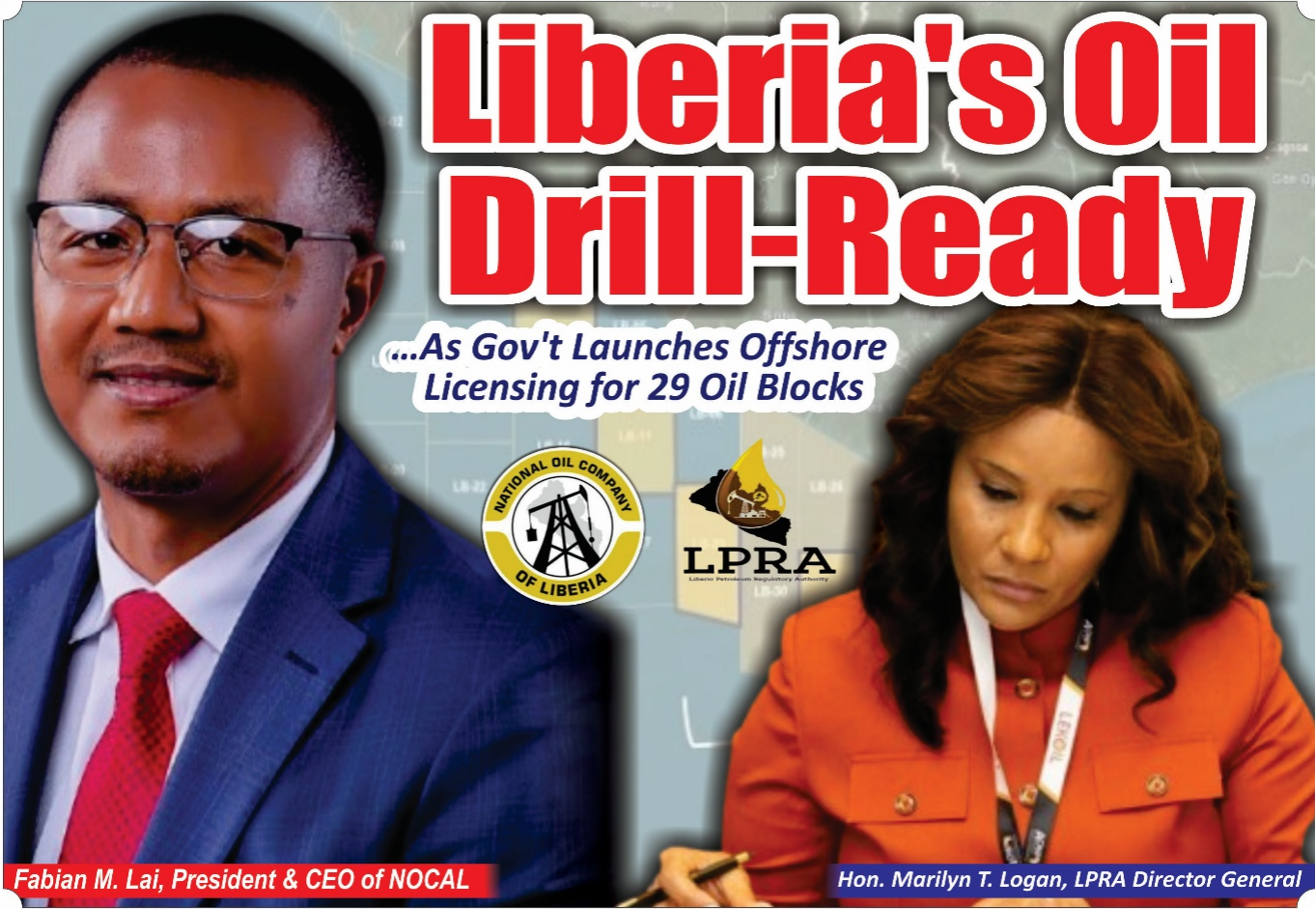
Meanwhile, Liberia will launch its 2026 Offshore Direct Negotiation Licensing Round on October 14, offering 29 offshore blocks across the Liberia and Harper basins as the country seeks to attract new exploration investment, according to Energy Capital & Power.
The Liberia Petroleum Regulatory Authority (LPRA) will formally present the round during African Energy Week 2026 in Cape Town, South Africa.
The acreage is supported by more than 50,000 line-km of 2D seismic and over 31,000 km² of 3D seismic data.
Prequalification for the round opened August 28 following an investor event in Houston earlier that month.
Companies can establish their technical and financial eligibility before submitting expressions of interest and entering negotiations for individual blocks.
Available acreage targets cretaceous structures, deepwater basin-floor fans and structural closures.
Liberia's offshore petroleum system shares geological characteristics with other Atlantic margin plays, including neighboring Côte d'Ivoire, where recent discoveries have increased industry interest in the region.
TGS has reprocessed 12,000 km of 2D seismic using pre-stack depth migration, along with 5,100 km² of 3D data from a larger 26,000-km² volume.
Additional gravity, magnetic, well-log and multi-client datasets are available to support evaluation of the acreage.
The offering includes blocks in the Liberia basin, as well as blocks in the Harper basin.
Other acreage within the broader 29-block grid is subject to existing commitments and agreements.
Several international operators already hold interests offshore Liberia.
TotalEnergies holds blocks LB-6, LB-11, LB-17 and LB-29, covering approximately 12,700 km², while Atlas Oranto Petroleum holds LB-15, LB-16, LB-22 and LB-24.
Recent activity has also emerged around Harper basin block LB-32.
Australian independent Bounty Oil & Gas agreed in September to acquire PetroQuest Liberia Deep Water, which holds an exclusive letter of engagement with the National Oil Company of Liberia to negotiate a production-sharing contract for the block.
Liberia is using a direct-negotiation licensing model that allows qualified companies to pursue individual technical and commercial opportunities.
Applicants are evaluated on financial strength, technical capabilities and offshore experience before advancing to negotiations over proposed exploration programs.
Prequalification is valid for five years, allowing eligible companies to participate as offshore opportunities become available.
The licensing round is being organized by Energy Capital & Power in partnership with LPRA; Source: NewsNow-Liberia.

Towards Economic Empowerment And Reconciliation