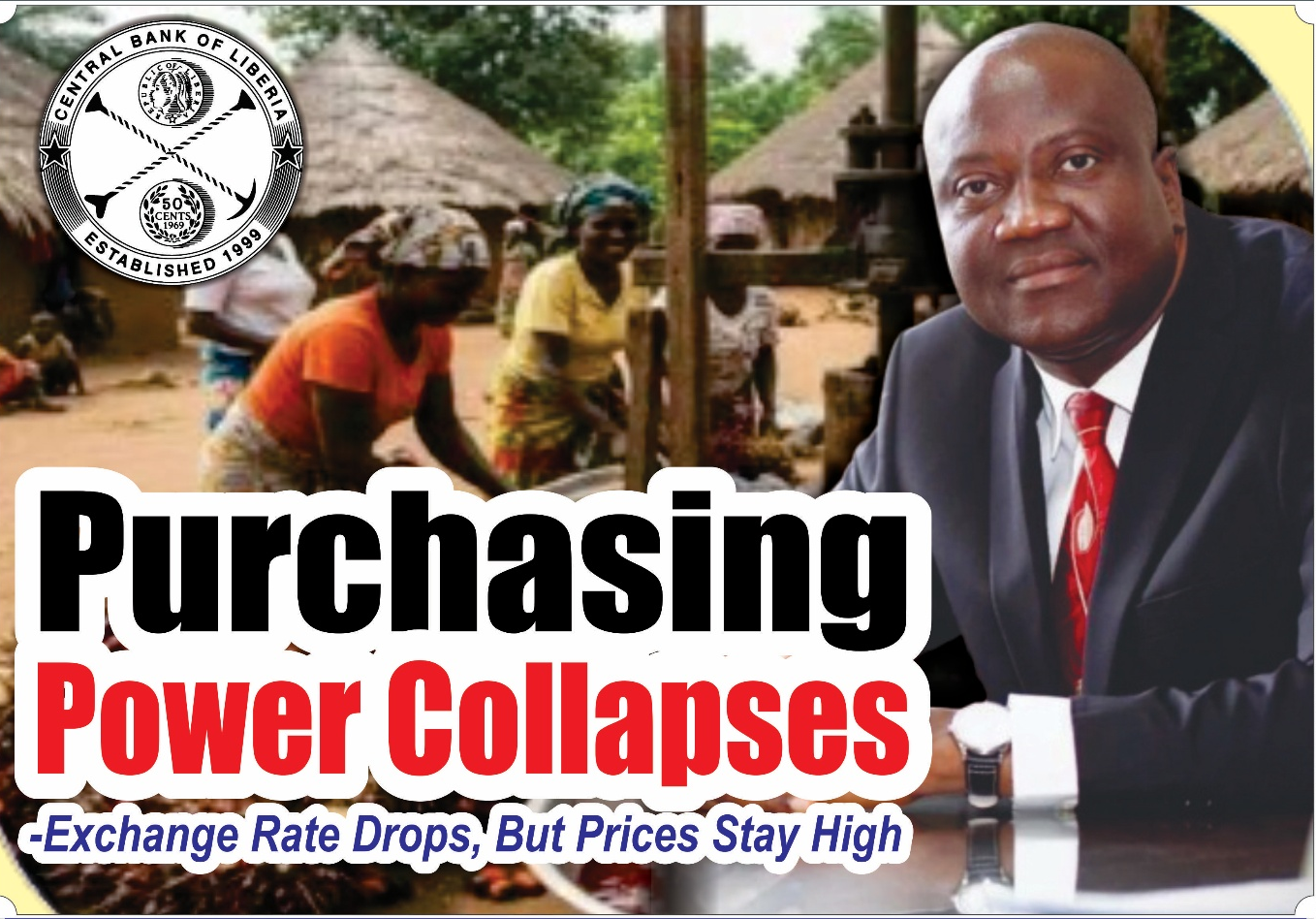
MONROVIA: Liberia’s improving exchange rate is yet to translate into relief at the marketplace, leaving households trapped between stubbornly high commodity prices, rising transportation costs, fuel pressures and weakening purchasing power as incomes struggle to keep pace with the cost of living.
The economic paradox is becoming increasingly visible: while the Liberian dollar has strengthened significantly against the United States dollar in recent weeks, many ordinary consumers continue to pay prices established during periods of a weaker local currency.
The Central Bank of Liberia’s (CBL) published market rates show the Liberian dollar moving from around L$180 to the US$1 range in August to approximately L$170–172 per US$1 in early October. On October 3, the CBL listed a buying rate of L$170.15 and a selling rate of L$172.19 to US$1.
Yet, the appreciation of the local currency has not produced a corresponding decline in the prices of basic goods.
Instead, consumers, petty traders, students, workers and market women are confronting what economists describe as sticky prices—prices that remain elevated even after some of the cost pressures that initially drove them upward have eased.
Recent reports from traders in Monrovia indicate that some wholesalers continue to calculate the cost of imported merchandise at exchange rates considerably higher than the Central Bank's published rate, creating a gap between the official foreign-exchange market and the rates effectively embedded in retail prices.
Exchange Rate Falls, Prices Remain. For ordinary Liberians who earn and spend largely in Liberian dollars, the situation represents a serious erosion of real income.
A stronger Liberian dollar should, in principle, reduce the local-currency cost of imported goods and other dollar-denominated inputs.
But where traders retain old inventory purchased at higher exchange rates—or continue using higher reference rates for replacement stock—the benefits of currency appreciation may take time to reach consumers.
That transmission gap is now at the heart of growing public frustration.
The result is an economy in which the exchange rate appears to be moving in one direction while the cost of living moves in another.
Food, transportation, rent, school-related expenses and other household necessities continue to consume a larger proportion of family income, leaving many households with little disposable income after meeting basic needs.
For low-income families, this amounts to a decline in purchasing power, even where nominal wages have not changed.
Transport fares add to household pressure; transportation has become another major pressure point.
As transport fares rise, workers and students who depend on commercial vehicles are being forced to make difficult daily choices between paying for transportation and meeting other basic needs.
Some commuters who cannot afford repeated transport fares have resorted to walking considerable distances to and from work, school and marketplaces.
Market women, whose livelihoods depend on moving between communities and commercial centers, are particularly exposed because transportation costs are absorbed into the price of bringing goods to market.
For students, the burden can be equally severe. Daily transportation costs can consume a substantial portion of household allocations for education, particularly for families with several school-going children.
The consequence is not simply inconvenience. Higher transportation costs increase the cost of doing business, raise distribution expenses and can ultimately feed into consumer prices.
This creates a familiar inflationary chain: higher fuel and transport costs increase the cost of moving goods; higher distribution costs increase wholesale and retail prices; and higher prices further reduce household purchasing power.
Fuel price pressure. Petroleum prices remain another important component of the cost structure confronting Liberian consumers.
Because Liberia imports virtually all of its petroleum products, movements in international petroleum prices, shipping and logistics costs, taxation, margins and the exchange rate can quickly affect domestic transportation and commercial activity.
The government's petroleum-pricing mechanism has therefore remained a critical economic variable, particularly because, fuel prices influence transportation, electricity generation, logistics and the movement of agricultural and imported commodities.
The impact is multiplied across the economy. When a commercial vehicle operator pays more to operate, passengers ultimately bear part of that cost. When a trader pays more to transport goods from a wholesale center to a market, consumers are exposed to higher retail prices.
Government moves vendors and salaries toward dollar payments. Against this backdrop, the government has adjusted the currency composition of selected public payments.
An Inter-Agency Circular issued in September reportedly moved registered government vendors to 100 percent United States-dollar payments for September through November 2026, while the dollar component of civil servants' salaries was increased from 70 percent to 80 percent, leaving 20 percent payable in Liberian dollars. The stated objective was to stabilize government payment operations within Liberia's dual-currency system.
The policy is significant because, it reflects the continuing importance of the United States dollar in Liberia's fiscal and commercial system.
But it also raises a broader economic question: how quickly can improved dollar liquidity and exchange-rate stability translate into lower prices for households that purchase most of their necessities in the domestic market?
For civil servants receiving a larger portion of their income in US dollars, the arrangement may provide some protection against exchange-rate volatility. However, the broader population—including informal workers, petty traders, farmers, market women, unemployed youth and other households without dollar-denominated incomes—may not receive the same protection.
The missing transmission. The central problem confronting policymakers is increasingly the transmission of macroeconomic stability to household welfare.
A favorable exchange-rate movement is important, but it is not sufficient by itself to reduce the cost of living.
For consumers to feel the benefit, lower foreign-exchange costs must eventually be reflected in wholesale purchasing, transportation, distribution and retail pricing.
That requires effective market monitoring, competition, transparent pricing and enforcement of applicable commercial regulations.
The Ministry of Commerce and Industry has a critical role in monitoring prices of essential commodities, investigating unjustified price increases and ensuring that consumers are not denied the benefits of changing market conditions.
The challenge is particularly important in a heavily import-dependent economy where exchange-rate movements can have an immediate impact on the domestic price structure.
A cost-of-living crisis beyond statistics. For policymakers, exchange-rate appreciation and macroeconomic indicators provide evidence of economic stabilization.
For ordinary Liberians, however, the most important economic indicator is increasingly the amount of food, transportation and other necessities that their income can purchase.
That is the real test of purchasing power. A worker whose salary remains unchanged while transportation, food and household expenses rise, experiences a decline in real income, regardless of improvements recorded in headline macroeconomic indicators.
The same applies to a market woman whose sales remain flat while transportation and wholesale costs rise. It applies to the student who walks to school because the daily fare has become unaffordable.
And it applies to the family forced to reduce the quantity or quality of food purchased because household income no longer stretches to the end of the month.
Government faces pressure to act.The prevailing situation is therefore placing increasing pressure on the government's economic management institutions to move beyond monitoring the exchange rate and address the price-transmission problem.
The Central Bank, Ministry of Commerce and Industry, Ministry of Finance and Development Planning and other relevant institutions have different mandates, but their policies ultimately converge at the level of household welfare.
The government will need stronger market intelligence, regular publication of commodity-price data, enforcement against abusive pricing practices where violations are established, and closer monitoring of transportation and petroleum-price effects.
At the same time, economic experts say, policymakers must recognize that not every high price is evidence of profiteering. Imported goods remain exposed to international prices, freight, insurance, taxes, logistics, and replacement costs.
The challenge is to determine where legitimate cost increases end and unjustified price rigidity begins.
For Liberia's consumers, that distinction offers little comfort when household budgets are already under severe pressure.
The immediate economic question is no longer simply whether the Liberian dollar is gaining value.
It is whether that gain will finally reach the marketplace—and whether ordinary Liberians will be able to buy more with the money in their pockets.
Until that happens, the apparent improvement in the exchange rate, risks remaining a macroeconomic statistic rather than a meaningful improvement in the daily lives of the people.
CEMENCO and Fouta Corporation have also increased the price of cement, citing prevailing exchange-rate conditions and rising operational costs.
The companies have further directed customers to arrange and bear the cost of transporting their purchases, rather than relying on company-provided delivery services, adding another layer of cost to an already strained construction sector.

Towards Economic Empowerment And Reconciliation