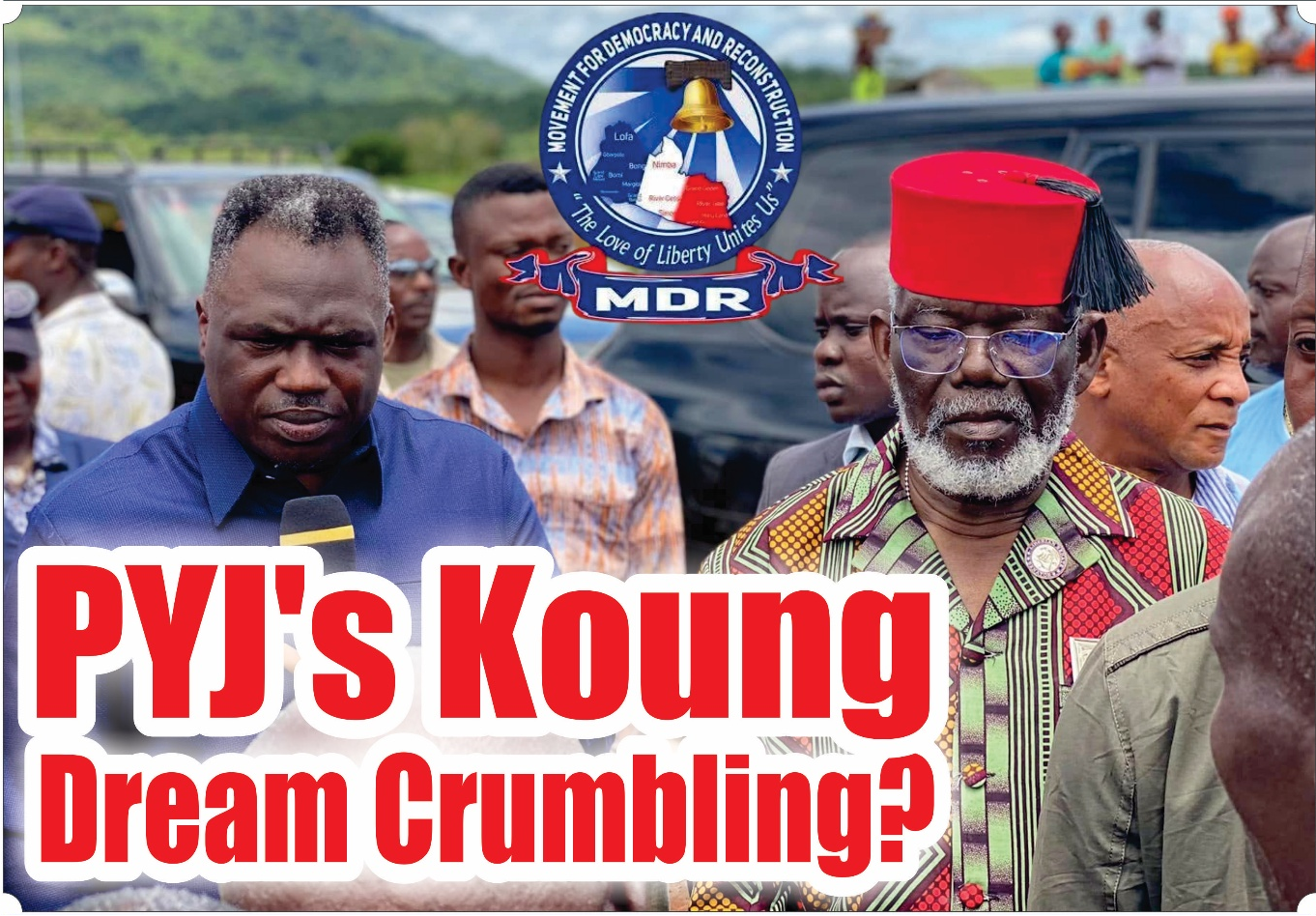
By: Our Political Editor
MONROVIA: Three years after then Nimba County Senator, Prince Y. Johnson (late) marketed the Boakai-Koung ticket to Nimba voters as a pathway to political power, his succession prediction faces a reality check as President Joseph Boakai remains firmly in charge of his administration and continues directing Liberia’s government.
Before the 2023 presidential election, the late Senator Prince Y. Johnson deployed one of his most politically consequential arguments to persuade citizens of Nimba County to embrace the Joseph Boakai-Jeremiah Koung ticket: elect Boakai, and Nimba, through Koung, would be positioned to wield unprecedented influence over the Liberian presidency.
The argument was not simply about electing a vice president. It was presented as a political pathway through which Nimba could move closer to the presidency.
In a recording of a conversation obtained and published by FrontPageAfrica in August 2023, Johnson was heard arguing that Boakai’s age and condition meant Koung would effectively assume much of the responsibility of running the government.
“This old man is old, he took Koung to be his Vice President when he wins, isn’t Koung that would be doing the job for him? Can he go everywhere? No!” Johnson said.
The statement was part of a broader political strategy surrounding the selection of Koung as Boakai’s running mate.
Johnson also told Nimba citizens in July 2023 that Koung’s elevation to the vice presidency represented “the pathway to the presidency,” while declaring that Nimba County would produce Liberia’s next president through Koung.
For Johnson, the message was politically powerful. Nimba voters were being asked to look beyond the immediate presidential contest and see the Boakai-Koung ticket as an opportunity for the county to position one of its own at the center of national political succession.
The calculation was straightforward: Boakai, then 78, would become president, while Koung, his much younger running mate, would occupy the vice presidency and potentially exercise substantial political authority.
That expectation helped frame the 2023 election in parts of Nimba not merely as a contest between Boakai and then-President George Weah, but as a contest with far-reaching implications for who would eventually occupy Liberia’s highest office.
Johnson’s intervention was particularly significant because of his political relationship with Koung. Koung had risen through Nimba politics with Johnson’s backing and later succeeded him as political leader of the Movement for Democratic Reconstruction, a party established by the then powerful and longest serving senator.
Johnson subsequently became an influential force behind the Boakai-Koung alliance. Reporting at the time, described Johnson as a pivotal figure in securing support for the ticket in vote-rich Nimba County.
But, according to keen observers, three years later, the political landscape looks markedly different from the expectation Johnson communicated to Nimba voters.
Boakai is still president. And rather than relinquishing the practical conduct of government to his vice president, Boakai continues to exercise the constitutional authority of the presidency.
Recent official records from the Executive Mansion show the President making appointments and administrative decisions, directing national initiatives, engaging foreign governments and international partners, and issuing policy pronouncements in September and October 2026.
On September 22, for example, the President made new appointments across several government institutions. Earlier in September, he appointed acting officials at the Ministry of Justice and continued directing the administration’s executive agenda.
On September 15, Boakai addressed the nation on Liberia’s achievement of more than US$1 billion in domestic revenue collection and outlined how his administration intended to use increased domestic resources for national development.
By October 1, the Executive Mansion was still issuing presidential directives and reporting on Boakai’s engagements, including his call for stronger diaspora participation in national development.
The contrast is therefore striking. The political picture Johnson projected in 2023 suggested that Koung could become the principal figure running the country under a Boakai presidency because of concerns then being raised about Boakai’s age and health.
That expectation has not materialized in the manner Johnson described.
Importantly, however, the issue should not be reduced to a question of whether Koung has influence within the administration.
As vice president, Koung occupies the country’s second-highest elected executive office and serves an important constitutional and political role. The question is narrower: has the prediction that he would effectively run the affairs of government in place of Boakai become reality? The available public record does not establish that.
Instead, the official record continues to identify Boakai as the President exercising executive authority, while Koung serves as Vice President. The distinction is constitutionally significant.
A vice president may wield substantial political influence, participate in government decision-making and undertake important national assignments, but the presidency remains constitutionally vested in the President unless the circumstances specified by law result in succession or transfer of presidential authority.
That reality gives new meaning to Johnson’s 2023 campaign argument.
At the time, his message was directed principally at convincing Nimba voters that supporting Boakai would create a political route for Koung—and, by extension, for Nimba—to move toward the presidency.
Johnson even framed the prospect in county-centered terms, telling Nimba citizens that the county would produce the next president through Koung.
The late senator’s strategy reflected his long-standing political influence in Nimba and his effort to consolidate the county behind a ticket that placed Koung at the center of national power.
But the passage of time has introduced a different political reality. Boakai is approaching the third year of his presidency, and there is no indication in the current official record that he is preparing to surrender the functions of the presidency to Koung.
Indeed, the President remains publicly active in domestic governance, international diplomacy, appointments, economic policy and national initiatives.
The very premise on which Johnson’s argument rested—that Boakai would be unable to shoulder the full demands of the presidency and that Koung would consequently become the person effectively running the country—has therefore, become a subject of political reassessment.
For Nimba, the question may now be more complicated than the promise made during the 2023 campaign. Did the county secure the political leverage Johnson envisioned? Has Koung’s vice presidency delivered the degree of influence Johnson suggested?
And, perhaps most importantly, was the promise of a Nimba pathway to the presidency intended as an immediate political reality or as a longer-term succession strategy?
Those questions are likely to remain relevant as Liberia approaches another electoral cycle.
Johnson is no longer alive to explain whether his 2023 remarks were intended literally, politically, or as a campaign strategy designed to motivate Nimba voters.
But the recording remains part of the political history surrounding the Boakai-Koung alliance.
And today, the contrast between the prediction and the present reality is difficult to overlook: the man Johnson described as too old to run the country remains firmly at the helm, while the man he portrayed as the one who would do the job remains vice president.
The political succession Johnson envisioned, at least as described in those 2023 remarks, has not unfolded on the timetable implied by his campaign message.
Whether that represents a collapsed political expectation, a postponed ambition, or simply a campaign argument whose circumstances changed with time, remains a question for Liberia’s evolving political landscape—not a conclusion that can yet be drawn from the available record.
Interestingly, LPR Radio, on September 29, 2026, reported that Boakai’s ‘One More Term’ Remark Fuels 2029 Re-election Speculation as Information Minister urges a more cautious interpretation.
President Joseph Nyuma Boakai has fueled speculation about his political future after suggesting publicly, for the first time, that he may consider seeking a second term in office when Liberians return to the polls in 2029.
The remarks were made during an engagement with Liberians in the United States at the Liberia Diaspora Annual Conference 2026 on Sunday.
According to reports from the event, President Boakai responded to a question about whether he intends to seek re-election by turning the question back to the audience and asking whether they would support another bid. After receiving an affirmative response, he smiled and said: “I am still entitled to one term.”
The comment immediately triggered debate over whether the President was signaling an intention to run again or merely acknowledging his constitutional eligibility to do so.
Under Article 50 of Liberia’s Constitution, a president serves a six-year term and may serve a maximum of two terms. Having assumed office in January 2024, Boakai remains constitutionally eligible to contest the 2029 presidential election.
However, political observers note that a distinction exists between affirming eligibility and formally declaring a candidacy.
Signal, Not Declaration
President Boakai did not announce a re-election campaign, launch a political organization, or explicitly state that he intends to run in 2029.
At the same time, analysts argue that his response went beyond a simple constitutional observation. Coming directly after engaging an audience on the prospect of a second term, the statement can reasonably be interpreted as an indication that the option remains under consideration.
The significance of the exchange lies less in the constitutional point itself than in the fact that the sitting President publicly engaged a direct question about his political future.
As such, the remarks are more accurately described as a political signal than a formal declaration of candidacy.
Piah’s Earlier Position
The comments also contrast with the more guarded public stance previously articulated by Information Minister Jerolinmek M. Piah.
In a February 2026 interview, when asked about the President’s prospects in the next election, Piah emphasized governance over electoral politics.
“What the President thinks about every day is the next generation, not the next election,” Piah said. “What we are doing is to meet the needs of the people, not about the next election. The people will decide about the next election.”
While Piah’s statement did not rule out a future re-election campaign, it sought to separate the administration’s governing agenda from political calculations surrounding 2029.

Towards Economic Empowerment And Reconciliation