MONROVIA: As Liberia battles stubborn economic pressures, five opposition parties have moved to consolidate their forces, raising a fundamental political question: can this alliance survive financial pressures and competing ambitions through 2029?
Liberia’s opposition politics has entered a potentially consequential new phase, with five political parties formally committing themselves to closer cooperation in a move that could reshape the country’s political landscape ahead of the 2029 elections.
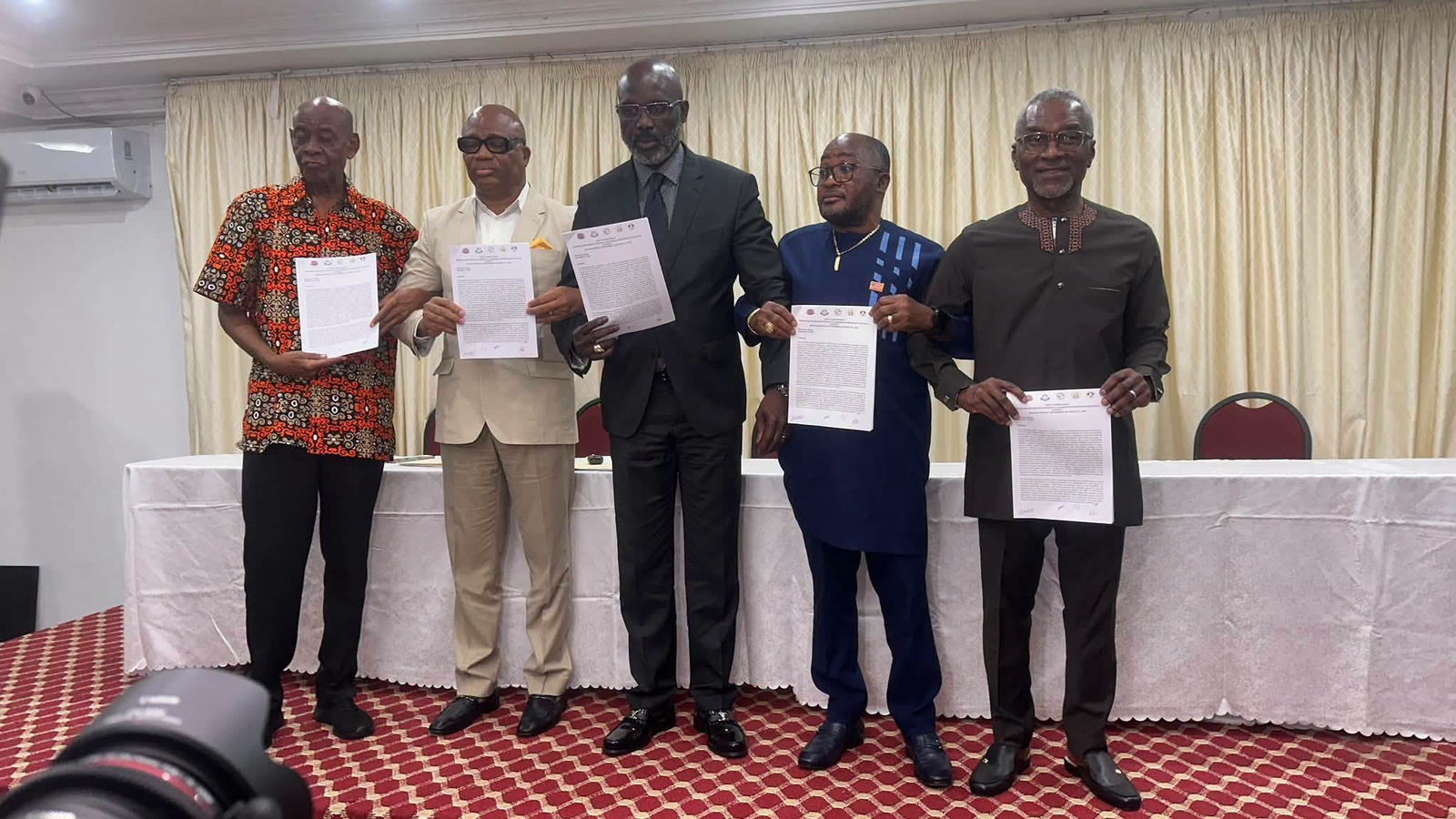
The Alternative National Congress (ANC); Coalition for Democratic Change (CDC); Movement for Economic Empowerment (MOVEE); Movement for Progressive Change (MPC); and Union of Liberian Democrats Party (ULDP) signed a joint communiqué on Sunday, September 27, 2026, establishing a framework for sustained opposition collaboration and tasking a Joint Technical Committee with developing an implementation and operational agenda.
The development places President Joseph Nyuma Boakai’s administration before a politically important test: whether its economic and governance agenda can produce tangible improvements quickly enough to prevent growing public frustration from becoming a durable political advantage for an increasingly coordinated opposition.
The opposition parties are not merely attacking the government over individual policies.
Their communiqué attempts to construct a broader political platform around economic opportunity, constitutional democracy, judicial independence, accountability, employment, property rights, health, education and protection of civil liberties.
The Communiqué states that increased economic growth and domestic revenue have not sufficiently improved conditions for poor Liberians, unemployed citizens and small businesses.
That message could resonate well beyond the traditional opposition base, if economic improvements remain difficult for ordinary Liberians to see and feel.
For the Boakai administration, the opposition's consolidation comes at a particularly sensitive moment.
The government has emphasized revenue mobilization, fiscal discipline, infrastructure, investment and institutional reform as foundations for long-term development. The IMF has acknowledged strong fiscal performance and improved revenue mobilization in 2026.
The political question is increasingly whether the administration can translate improved public finances into jobs, affordable basic commodities, functioning services, business opportunities and visible improvements in living conditions.
The opposition parties are effectively saying that the government's economic achievements have yet to sufficiently reach the people.
Their Communiqué, therefore, places economic delivery alongside corruption, judicial independence, civil liberties and national security—turning separate grievances into a potentially unified political narrative.
The five parties accuse the government of failing to respond adequately to what they describe as Guinea's alleged occupation of Liberian territory in Foya District, Lofa County, and demand stronger diplomatic action.
They also criticize the administration's in handling the relations with the European Union, including the recall of its ambassador and head of Delegation, Nona Deprez, and call for greater tolerance of diplomatic criticism.
On the proposed arrangement involving the transfer of as many as 1,200 foreign nationals from the United States to Liberia, the opposition demands greater transparency and public disclosure.
On corruption, the parties call for independent investigations into allegations surrounding the reported US$10 million Foya construction project and an alleged US$8 million transfer of Central Bank reserves to SIB Liberia, among other cases.
The Communiqué also raises concerns about alleged political interference in judicial affairs and calls for respect for Supreme Court decisions and judicial independence.
On freedom of expression, the opposition objects to what it characterizes as restrictions on criticism of government officials, including the use of the Cybercrime Act, and calls for stronger constitutional protection of free speech.
The document further calls for an independent investigation into the reported US$19 million and US$317 million drug seizures, while raising concerns about what the parties describe as selective prosecution.
On the broader social front, the parties cite inadequate investment and weak remuneration in health and education, while also raising concerns about property demolitions, access to government procurement and opportunities for Liberian-owned businesses.
However, former President George Manneh Weah's recent return to Liberia adds another political layer to the debate. The communiqué also addresses former President Weah, condemning what the signatories describe as a threatening security environment surrounding his return to Liberia in September 2026.
That issue is politically significant because, former President Weah remains the principal figure around whom the CDC's opposition machinery is organized.
The CDC emerged from the Congress for Democratic Change, which first contested national elections under Weah in 2005. It reached the presidential runoff in 2005 and 2011 before the broader CDC coalition won the presidency in 2017. Weah subsequently lost the 2023 runoff to Boakai.
His presence alongside ANC leader, Alexander Benedict Cummings, MOVEE leader, Dee-Maxwell Saah Kemayah, MPC leader, Simeon Freeman and ULDP leader, Jonathan Mason therefore, gives the new arrangement a mixture of established electoral machinery.
Liberia has a long history of opposition parties discovering that electoral unity is easier to announce than to sustain.
During the Charles Taylor era, opposition parties operated in a deeply polarized political environment dominated by Taylor's National Patriotic Party. Taylor won the 1997 presidential election with 75.33 percent of the vote, while the political environment remained heavily shaped with division by the country's leading parties.
The most recent experiment was the Collaborating Political Parties (CPP).
Formed by the Unity Party, ANC, Liberty Party and All Liberian Party, the CPP initially offered a powerful opposition platform after the 2017 elections.
Interestingly too, the UP, ALP and significant elements of the LP departed, leaving the arrangement substantially weakened.
Liberian opposition alliances have repeatedly faced their most serious tests not when confronting the incumbent, but when confronting themselves.
Can this coalition survive until 2029, remain the great challenged to the new opposition front.

Towards Economic Empowerment And Reconciliation