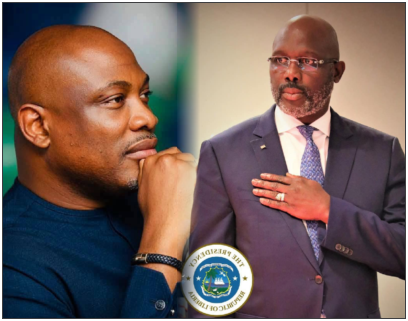
ACCRA: Representative Taa Wongbe of Nimba County has offered a reflective tribute to former Liberian President George Manneh Weah, praising his historic football journey, political resilience and peaceful acceptance of Liberia’s 2023 election results and gave him his flowers.
Representative Wongbe has publicly reflected on the extraordinary journey of former President Weah, separating political disagreement from recognition of a Liberian whose life story has crossed the boundaries of sport, politics, national identity and democratic leadership.
Wongbe’s reflection, prompted by a conversation with ECOWAS colleagues in Ghana following Liberia’s defeat to Rwanda, evolved into a broader examination of Weah’s legacy—particularly his achievements in football and his conduct following the closely contested 2023 Presidential election.
According to Wongbe, the discussion began with football but quickly turned to Weah’s political journey after he mentioned that the former president lost his reelection bid by just 20,567 votes.
“One of my colleagues looked at me in disbelief. ‘Only twenty thousand votes? And he accepted it?’” Wongbe recounted.
According to Wongbe, when he confirmed that Weah had accepted the result, his colleague responded: “That man deserves a peace award.”
The comment, Wongbe said, prompted him to reconsider aspects of Weah’s public life that extend beyond partisan politics.
“I have never voted for George Weah. I have never supported him politically. And this is not an endorsement of his record as president,” Wongbe wrote, making clear that his appreciation should not be interpreted as a political endorsement for Weah.
Representative Wongbe acknowledged that he had been an opposition figure and a strong critic of the Weah administration, arguing that there were aspects of Weah’s presidency that could have been handled differently and better. “History will debate that record, as it should,” he stated.
Yet, beyond the political arguments surrounding Weah’s presidency, Wongbe said, there is another story worth remembering—the story of a boy from one of Monrovia’s poorest communities who rose from the streets of Liberia to become one of the most celebrated footballers in world history.
In 1995, Weah reached an unprecedented height in African football, winning the FIFA World Player of the Year award, the Ballon d’Or and African Player of the Year in the same year, the Nimba County Representative recalled.
For Wongbe, that achievement remains profoundly significant because, according to him, Weah accomplished it while carrying the identity of a country emerging from devastating conflict and international obscurity.
“From the streets of Monrovia to the very top of world football,” Wongbe reflected. Before entering politics, Weah had already established Liberia as a recognizable name on the international sporting stage. His career with leading European clubs, combined with his achievements as an individual footballer, gave Liberia a level of global visibility rarely achieved by a country of its size, Wongbe noted.
Wongbe also highlighted Weah’s continued connection to Liberia during the country’s years of civil conflict and his humanitarian engagement, including his work with UNICEF beginning in the 1990s. His political journey, Wongbe noted, was equally marked by persistence.
Weah first contested the presidency in 2005, losing to Madam Ellen Johnson Sirleaf. He challenged the election outcome before eventually withdrawing his protest in what he described as being in the interest of national peace.
He returned to the presidential race in 2011 as Ambassador Winston Tubman’s running mate, before making another major political move in 2014 by contesting the Montserrado County senatorial election.
Wongbe recalled supporting Benjamin Sanvee during that election but acknowledged that voters overwhelmingly chose Weah, who won approximately 78 percent of the county vote. “We wanted something different. The people chose Weah,” he wrote.
Three years later, Weah completed one of the most remarkable political transformations in Liberia’s modern history, moving from international football icon to President of the Republic of Liberia after more than a decade in electoral politics.
But for Wongbe, Weah’s political legacy cannot be discussed only through his rise to power. It must also include what happened when that power was lost.
In the 2023 presidential runoff, Weah narrowly lost to current President Joseph Nyuma Boakai, then main opposition leader.
Representative Wongbe emphasized that the margin was only 20,567 votes, making the election one of the closest presidential contests in Liberia and Africa recent history.
More importantly, Representative Wongbe pointed to Weah’s decision to concede defeat and facilitate a peaceful transfer of power. “He accepted that the country was bigger than the presidency. That matters,” Wongbe wrote.
For Wongbe, that moment offers a significant lesson about democratic politics: political power is temporary, while the stability of the state belongs to everyone.
The representative also cautioned against allowing political disagreements to erase the achievements of individuals. “Appreciation does not require agreement, and giving a man his flowers does not require rewriting history,” Wongbe stated.
That distinction forms the intellectual core of Wongbe’s tribute. He does not dismiss criticism of Weah’s administration; instead, he argues that assessing a presidency and acknowledging an individual’s contributions to national identity can coexist.
Liberians, Wongbe observed, can sometimes become so consumed by political divisions, social class and educational credentials that they overlook the extraordinary journeys of citizens who rise from difficult circumstances.
“We sometimes forget the systems that produced all of us—and the extraordinary distance some people had to travel just to arrive at the starting line,” he wrote.
For Wongbe, Weah represents both the challenges and possibilities of Liberia.
He is a product of a country scarred by poverty, inequality and war, but also evidence that talent, determination and opportunity can carry a Liberian from one of Monrovia’s poorest communities to the summit of international football and eventually to the presidency.
Wongbe nevertheless acknowledged that Weah’s legacy remains open to debate.
Liberians can examine his six-year administration, assess its policies and shortcomings, and question whether his unique position as Africa’s most celebrated footballer should have translated into a greater transformation of Liberian sports and football infrastructure.
But, Wongbe argues, those debates should not prevent the country from recognizing the milestones Weah achieved.
“We can debate President Weah’s six years in office, and we should,” Wongbe said. “We can also ask whether someone who reached the absolute pinnacle of football should have done far more to transform Liberian football and sports—and we should ask that too.”
His conclusion, however, is less about politics than national memory.
Wongbe says, Weah deserves recognition for breaking barriers for African football, persevering through repeated political setbacks and, most significantly in his view, choosing national stability after a closely fought presidential election.
“So today, I simply want to give George Manneh Weah his flowers for what he accomplished for Liberia on the world stage,” Wongbe declared.
“For the barriers he broke for African football. For the perseverance of his journey. And especially, for that moment in 2023 when political power and peace stood on opposite sides of a painfully close election—and he chose to let Liberia move forward.”
Wongbe concluded his tribute with a message that deliberately rises above partisan politics:
“Whatever else history ultimately writes about George Weah, that chapter deserves to be remembered. Respect, Mr. President.”

Towards Economic Empowerment And Reconciliation