CALDWELL: A woman’s death after alleged surgery by a man accused of falsely presenting himself as a doctor has exposed troubling gaps in Liberia’s medical regulation, raising urgent questions about who protects patients from unlicensed practitioners.
Saybah Kollie’s death has ignited renewed concern over the proliferation of unlicensed and allegedly unqualified health practitioners operating across Liberia, with critics warning that weak regulatory enforcement is leaving desperate patients vulnerable to potentially dangerous medical treatment.
Kollie’s case, as documented in the account provided, raises questions not only about the purported conduct of Mohamed Ali Bah, who allegedly represented himself as a qualified medical practitioner, but also about the effectiveness of Liberia’s medical regulatory system.
For her family, what began as an attempt to save a loved one ended 47 days later in tragedy!
Kollie reportedly collapsed on a Sunday morning in early April, shortly after her son’s second birthday. Her husband, Blama Kamara, and community members rushed her to a nearby facility in Stockton Creek, where the family was reportedly introduced to Bah.
Kamara said, Bah warned that Kollie could die if treatment was delayed. Trusting the man’s claimed medical expertise, the family proceeded with treatment.
According to Kollie’s sister, Janga Kollie, however, no diagnostic tests were initially performed. She alleged that Bah examined Saybah by pressing her abdomen and concluded that she had fibroids.
That diagnosis became the basis for further treatment, including an eventual operation.
Medical diagnosis ordinarily depends on appropriate clinical examination and, where necessary, laboratory or imaging investigations.
In Kollie’s case, family members say, they were not shown any evidence of such testing before surgery.
Kamara was initially asked to pay US$20, while Bah allegedly told him that Kollie had lost significant amounts of blood and required seven pints at US$50 per pint, amounting to US$350.00 for a struggling family under a deteriorating economic condition.
Within a week, according to the family, treatment and accommodation costs had reached approximately US$330 besides the cost of blood.
Kollie (the deceased lady) appeared to improve temporarily and was taken home but condition subsequently deteriorated.
According to her family, Bah (the alleged doctor) then recommended surgery and allegedly claimed to be a surgeon at a local hospital and a professor at a major medical school in Monrovia.
The husband (Kamara) said, he asked whether the facility had an ultrasound machine and was assured that it had the necessary equipment. A family member subsequently signed paperwork consenting to surgery.
After the operation, however, Kollie’s condition reportedly worsened. Her bleeding allegedly continued, prompting repeated demands for additional blood. Janga, a family member, said, the family ultimately purchased more than 15 pints at a cost of about US$750.
As Kollie became increasingly weak, relatives reportedly sought to transfer her to another hospital. Her family disclosed that Bah initially resisted the move and did not provide a formal referral note.
Kollie was eventually taken to 14 Military Hospital and later referred to JFK, where doctors reportedly discovered that she had cervical cancer.
According to the family, physicians at JFK said, she had arrived in critical condition and that treatment came too late. Kollie died a day later.
The death certificate reportedly attributed her death to complications associated with cervical cancer, including kidney failure, severe depletion of blood, fluid accumulation in the lungs and toxins building up in the brain.
JFK Communications Director, James-Emmanuel D. Cole Jr. confirmed that Kollie was received as a serious medical emergency following a referral from 14 Military Hospital. He said, the hospital’s clinical team made efforts to save her but she ultimately died.
JFK, however, did not determine publicly whether the surgery performed at Stockton Creek contributed to her death, nor did it disclose whether concerns about the facility had previously been reported to the Liberia Medical and Dental Council.
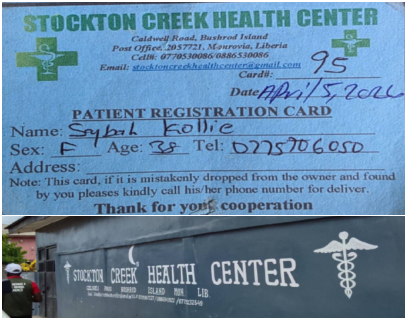
Bah has denied treating Kollie at his facility, according to the account. The family disputes that denial, pointing to a patient card dated April 5, 2026, and saying, several people could attest that Kollie received treatment there.
Kamara said, Bah contacted him after Kollie’s death and again after journalists began asking questions about the case.
“I know there was foul play somewhere,” Kamara said, questioning why Bah would deny that Kollie had been treated at the facility and undergone surgery there.
Beyond the disputed circumstances surrounding Kollie’s treatment, the case has raised serious questions about regulatory oversight.
According to Joseph Colmah, the LMDC’s Medical and Research Director, the Council’s credential committee requested Bah’s medical license in 2022. Colmah said, Bah did not provide the requested license.
Despite that, the facility reportedly remained operational.
In 2024, Stockton Creek allegedly sought authorization to upgrade from a basic clinic to a higher-level health facility. According to the account, the Council instructed the facility to suspend patient care pending inspection, but inspectors did not return and the clinic continued operating.
The Council reportedly shut the facility down only in May 2026, shortly after Kollie’s death and after members of her family began publicly raising concerns.
The Council subsequently announced a nationwide regulatory assessment intended to strengthen oversight of health facilities and practitioners.
Yet, questions remain about enforcement. A reporter who visited the facility in June, according to the account, was allegedly able to obtain treatment and pay L$1,000 despite the reported shutdown.
In July, the LMDC published a list of 532 licensed doctors in Liberia. The registry included an active license for an individual identified as “Dr. Bah Mohammed Aliou,” with license number NL/636, valid from January 17, 2026, to January 16, 2027.
A source cited in the original account claimed that the individual listed was the same person associated with Stockton Creek. However, the Council did not respond to questions seeking clarification on whether the two names referred to the same individual.
Colmah disputed the suggestion that the Council had failed to police Bah, arguing that its ability to pursue allegations of falsely claiming to be a doctor requires documentary evidence, such as a prescription or medical record bearing the title.
He also said, the Council does not have authority to physically lock a facility and that court action may be required. That position has drawn criticism from legal and public-health figures.
Joseph Somwarbi, a pharmacologist and former chair of the House of Representatives Committee on Health, argued that the Council has a responsibility to ensure that health facilities and practitioners are properly licensed and that licenses are visibly displayed.
He further called for closer cooperation between the LMDC and the Liberia National Police to close illegal facilities and pursue criminal action against unlicensed practitioners.
Former Liberia’s Solicitor General, Tiawan Gongloe similarly called for an investigation into the Bah issue, describing unauthorized medical practice as a serious threat to public safety.
Gongloe also argued that the LMDC could bear responsibility if evidence establishes that regulatory failures allowed an unauthorized practitioner to continue operating.
“LMDC should stop him. He is a menace. Every second that that man is operating, Liberians are at risk,” Gongloe said.
Kollie’s case has therefore, become bigger than a single disputed medical encounter. It has exposed a wider vulnerability in a health system where poverty, limited access to qualified professionals and weak institutional capacity can create opportunities for individuals to exploit desperate patients.
Liberia already faces significant healthcare challenges. In such an environment, patients often make medical decisions based on trust, reputation and affordability. That makes effective licensing, inspection, enforcement and public disclosure especially important.
A regulatory system that identifies unqualified practitioners but fails to prevent them from continuing to see patients risks undermining public confidence in legitimate healthcare professionals and institutions.
For Kollie’s family, the consequences are painfully personal.
Kamara is now caring for their two young children without their mother, while questions surrounding her treatment remain unanswered.
“If a man like that is not a doctor, and his place is still operating at a time like this, my mouth is full. I don’t know,” Kamara said.
His anguish captures the larger public concern: when patients cannot easily distinguish between qualified medical professionals and people allegedly masquerading as doctors, regulatory failure can become a matter of life and death.
Health advocates urge that Kollie’s death should therefore prompt more than public outrage, saying that it demands a credible investigation, transparent regulatory enforcement and a clear determination of responsibility—both for any individual whose conduct may have endangered a patient and for institutions accused of failing to act when warning signs emerged.

Towards Economic Empowerment And Reconciliation