MONROVIA: ArcelorMittal Liberia (AML) has announced plans to increase iron ore exports to more than 20 million metric tons in 2027, marking a dramatic expansion of its operations and positioning Liberia for a potentially greater role in the global iron ore market.
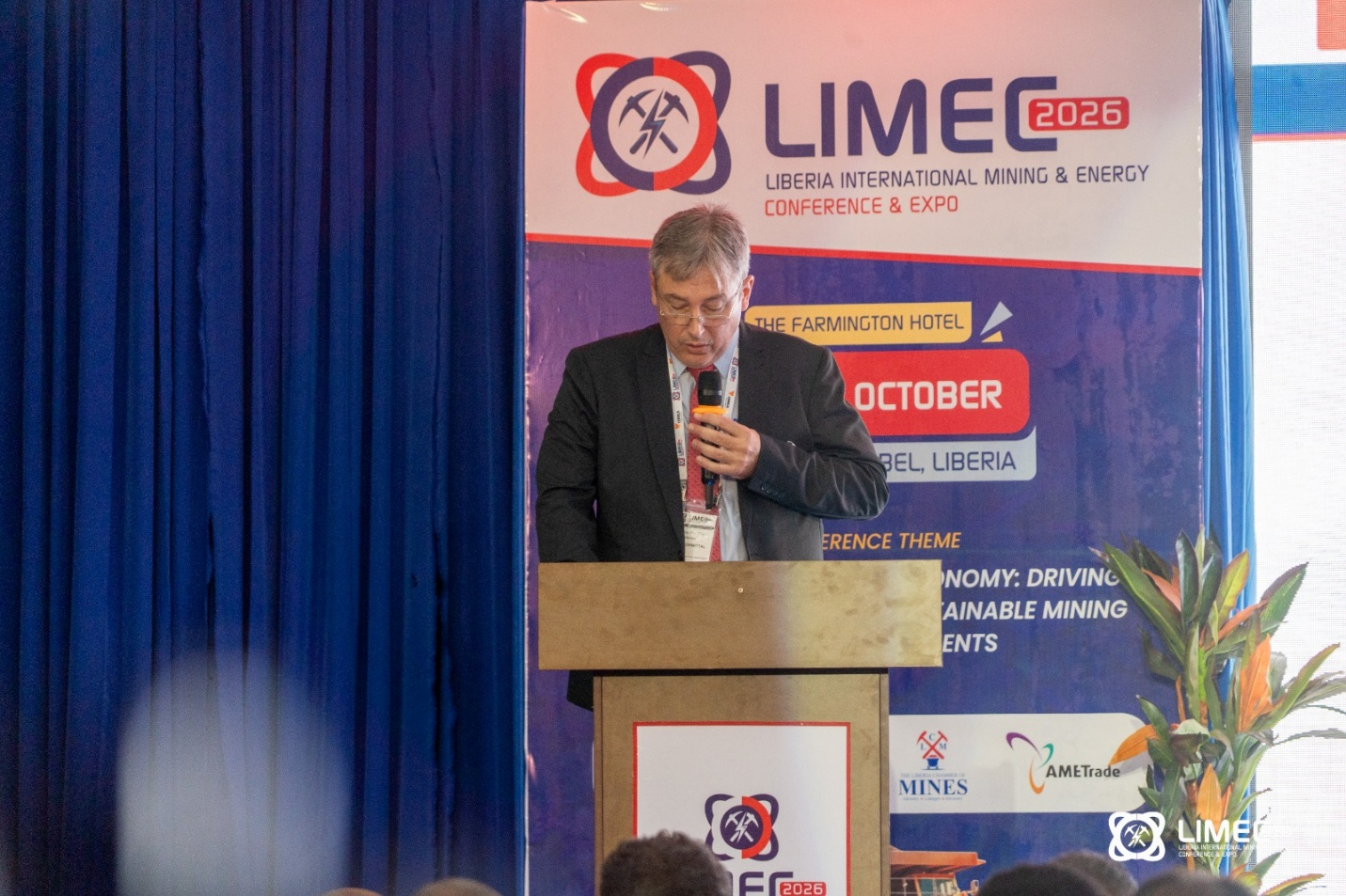
The projection was announced Wednesday, October 28, 2026, by AML Chief Executive Officer, Michiel van der Merwe at the opening plenary of the Liberia International Mining and Energy Conference (LIMEC), where he highlighted the company’s nearly US$4 billion investment in the country and its commitment to supporting long-term economic growth.
The planned export increase represents a major leap from the less than five million tons Liberia exported through AML’s operations as recently as 2024.
Van der Merwe attributed the expansion to the company’s Phase II development programme, including the commissioning of Liberia’s first large-scale iron ore concentrator and the rehabilitation and expansion of critical railway and port infrastructure.
“These are investments in mining, rail, port, power and social infrastructure,” van der Merwe told delegates, emphasizing that the company’s commitment extends beyond mineral extraction to employment, skills development, local businesses, and Liberia’s economic future.
The announcement places mining and infrastructure development at the center of renewed discussions about how Liberia can convert its substantial natural resources into greater economic opportunities, industrial growth, and sustainable benefits for its people.
Van der Merwe opened his address by highlighting four milestones that, he said, define AML’s presence in Liberia: the reopening of the country’s iron ore mining sector in 2011, the company’s long-term commitment, its operations across three presidential administrations, and investments approaching US$4 billion.
The investment covers mining operations, railway and port infrastructure, power facilities, and social development. Together, these assets form an integrated system connecting iron ore deposits in Nimba County to the Port of Buchanan in Grand Bassa County.
At the heart of that system, is a 245-kilometre railway linking the mines to the coast, enabling the transportation of iron ore for export to international markets.
Van der Merwe said, the company’s operations and the thousands of Liberians involved in sustaining them were helping establish Liberia as a strategic supplier of premium iron ore.
He argued that the country’s mineral wealth, geographical position, and potential to attract investment create significant opportunities as global demand for minerals evolves alongside industrial development and the transition toward lower-carbon steelmaking.
However, he stressed that resource endowment alone would not guarantee prosperity. Collaboration between government, investors, companies, and host communities—and sustained investment in Liberian skills and expertise—would be essential to ensuring that economic growth benefits the wider population.
A central component of AML’s expansion is the commissioning of Liberia’s first large-scale iron ore concentrator, which the company says will enable it to produce premium iron ore concentrate for international steelmakers.
The facility marks a significant step toward adding value to Liberia’s mineral output by improving the quality of iron ore before export. It also positions the operation to supply steel producers pursuing technologies designed to reduce carbon emissions.
Van der Merwe described the concentrator as a milestone for both AML and Liberia, arguing that its development demonstrates the country’s capacity to attract and execute major industrial investments.
The project is expected to support higher production volumes, strengthen export capacity, and create opportunities for employment, technical training, and local business participation.
The projected increase to more than 20 million tons in 2027 would represent approximately four times the export volume recorded in 2024, based on the figures cited by the AML chief executive.
The company is also planning for potential future production growth to 30 million tons at its mines, a target that would require sustained coordination among mining operations, transportation infrastructure, and export facilities.
Beyond the concentrator, the expansion depends heavily on the railway connecting Tokadeh to Buchanan.
Van der Merwe disclosed that AML had invested approximately US$800 million to rehabilitate and expand the railway and port facilities, which he noted are assets owned by the Government of Liberia.
The investment is intended to provide the transportation capacity required to support AML’s growing production and future expansion plans.
But the railway’s significance extends beyond the company’s own operations. The government and AML have committed to developing it as a multiuser corridor that other mining companies can access under an agreed framework.
According to van der Merwe, the Third Amendment to AML’s Mineral Development Agreement, ratified earlier this year, reinforces the arrangement under which the railway will remain open to other users, with the Government of Liberia determining which additional companies may access the infrastructure.
Under the proposed arrangement, new users would finance the expansion capacity they require, while benefiting from foundational investments already made by AML.
If effectively implemented, the multiuser model could reduce the need for other mining companies to develop entirely separate rail infrastructure, potentially lowering investment barriers and making additional mineral deposits commercially viable.
Van der Merwe also highlighted progress toward establishing an independent company to operate the Tokadeh-to-Buchanan railway beginning in 2030.
The proposed framework, known as the Rail Systems Operating Principles (RSOP), reflects discussions among successive administrations and industry stakeholders over the governance, operation, and shared use of the corridor.
He described the planned independent operator as an important step toward creating a shared infrastructure platform capable of supporting additional mining investments and expanding the country’s economic potential.
AML also supports the establishment of a National Rail Authority that would eventually oversee the development and regulation of multiple railway corridors across Liberia.
Van der Merwe said, the company wants the operating principles agreed for the Tokadeh-to-Buchanan corridor to be recognized when the proposed national authority is established.
Such arrangements could have significant implications for Liberia’s mining sector, where access to reliable transportation infrastructure is essential to attracting investment and bringing mineral resources to market.
Nevertheless, the anticipated benefits will depend on effective implementation, transparent access rules, appropriate oversight, and coordination between the government and participating companies.
As Liberia seeks to attract investment and expand its industrial base, van der Merwe urged stakeholders to work collectively to establish conditions that encourage investment, strengthen local capacity, and promote community development.
He said, AML had maintained its commitment to Liberia for approximately two decades and was prepared to continue investing for another 40 years or longer.
“No single company, government institution or investor can achieve all of Liberia’s goals alone,” he told delegates. “But together, we can create an environment where investment thrives, industries grow and communities prosper.”
The projected increase in iron ore exports offers a significant opportunity to expand export activity and reinforce Liberia’s position in international mineral markets.
Yet, the broader national impact will depend on how increased production translates into government revenue, decent employment, stronger local businesses, skills transfer, and improvements in the lives of people living in mining communities.
For Liberia, the challenge is not simply to extract and export more iron ore, but to ensure that expanding production and infrastructure create lasting economic value at home.
As the LIMEC conference brings government officials, investors, and industry leaders together, AML’s expansion plans place a central question before policymakers: how can Liberia turn rising mineral exports into broad-based development that reaches beyond the mines and benefits the nation as a whole?

Towards Economic Empowerment And Reconciliation