By Frank P. Martin
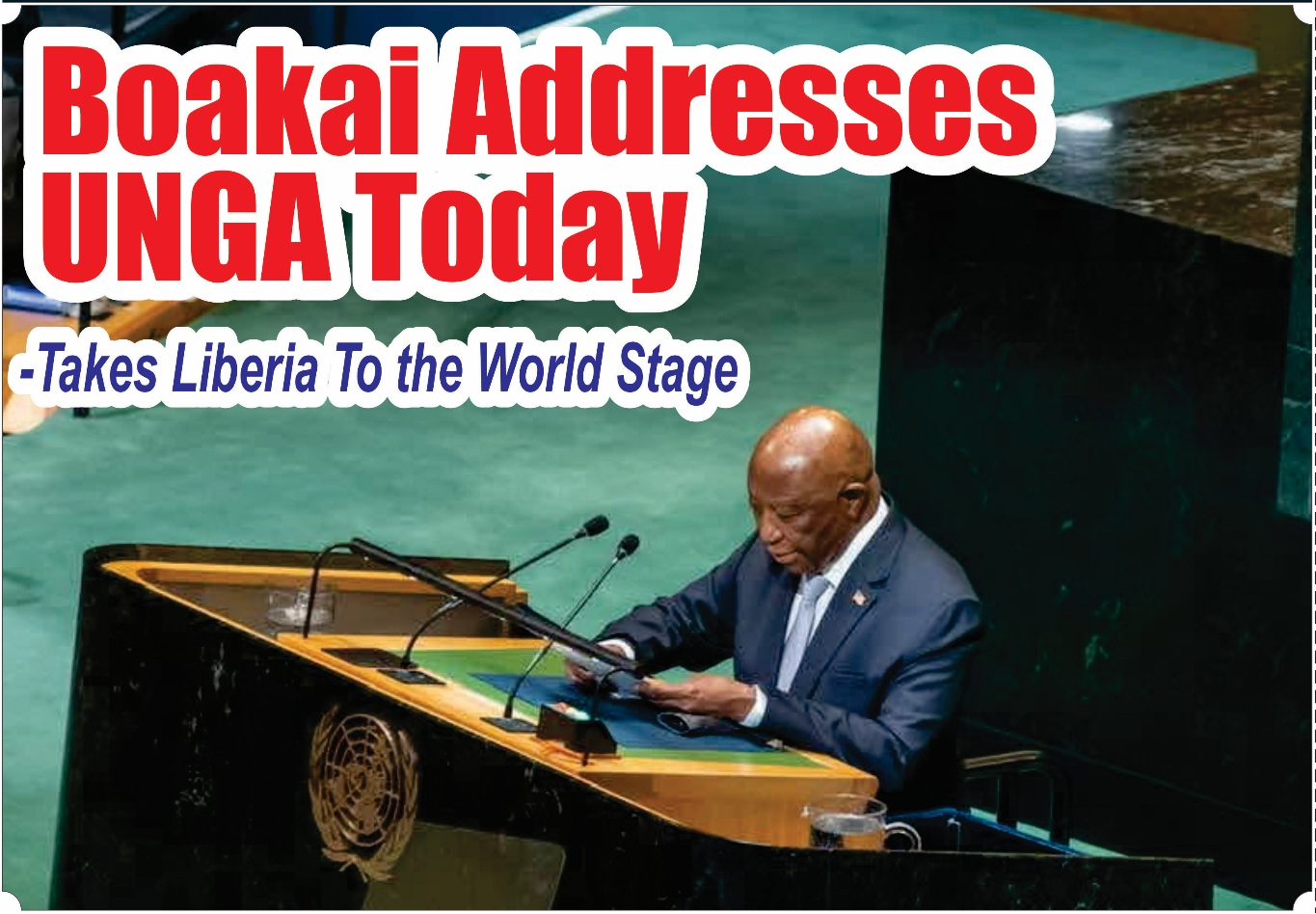
NEW YORK: President Joseph Nyuma Boakai has used Liberia’s address to the 81st Session of the United Nations General Assembly to deliver a forceful call for the renewal of global multilateralism, warning that the international system is facing a crisis of trust that can no longer be ignored.
Addressing world leaders in New York on Thursday, President Boakai said confidence in multilateral institutions had been weakened by what he characterized as ‘inconsistent and selective application of international principles,’ but argued that the answers were not to abandon the United Nations.
“Our answer to that fragmentation cannot be less multilateralism. It must be better multilateralism,” the Liberian President declared.
The Liberian leader’s address came as the UN opened its 81st session under the theme- “Restoring Trust, Managing Transformation: A United Nations that Delivers for All.”
The session is being presided over by Bangladesh’s Foreign Minister, Khalilur Rahman, who was elected president of the General Assembly in June and formally assumed office in September.
President Boakai’s speech placed Liberia’s own experience of civil conflict, institutional reconstruction and democratic transition at the center of his argument for a stronger international system.
He recalled Liberia’s historic role as one of only four African countries to sign the UN Charter in San Francisco in 1945, saying the country had long believed that peace depended on international law, human dignity, human rights and development.
“Having risen from the ashes of conflict to become a resilient democracy, Liberia is living proof that dialogue can overcome division and that institutions can be rebuilt,” Boakai told the Assembly.
The Liberian leader said the central challenge confronting the UN was not the irrelevance of some of its founding principles but the miserable failure to apply them consistently.
“Trust in multilateralism is broken and needs to be restored,” he said, arguing that selective implementation of international norms had contributed to growing global fragmentation.
President Boakai’s intervention came against the backdrop of wars, humanitarian crises worldwide, geopolitical tensions and growing questions about the effectiveness of international institutions and orders.
The 2026 General Assembly opened amid conflicts including those in the Middle East, Europe, Africa, and Ukraine, alongside concerns about climate change, inequality and the governance of Artificial Intelligence (AI).
The Liberian President also paid glowing tributes to outgoing General Assembly President, Annalena Baerbock and UN Secretary-General, António Guterres, whose tenure is due to end on December 31, 2026.
He congratulated Khalilur Rahman on his election President of the General Assembly and pledged Liberia’s full support.
The Liberian President linked his call for international accountability to his administration’s domestic agenda, saying Liberia was itself engaged in rebuilding confidence in state institutions.
He said his government was strengthening public accountability, promoting prudent financial management, intensifying the fight against corruption and supporting the judiciary as part of a broader effort to restore public confidence.
Boakai presented these domestic measures as part of Liberia’s wider transformation from a country devastated by civil war into a constitutional democracy.
His remarks come as the current administration continues to promote its flagship national development program, styled: ARREST Agenda for Inclusive Development, built around Agriculture, Roads, Rule of Law, Education, Sanitation and Tourism.
According to the President, the government has made progress in revenue administration and infrastructure development, including efforts to improve rural roads connecting farming communities to markets.
On international peace and security, Boakai warned that development could not be sustained where armed conflicts continued to destroy communities.
“Without peace, development is impossible, and without inclusive development, peace is an illusion,” he said.
He called for an immediate end to hostilities in conflict zones, unhindered humanitarian access and full respect for international humanitarian law.
But beyond responding to conflicts after they erupt, Boakai urged the international community to invest more heavily in prevention.
He described preventive diplomacy, mediation and early-warning systems as both a moral responsibility and an economic necessity, arguing that preventing conflict costs far less than rebuilding societies after war.
Liberia’s own history, he suggested, provides a powerful basis for that argument.
The West African country endured two devastating civil wars between 1989 and 2003 before embarking on a long process of peace-building, institutional reconstruction and democratic consolidation.
As a current member of the UN Security Council, Boakai said, Liberia was applying its preventive-security approach to emerging threats across West Africa.
He identified transnational organized crime, cyber warfare and illicit narcotics trafficking along maritime routes in the Gulf of Guinea as growing security concerns.
The President said Liberia was strengthening joint security operations against international drug networks and called for greater international assistance.
“No nation can police global criminal networks alone,” he said.
He appealed for targeted support in areas including coast guard surveillance, intelligence sharing and port-security technology.
His remarks underline the growing importance of maritime security to Liberia and the wider Gulf of Guinea region, where trafficking networks have increasingly presented challenges to coastal states.
A major portion of the President’s address focused on the international financial system and the economic pressures confronting developing countries.
Boakai argued that developing nations were entering the final years of the 2030 Agenda while facing unsustainable debt, limited fiscal space and repeated external economic shocks.
At the heart of the problem, he said, was a financial architecture designed for a different era.
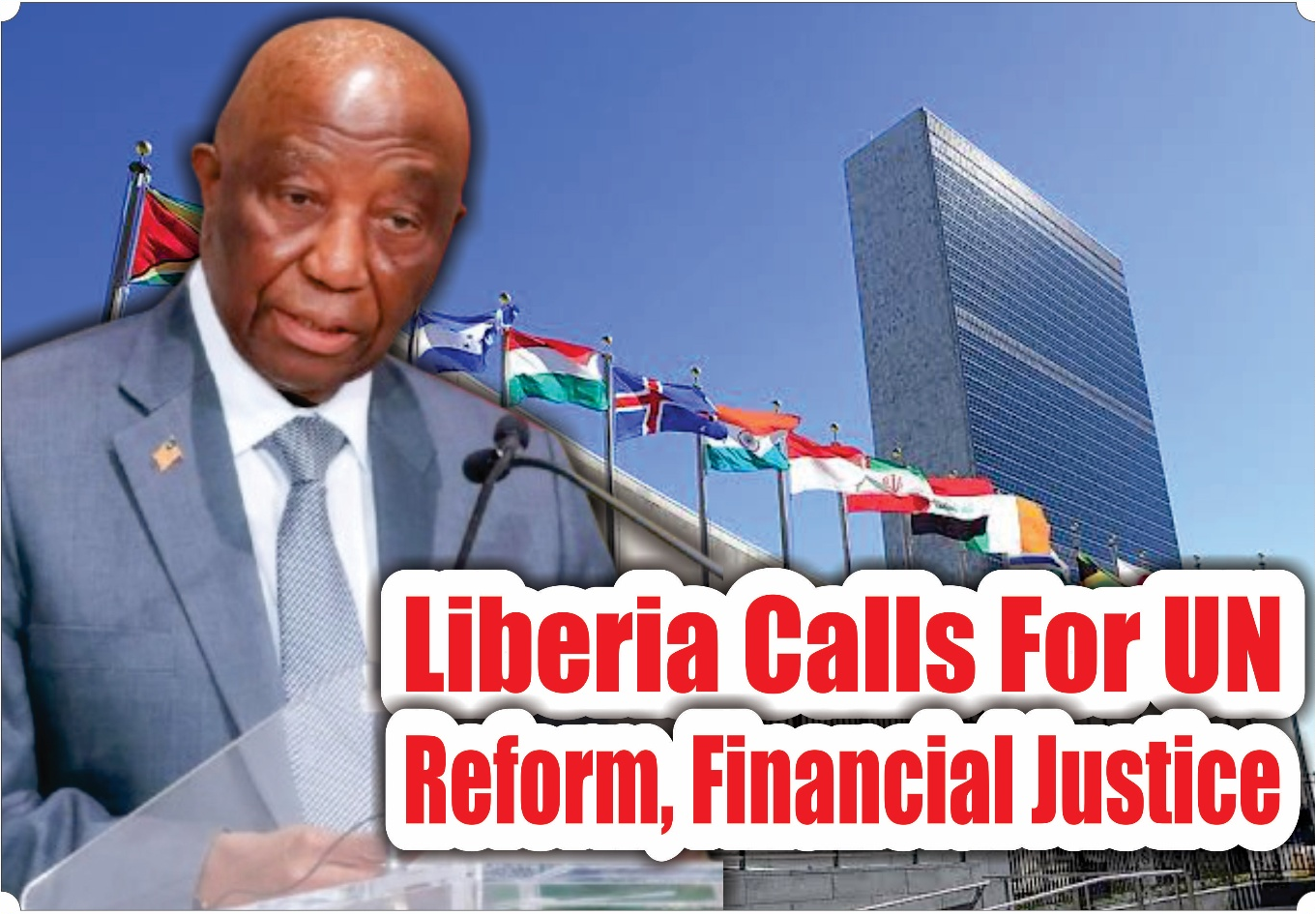
“Liberia calls for urgent, structural reform of the international financial architecture,” President Boakai said.
He called for greater access to concessional financing, debt sustainability and predictable development capital.
He also demanded greater representation for developing countries within the Bretton Woods institutions, particularly the World Bank and International Monetary Fund.
“A financial system that decides the fate of billions cannot continue to be governed by so few,” he told delegates.
For Liberia, he said, reform of the international financial system was not simply a technical matter for economists and financial institutions.
Instead, he framed it as a central requirement for achieving the Sustainable Development Goals and rebuilding trust between developed and developing nations.
Boakai also used the UN platform to highlight Liberia’s vulnerability to climate change despite the country’s relatively small contribution to global greenhouse-gas emissions.
He cited coastal erosion, flooding and changing agricultural cycles among the threats confronting Liberian communities.
At the same time, he pointed to Liberia’s role as a custodian of one of West Africa’s most important remaining forest ecosystems.
Liberia contains approximately 42 percent of the remaining Upper Guinea Forest, according to the United Nations Development Programme, making the country an important holder of globally significant biodiversity and forest resources.
Boakai argued that countries protecting such ecosystems should not be left to bear the economic costs alone.
“Climate responsibility must be paired with climate justice,” he said.
He called on industrialized countries to honor climate-finance commitments and operationalize loss-and-damage mechanisms for vulnerable nations.
The Liberian President also placed young people at the centre of his vision for Africa’s development.
He noted that more than 60 percent of Africa’s population is under the age of 25 and described the continent’s youthful population as a major potential driver of innovation.
Boakai warned that young Africans must be equipped with the skills required to participate meaningfully in the global digital economy.
He called for greater investment in science, technology, engineering and mathematics, digital literacy and technical education.
The objective, he said, should be to ensure that young Africans become “co-creators in the global digital economy, not just consumers.”
Gender equality also featured prominently in his address.
Boakai reaffirmed Liberia’s commitment to political, economic and social equality for women and girls, arguing that women's participation in leadership strengthens peace-building, economic development and accountable governance.
He welcomed international efforts to develop governance frameworks for emerging technologies, including the UN Secretary-General’s Independent International Scientific Panel on Artificial Intelligence.
But he warned against a future in which developing countries merely consume technologies created elsewhere.
Boakai called for support to help developing nations build what he described as “true digital sovereignty.”
He also supported stronger ethical rules and regulation of artificial intelligence, particularly its application in warfare.
“Innovation must protect human development, not automate human destruction,” he said.
The remarks place Liberia alongside growing international calls for stronger global governance of rapidly developing AI systems, an issue that has become increasingly prominent on the UN agenda. UN Secretary-General Guterres has also placed AI governance among the major challenges facing the international community as his tenure approaches its end.
He described the absence of permanent African representation on the Council as a historic injustice that must be corrected.
“Africa is home to 1.5 billion people and accounts for nearly one-third of UN membership,” he said, while noting that a large proportion of Security Council mandates concern African peace and security.
Yet, he argued, Africa has no permanent seat on the body responsible for making some of the most consequential decisions on international peace and security.
“Eighty years of patience is enough. The time for structural reform is now,” Boakai declared.
He reaffirmed Liberia’s support for the Common African Position on Security Council reform and welcomed the presentation of the African Model during the recent intergovernmental negotiations.
Liberia, he said, supports Africa’s demand for no fewer than two permanent seats, with all accompanying rights and responsibilities, including the veto for as long as the veto exists, as well as additional non-permanent seats.
“Correcting this imbalance is not a favor to Africa,” Boakai said. “It is necessary to restore the United Nations’ trust, credibility, and legitimacy.”
The demand comes at a time when reform of the Security Council remains one of the most contentious questions before the UN, with developing countries pressing for a structure that they say better reflects the geopolitical realities of the 21st century.
In his closing remarks, Boakai framed the 81st General Assembly as facing a fundamental choice: whether the international system would continue to lose credibility or undertake meaningful reforms capable of restoring confidence.
He presented Liberia’s own post-war experience as evidence that broken institutions can be rebuilt through sustained political commitment.
“Liberia’s journey, from civil conflict to constitutional democracy and from broken institutions to accountable governance, shows what is possible when nations commit, deliberately and consistently, to restoring trust and managing transformation,” he said.
The President concluded by invoking Liberia’s historic participation in the founding of the United Nations in San Francisco in 1945.
He said Liberia remained ready to work with other member states to uphold the UN Charter, protect human dignity and prevent war.
“Let us leave this Assembly committed to a United Nations that not only deliberates on crises but also resolves them,” Boakai told world leaders, “that restores trust through results, protects the vulnerable, honors the rights of all nations, and secures a peaceful planet for generations to come.”
President Boakai’s appearance in New York forms part of Liberia’s participation in the 81st UN General Assembly, where his administration has sought to project the country as a voice for peace, development, climate justice, stronger African representation and reform of global institutions. Liberia’s government had announced that Boakai would address the General Debate on September 24 and participate in high-level engagements on the margins of the Assembly.

Towards Economic Empowerment And Reconciliation