Funding Peace, Empowering Women -Ngafuan Demands National Peace Funding
Governance |
👁 6 Views
|
September 23, 2026
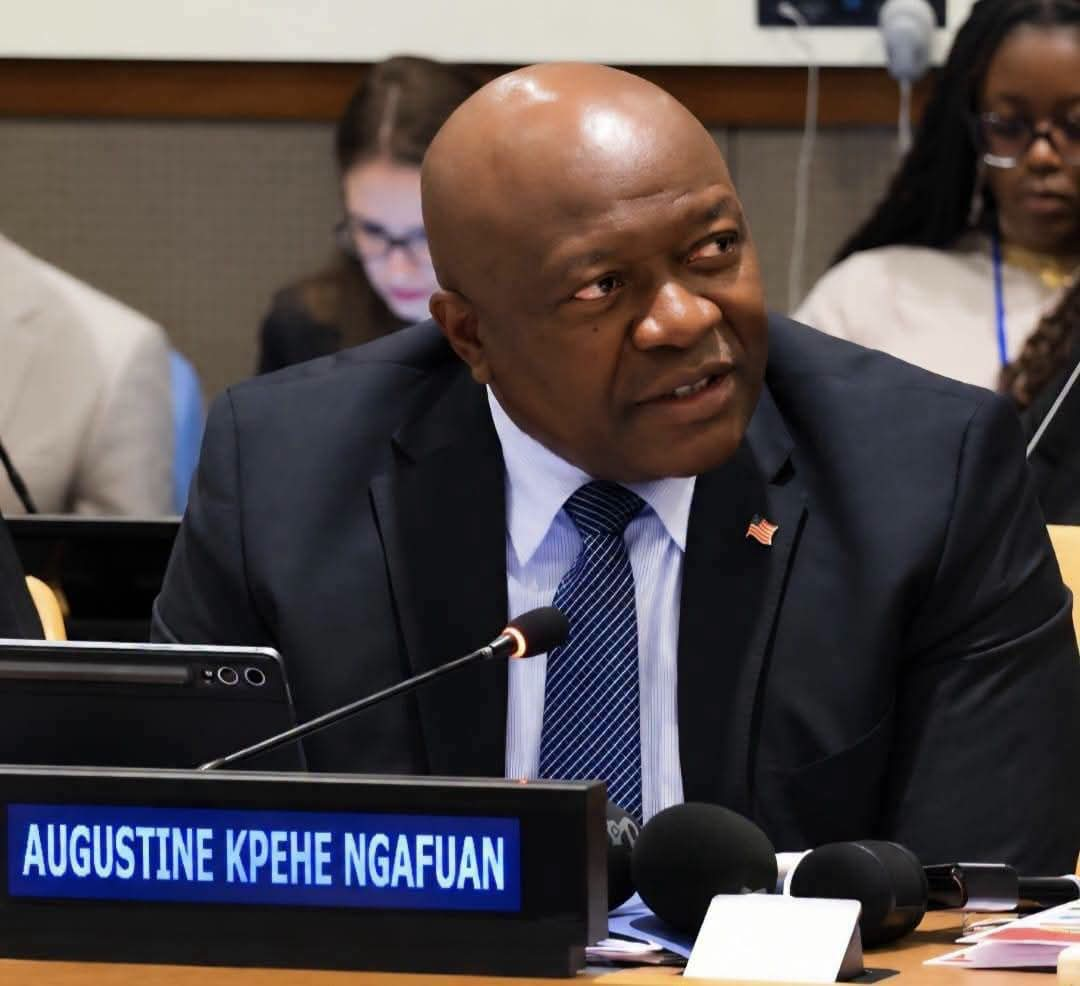
MONROVIA: Finance and Development Planning Minister, Augustine Kpehe Ngafuan, has challenged Liberia to move beyond political commitments on peacebuilding and women’s empowerment, demanding sustained national budgetary support to protect the country’s hard-won peace.
Ngafuan said, Liberia’s Women, Peace and Security agenda must be financed through the national budget rather than depend primarily on donor-funded projects, warning that a country cannot claim ownership of its priorities when their survival rests on external funding cycles.
The minister made the remarks while emphasizing the need for a fundamental shift in the financing of peacebuilding, gender equality and women’s participation in national security and development.
“For us in Liberia, we believe in principles. If peace and security is a priority, then it must eventually find its way into the national budget,” Ngafuan said, stressing that sustainable peace requires predictable domestic resources rather than political declarations alone.
His statement places national financing at the center of Liberia’s continuing post-war recovery and the implementation of its Women, Peace and Security commitments.
Acknowledging the contribution of Liberia’s international development partners, Ngafuan cautioned against allowing externally funded programmes to become substitutes for national responsibility.
“We can’t say, we own an agenda if its survival depends entirely on someone else’s project cycle,” he said.
According to the minister, international assistance remains essential to Liberia’s development, but partnerships should reinforce national priorities and strengthen public institutions instead of determining the direction of the country’s peace and development agenda.
He argued that national ownership must be demonstrated through government planning, institutional responsibility and the allocation of public resources.
“We must make sure that Women, Peace and Security is not simply a donor project for Liberia; it must and it is a national investment,” Ngafuan emphasized.
The minister’s position comes as Liberia seeks to strengthen its next generation of Women, Peace and Security programming and translate longstanding commitments into measurable national development outcomes.
Ngafuan particularly highlighted the contribution of Liberian women to the country’s transition from conflict to peace, describing them as “architects” of the peace process rather than spectators.
Liberia’s civil wars, which spanned approximately 14 years, claimed the lives of nearly 250,000 people and displaced millions, according to United Nations records.
The signing of the Accra Comprehensive Peace Agreement on August 18, 2003, brought the second civil war to an end and opened the way for post-war reconstruction, institutional reform and peacebuilding.
Women played a prominent role in the movement that helped bring the conflict to an end. Through mass demonstrations, sit-ins, strikes and community mobilization, they pressed the warring parties to remain at the negotiating table and reach a settlement.
During the 2003 peace negotiations in Accra, Ghana, Liberian women organized a high-profile sit-in to pressure the negotiators to continue the talks until an agreement was reached.
Their intervention became a defining example of women’s influence in Liberia’s peace process, although their participation in formal negotiations remained limited.
Research on the Accra process indicates that women had no female negotiators or mediators in the formal talks. Female civil-society leaders participated as observers, accounting for 17 percent of witnesses to the signing of the final agreement.
The contrast between women’s powerful grassroots mobilization and their limited representation in formal negotiations, remains a significant lesson for Liberia’s Women, Peace and Security agenda.
For Ngafuan, that history gives Liberia a special responsibility to treat women’s participation in peace and security as a national investment rather than another externally supported development initiative.
According to Ngafuan, the government is seeking to institutionalize its approach through the ARREST Agenda for Inclusive Development (2025–2029), Liberia’s fourth post-conflict national development plan.
The agenda places gender equality and women’s empowerment within the broader national development framework, identifying inclusive social development as a strategic policy area.
It also seeks to strengthen the connection between development planning and programme-based budgeting so that national priorities are translated into actual public expenditure.
“Gender is treated as a cross-cutting development priority,” Ngafuan said, emphasizing that responsibility for advancing gender equality cannot rest solely with the Ministry of Gender, Children and Social Protection.
He identified education, health, agriculture, justice, security and the Ministry of Finance and Development Planning as institutions with responsibilities for implementing gender-related commitments.
The minister said, Gender-Responsive Planning and Budgeting (GRPB), is central to the government’s strategy, as it connects policy commitments to resource allocation and institutional implementation.
“Plans without budget are assumptions, and budgets are where government realizes its real priorities,” Ngafuan said.
According to him, nine government planning entities are being used as pilot institutions to strengthen the integration of gender considerations into planning and budgeting processes.
Ngafuan also pointed to an increase in the budgetary allocation to the Ministry of Gender, Children and Social Protection, citing a rise from US$2.35 million in 2023 to US$4.21 million.
Based on the figures he provided, the increase represents approximately 79 percent.
He indicated that the government intends to continue increasing support as it works to translate gender equality and peacebuilding commitments into concrete programmes.
The minister’s comments come amid broader efforts to strengthen women’s economic participation, leadership and protection from gender-based violence.
Liberia’s ARREST Agenda identifies significant infrastructure, employment, governance and human-development challenges, including widespread multidimensional poverty.
The plan establishes targets for improving women’s representation in leadership, economic participation and gender equality.
Among its stated objectives, is an increase in women’s representation in leadership from a 2023 baseline of 30 percent to 50 percent by 2029, alongside efforts to reduce gender-based violence and improve Liberia’s performance on global gender indicators.
Liberia has previously implemented two National Action Plans on Women, Peace and Security, covering the periods 2009–2013 and 2019–2023.
The second plan focused on prevention, protection, women’s participation, relief and recovery, as well as coordination and accountability.
The Ministry of Gender has begun assessing the implementation of the second plan as part of preparations for a third-generation National Action Plan covering 2026–2031.
Ngafuan said, the Ministry of Finance and Development Planning is working with the Ministry of Gender to ensure that priorities contained in the emerging National Action Plan III are reflected in the national budget.
“We are in budget preparations, and we had the first deep dive with the Ministry of Gender,” he said, adding that further discussions are expected as the government considers how to scale up support for the sector. “Women’s issues are development issues,” the minister emphasized.
The United Nations Mission in Liberia (UNMIL), established after the civil war, supported disarmament, institution-building and three post-war electoral cycles before transferring full security responsibility to Liberian authorities in 2016.
The transition underscored the importance of strengthening Liberia’s national institutions to sustain peace and security.
For Ngafuan, the next phase of that responsibility must include the government’s willingness to finance the institutions, programmes and policies that support peace, gender equality and women’s participation.
His argument is that peacebuilding cannot be treated as a temporary project dependent on external funding. Instead, it must be integrated into the country’s long-term development and budgetary architecture.
Two decades after the end of Liberia’s civil war, the country’s experience continues to demonstrate that peace agreements and security institutions are only part of the foundation for lasting stability.
The sustainability of peace also depends on national investment in the people and institutions responsible for maintaining it.
For Liberia’s women, whose mobilization helped shape the transition from war to peace, the emerging policy debate is moving from recognition of their historic contribution to the more demanding questions of sustained financing, meaningful representation and measurable development outcomes.
Meanwhile, Ngafuan’s call for national budgetary support therefore, places the government’s financial commitments at the center of Liberia’s continuing peacebuilding and Women, Peace and Security agenda.