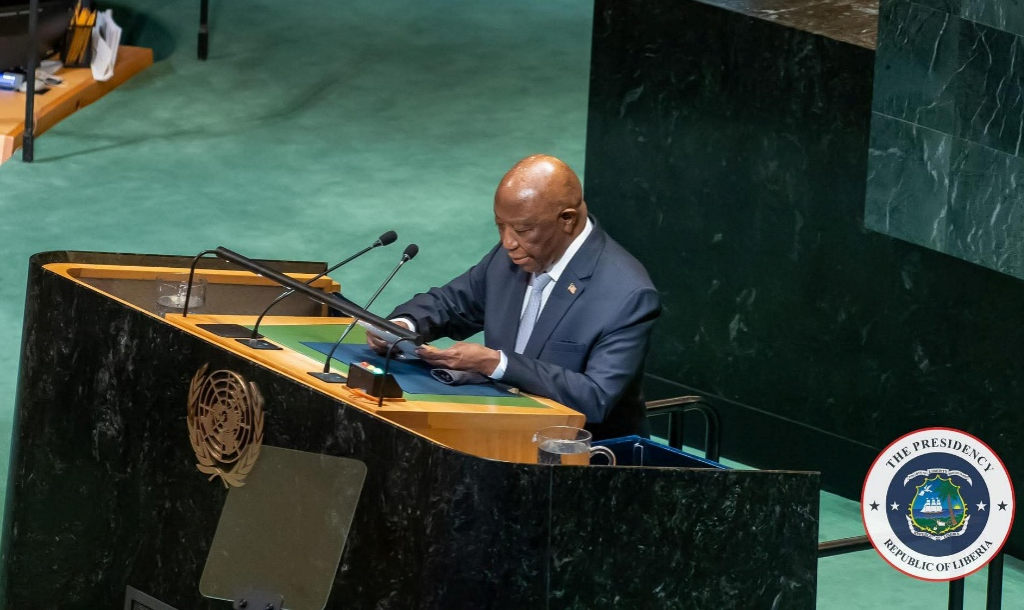
NEW YORK, USA: President Joseph Nyuma Boakai has launched Liberia’s Third National Action Plan on Women, Peace and Security (NAP III), reaffirming his administration’s commitment to strengthening women’s participation in peacebuilding, governance and national security.
The plan was unveiled Monday, September 21, 2026 during a Liberia-hosted high-level event on Women, Peace and Security at Conference Room 5 of the United Nations Headquarters in New York.
Addressing the gathering of international partners, government officials, women’s organizations and other stakeholders, President Boakai highlighted the historic role Liberian women played in ending the country’s civil conflict and building peace.
Quoting a popular Liberian saying, the President said: “Men make the big decisions while women make the small decisions. But it is the women who decide which decisions are big and which decisions are small.”
President Boakai recalled that Liberia’s peace was not achieved solely through negotiations at the Accra peace talks, but was also driven by women who mobilized in communities, markets, churches and mosques and demanded an end to the conflict.
He specifically recognized the contributions of the Women in Peacebuilding Network, the Liberian Mass Action for Peace, market women, and Muslim and Christian women who worked across religious, ethnic and political divisions.
“Liberian women helped build peace,” President Boakai said, stressing that women were not simply participants in the country’s peace process but played a decisive role in mobilizing communities for an end to the war.
The President disclosed that Liberia’s Third National Action Plan was developed from lessons learned through the implementation of the country’s previous two national action plans.
He said NAP III is structured around five key areas aligned with Liberia’s ARREST Agenda for Inclusive Development: Prevention; Protection and Access to Justice; Participation; Relief, Recovery and Resilience; and Coordination, Accountability and Financing.
On prevention, President Boakai said Liberia would focus on addressing the underlying causes of conflict by promoting social cohesion, reducing inequality, challenging harmful social norms, strengthening early-warning systems and placing women at the center of violence-prevention efforts.
On protection and access to justice, President Boakai pointed to steps taken by his administration toward transitional justice, including Executive Order 131 of 2024, which established the Office to operationalize the War and Economic Crimes Court.
He said women advocates and civil society organizations played an important role in advancing gender-sensitive provisions addressing conflict-related sexual violence and other gender-based atrocities committed during Liberia’s civil wars.
The President also emphasized the importance of women's participation in decision-making, saying sustainable peace cannot be achieved when women are present as victims but excluded from positions where decisions about peace and security are made.
He said his government is working to increase women’s representation in elected and appointed positions and within Liberia’s security institutions.
Within the Armed Forces of Liberia, President Boakai highlighted the launch in February 2026 of a two-year Elsie Initiative Fund project by the AFL in partnership with UN Women Liberia.
According to the him, the initiative seeks to address institutional barriers, strengthen the recruitment and retention of women, and expand opportunities for women in deployment and leadership roles in United Nations peacekeeping.
"Liberia’s immediate target, is to increase female representation in the Armed Forces to 15 percent by 2028, as part of a broader national objective of reaching 40 percent representation by 2030", the Liberian leader disclosed.
President Boakai also noted that NAP III is designed to respond not only to the legacy of Liberia’s civil wars but also to emerging threats to peace and security.
He cited climate pressures, democratic reversals, violent extremism, transnational crime, displacement, economic insecurity and other forms of violence as challenges that can disproportionately affect women and girls.
He hinted that Liberia’s recovery strategy must therefore extend beyond rebuilding physical infrastructure to restoring livelihoods, dignity and institutions while ensuring that women and girls are not excluded from opportunities.
The President also called for stronger coordination, accountability and financing, directing relevant government institutions to work with civil society, traditional and religious leaders, women’s organizations and international partners in implementing NAP III.
President Boakai told the gathering that Liberia’s current position as a non-permanent member of the United Nations Security Council presents an opportunity for the country to elevate Women, Peace and Security as a major priority.
He noted that Liberia, which spent years on the Security Council agenda during its conflict period, has now returned to the Council table and is scheduled to assume the Council Presidency in December.
He said Liberia intends to draw from its own peacebuilding experience, including the country’s Peace Hut model, as it contributes to global discussions on women, peace and security.
The President also pointed to Liberia’s experience in West Africa, where challenges including democratic reversals, transnational crime, insecurity and contested borders continue to affect regional stability.
He said Liberia would advocate for preventive diplomacy and locally led solutions to address crises before they escalate.
“A Seat Is an Opportunity”
President Boakai said Liberia’s membership on the Security Council must be matched by concrete action at home.
“When Liberia sought a seat on the United Nations Security Council, we committed to bringing the voices of women and youth into that chamber, particularly those who contribute to peacebuilding in their communities,” he said.
The President added: “A seat is an opportunity, not an achievement. What we do with it is the achievement.”
He further stressed that NAP III represents the domestic component of Liberia’s broader Women, Peace and Security commitment, particularly at a time when international financing for peacebuilding is declining.
While acknowledging that Liberia would require international support to fully implement the plan, he said the government was committed to demonstrating political ownership and providing the necessary institutional coordination and resources.
President Boakai concluded by thanking Liberia’s international partners and recognizing the women who played a central role in the country’s peace process.
He specifically addressed women at the Fish Market Peace Hut who participated in the event from Monrovia, saying their courage had helped change the course of Liberia’s history.
He said the goal of NAP III is to build a Liberia where women and girls can live safely, participate fully in national affairs, lead with dignity and contribute to shaping the country’s future.
The President then formally launched Liberia’s Third National Action Plan on Women, Peace and Security (NAP III) at the United Nations Headquarters in New York.

Towards Economic Empowerment And Reconciliation