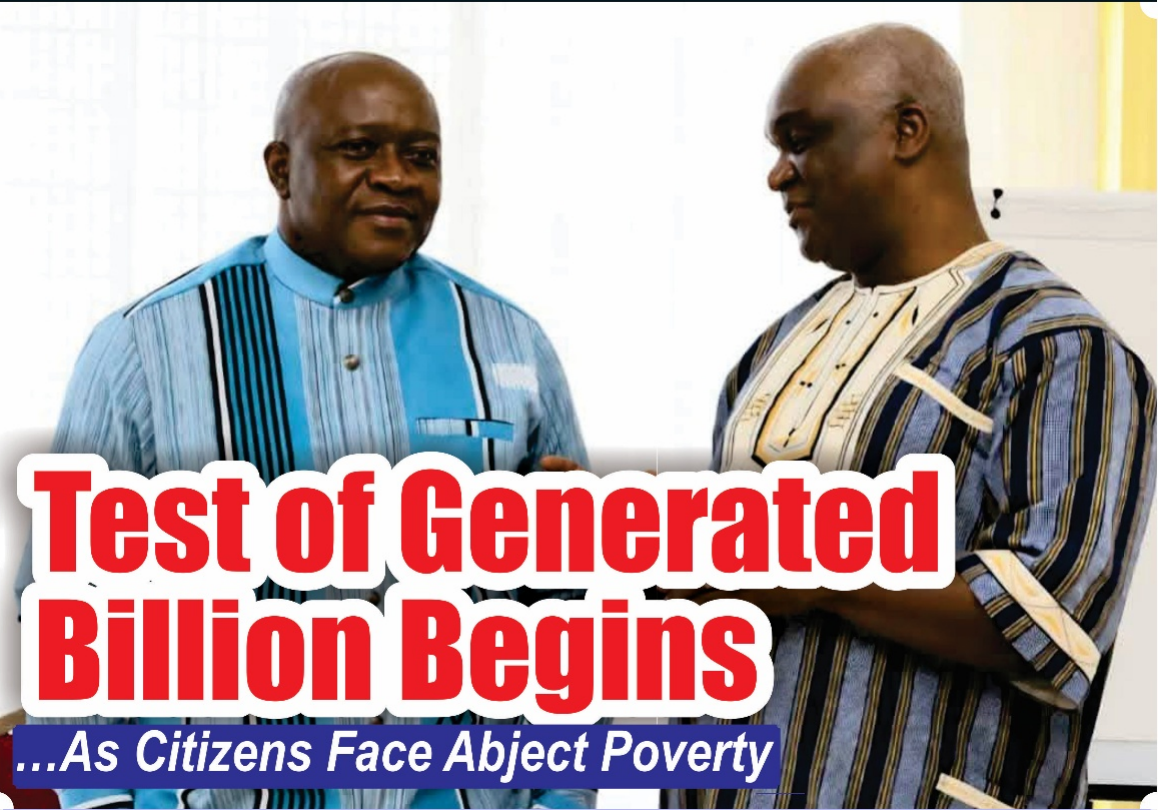
MONROVIA: Liberia’s historic crossing of US$1 billion in domestic revenue generation has triggered a harder public question:
if government has collected unprecedented financial resources, why are millions of Liberians still struggling to see meaningful changes in incomes, services, prices, roads, healthcare and everyday living conditions?
Finance and Development Planning Minister, Augustine Kpehe Ngafuan’s latest disclosure to the nation that much of the record revenue generated has already been spent has apparently shifted the national conversation from celebration to accountability and transparency.
Speaking on OK FM’s OK Morning Rush recently, Minister Ngafuan explained that government does not keep US$1 billion sitting in a bank account.
Minister Ngafuan made it clear that the government raises and spends the money continuously on salaries, security, debt obligations and development programs.
His explanation may clarify the mechanics of government finance, but it has simultaneously intensified the question confronting the Boakai administration: what tangible transformation should most ordinary Liberians expect from a government with substantially greater fiscal capacity?
The US$1 billion milestone is unquestionably significant; Liberia crossed the threshold in domestic revenue collection for the first time in its history, rising from approximately US$700 million in 2023, US$848 million in 2025 and more than US$1 billion in 2026.
The government says it is now targeting about US$1.3 billion by the end of this year (2026).
But, the bigger the revenue figure becomes, the greater the public expectation.
For ordinary Liberians, the debate is no longer simply about whether the government can collect more money; it is about whether increased collections are translating into increased public value.
From celebration to accountability: The first-billion-dollar announcement was greeted by government as a landmark in Liberia's fiscal history.
President Joseph Nyuma Boakai described the achievement as evidence of Liberia's growing capacity to finance its own priorities rather than depending excessively on borrowing and foreign assistance.
Finance Minister Ngafuan has similarly declared that the milestone represents increased fiscal capacity, not an assertion that Liberia's development problems have suddenly disappeared.
He pointed to government’s spending on soldiers, salaries, health infrastructure, road projects and the settlement of arrears to commercial banks and media institutions.
Yet, according to some commentators, this is precisely where the celebration collides with public frustration.
A larger budget does not automatically mean a better life. Revenue becomes meaningful to citizens only when it translates into functioning hospitals, affordable education, reliable electricity, improved roads, clean water, better salaries, lower business costs, employment opportunities and stronger social protection.
This distinction is becoming increasingly important as Liberia's fiscal numbers rise while many citizens continue to complain about the cost of living and limited improvements in their daily circumstances, said Robert Jenkins, a university student reading public administration.
The question being asked in markets, workplaces and communities, is increasingly direct: Where is the impact of the billion dollars?
Street vendors interviewed following the announcement questioned whether the record revenue had changed their economic circumstances.
Some said, the cost of basic commodities remained high and that their daily struggles look little different from periods when the national budget was considerably smaller.
Such expressed sentiment appears to expose what Jackson Gibson, a community activist, refers to as the central dichotomy confronting the government: Liberia's fiscal capacity is expanding faster than the public's perception of improved living standards.
For government, the billion-dollar collection represents progress. For many citizens, progress will be measured differently.
It will be measured by whether a parent can afford school fees, whether a patient can obtain medicine at a public hospital, whether a civil servant can meet household expenses, whether a young person can find work, whether electricity becomes more dependable and whether roads actually reduce the cost and difficulty of moving people and goods.
A revenue windfall with a warning attached. There is another reason the much-heralded billion-dollar celebration requires careful scrutiny.
Ngafuan disclosed that approximately US$200 million of this year's revenue came from a one-time mining-related payment.
This indicates that a substantial portion of the headline achievement is tied to an extraordinary transaction rather than a recurring annual stream of tax revenue. The distinction is critical, according analysts.
Liberia can celebrate the revenue, but government cannot assume that the same extraordinary payment will automatically return every year at the same level.
The World Bank has also identified weaknesses in public investment execution, with capital-budget execution averaging only about 33 percent between 2018 and 2025.
That creates a two-part challenge: collect more money and spend it better. One analyst said, the first is becoming increasingly visible. The second is what citizens are now demanding to see.
Nevertheless, Minister Ngafuan has strongly defended the government's expenditure decisions, explaining that the money is being deployed rather than accumulated.
Among the expenditures he cited, are the recruitment and training of 600 soldiers, health infrastructure, early salary payments, repayment of government obligations to commercial banks and media houses, and contributions to major road projects.
Those expenditures demonstrate that revenue is being absorbed by government obligations and programs.
But they also raise legitimate public-finance questions: how much of the additional revenue is producing lasting assets, and how much is being consumed by recurrent expenditure?
Despite bragging and celebrations of billion being collected from Liberians on taxes, Liberia remains a low-income country with deep governance, economic, and social constraints.
Ranked 178th out of 191 countries in the 2024 Human Development Report, nearly 45 percent of the population lives in multidimensional poverty, a reality worsened by high unemployment, limited infrastructure, and weak access to basic services.
In the face of this glaring situation, some national leaders insist that the budget is working for the ordinary people by increasing access to finance and putting food on their tables.
However, the size of the overall national budget has been overshadowed by controversy over massive allocations to a handful of senior political figures.
The national budget is poised to channel millions of dollars toward the offices of the President, Vice President, Speaker, Deputy Speaker, and Senate Pro-Tempore, while ordinary citizens struggle to feed their families, some citizens said.
Many civil servants and their households had hoped for a budget that would translate increased national revenue into better income and living conditions. Instead, they say the reality is the opposite.
“The big people are the ones who are exploiting us, the citizens. Imagine one person taking so many millions while the rest of us are earning little,” said Moses Fallah, a classroom teacher on Bushrod Island.
An examination of the 2026 national budget visibly shows low funding for key program areas under the Public Sector Investment (PSI) portfolio.
Although, Minister Ngafuan, speaking via OK FM recently, described the budget as an instrument of “joy,” the figures, some Liberians at home and abroad, opined, tell a different story.
The ‘Investigative’ INDEPENDENT Newspaper’s analysis indicates that the US$1.2 billion approved budget is heavily skewed towards recurrent spending—covering employee compensation, the purchase of luxurious and /or comfortable vehicles, and increased funding on foreign travels for government officials that, critics say, generate little or no impactful benefits most ordinary citizens.
Under PSI, the numbers suggest a lack of serious interest from the Unity Party Alliance-led government in capital investment or long-term development in healthcare, the military, agriculture, education, and other social services.
Despite Minister Ngafuan’s boast that Liberia has joined what he called “the billionaire club” alongside other countries in the sub-region, many of those countries are far ahead of Liberia in terms of infrastructure and human development.
Healthcare in Liberia is increasingly expensive and chaotic, with access to essential medicines becoming more difficult for ordinary citizens across the country.
Conversely, most Liberian governing elites and their family members do not seek medical attention from local hospitals and health centers as they often travel to developed foreign countries including USA, India, UK, Ghana, among many others.
Health facilities across the country report frequent stockouts of basic drugs. Citizens are routinely encouraged to travel to Ghana and other neighboring states to seek advanced medical treatment because of the government’s apparent poor investment in the health sector.
Over the years, the country’s military has been lagging behind in acquiring modern and sophisticated weaponry to respond to potential security threats.
Critics of succeeding administrations continue to question central administrations’ priorities, citing fragile security at key points of entry into the country.
“It is very important, and so I expect the Finance Minister to tell the Liberian people how much investment has been made in the defense and other security sector from the US$1.2 billion budget,” he added.
Capital investment in defense, agriculture, social services, and education combined is reported to be not more than US$25 million—approximately 2.08 percent of the US$1.2 billion budget.
Minister Ngafuan also told the public that, in terms of minimum pay for public sector workers, Liberia is doing better than Ghana and Nigeria, which he claimed have minimum monthly wages of US$57 and US$54 respectively.
Even though top public officials earn millions of dollars annually, Minister Ngafuan expressed delight that no government employee earns less than US$150 as a minimum monthly salary.
“In terms of pay, we are doing better than countries like Ghana and Nigeria,” he added.
Moreover, the real test is not the billion. The historic revenue achievement should not be dismissed. It represents an important expansion of Liberia's ability to mobilize domestic resources. But the milestone itself cannot become the measure of success. The real test begins after the announcement.
A government can collect US$1 billion and still leave citizens asking whether their lives have changed. Conversely, the value of a larger fiscal envelope becomes undeniable when people can point to better hospitals, functioning schools, safer roads, reliable electricity, stronger incomes and expanded economic opportunities.
Liberia is therefore, entering a more demanding phase of its fiscal journey. The question is no longer whether the country can reach a billion dollars. The question is whether the billion dollars can reach the people.
And with only months remaining in the 2026 fiscal year, the pressure is mounting for the government's revenue triumph to become more than historic statistics—to become economic reality in the lives of the vast majority of ordinary Liberians.

Towards Economic Empowerment And Reconciliation