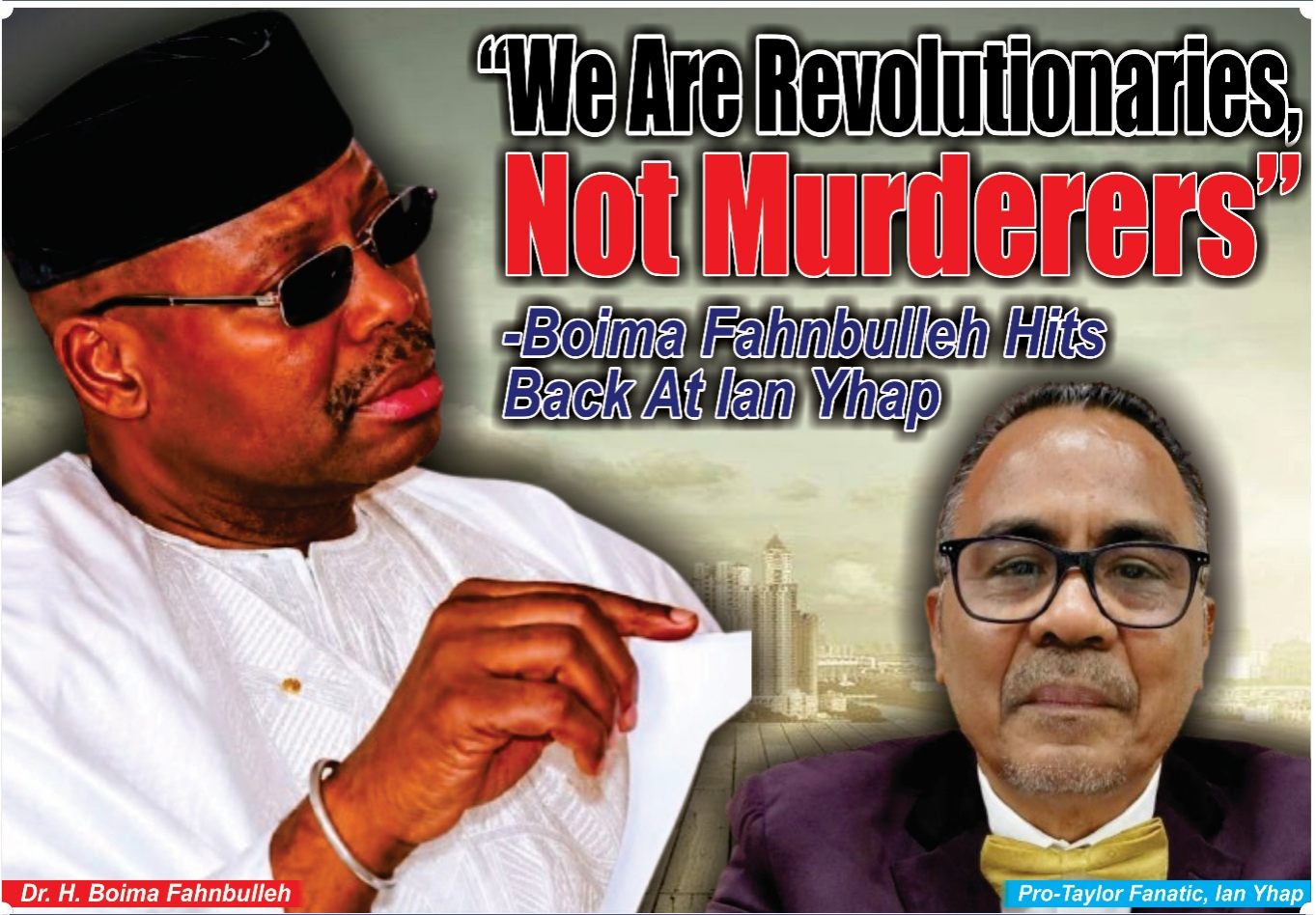
MONROVIA: H. Boima Fahnbulleh Jr., (PhD), a noted Liberian political scientist and philosopher has strongly rejected assertions by a prominent Liberian electrical engineer and consultant, Ian Yhap, that he (Dr. Fahnbulleh) “played a significant role in the chain of events that eventually led Liberia into war.”
“I would not have bothered to reply to the disinformation and misreading of history as portrayed by this Yhap but because many of our people do not understand the agenda of the likes of Yhap, I will open his eyes to the reality of the Liberian situation as it involves me,” Dr. Fahnbulleh said in his recent Writeup, styled: “Where Ignorance Is Bliss, ‘Its Folly To Be Wise!
Fahnbulleh: “I came to know this Yhap when he was recruited as a consultant for the renovation of the Executive Mansion. At the time, I wondered what he would be doing as a consultant but subsequent developments alerted me to some interesting processes surrounding the renovation of the Executive Mansion.
“At our first encounter in the office of the Minister of State, I noticed the hostile sneer and was forced to ask later on about the character. I was told that he was a member of the Tolbert family and then I understood the hostile glance and obvious hostility of one who was still living in the graveyard of his agony. What many of them do not realize is that we too have agonies, terrible empirical ones, but we have long since decided to move forward for the sake of the unity of our country and the peace of our Republic,” Dr. Fahnbulleh pointed out.
“However, we will not ignore the records of history and say to a war weary nation that the ruthless pacification of the hinterland regions was done through negotiations or that a pistol held to the head of a chief was a matter of jest! It is dangerous folly to tell generations of young people that they must accept their history as they found it even with its tragedies!
“The responsibility of every generation is to analyze the pitfalls, give an accurate and honest interpretation of these tragedies and then commit itself not to duplicate the processes that led to the tragedies in the first place,” Fahnbulleh said.
The political scientist stressed that the interpretation of history must be honest in order to educate and revive.
According to him, revisionist history lacks the power to awaken and stimulate the minds of those who have a conscious grasp of their history.
“As we are aware, historical events are not static relics but foundational blocks which guide the process of construction and reconstruction,” he added.
This is the case with Yhap. He argues that: “Henry Boima Fahnbulleh, Jr. played a significant role in the chain of events that eventually led Liberia into war.”
Fahnbulleh, in his writeup, asked: “How was this done? By agitating against the arrogance and stagnancy of a moribund social class or resisting tyranny as any patriot of conscience would do? Some men accept tyranny because they think only of themselves. Other men resist tyranny because they think of a nation and a people!
“I fought against class snobbery and political tyranny. I have explained all of this in my TRC presentation for which I was absolved by the Commission. One thing I did not do was to unleash on a people a devastating civil war and then to hold them as captives until I was given power. This is not me. Power has never interested me as an end in itself.”
Dr. Fahnbulleh further narrated: “Twice I was offered the vice presidency, first by Samuel Doe and secondly by George Weah through Jefferson Koijee. On both occasions I turned them down. In the case of Doe, I told him when he made the suggestion on our way from India after the Non-aligned Conference that I found it difficult to go into politics on the back of the military.
“I reminded him that he had told the heads of diplomatic missions in my presence as foreign minister that if money was provided for development, he would hold elections and return to the barracks. He had even expressed interest in going back to school. The American ambassador at the time, William Swing, said arrangements could be made for further education in the United States. This was my frank opinion to Samuel Doe at the time but I realized later on that others were telling him to hang on to power. This is another story,” the political scientist indicated.
According to Dr. Fahnbulleh, “In the case of George Weah, I realized that they were naïve and idealistic young men who did not understand the forces at work in the society. The forces with whom I worked at the time were telling people that I had plans for an assassination to seize power and also hinting to the Americans that I was a communist. These fellows did not understand that any association with their program would have doomed them to rejection and marginalization by very powerful forces in the international system. Also, we were ideologically far apart. I managed to survive under very difficult conditions and that was enough for me. I entered the race in 2017 to promote my tendency of popular democracy!”
Fahnbulleh: “Yhap argues erroneously or maybe deliberately” to deceive that: “The Ministry of Education scholarship program of the early 1980s is relevant because numerous contemporaneous newspaper reports alleged that some of those scholarships were used to send selected young Liberians to Libya. Instead of pursuing academic studies, several reportedly received military and guerrilla training under Muammar Gaddafi’s regime. Many of those individuals later became key figures in armed movements that sought to overthrow the Doe government. My late friend, Matthias Nimley, told me personally that he was one of the scholarship recipients, lending a personal dimension to what has long been part of Liberia’s historical discussion.”
“Now, these are some of the lies that these people tell to convince the gullible that their narrative is factual. In this case Yhap lies on a dead man to promote his fiction,” Dr. Fahnbulleh stressed.
“There were no scholarships from Libya and students were never sent to Libya for studies or military training. As a matter of fact, the military regime broke off diplomatic relations with Libya in1980 under the prodding of the Americans. Khadaffi invited Samuel Doe to Tripoli but the Americans would have none of it.
They asked Samuel Doe to reject the invitation which he did. The Libya people’s Bureau was then closed and the staff deported. Now to lie on a dead man is dishonest. What sacrilege! What disgraceful misrepresentation! We are an African people and we cherish the memories of dead friends and relatives!”
Fahnbulleh: “I will tell Yhap the true story and hope he is honest enough to understand this period of our history. In late 1980, Samuel Doe accepted an invitation from the Ethiopian military government. He took a large delegation and I was included.
During our visit, we toured some slums and saw illiterate slum dwellers, mainly women learning to read and write. I was fascinated by this experiment in social advancement. I then asked the Minister of Education how the program was conceived. He told me that the year before Ethiopia had won the Literacy Prize from UNESCO and it was then decided that they should introduce Adult Literacy throughout the vast territory of Ethiopia with a population of about 65 million people at the time. I thought this was a good idea to introduce in Liberia in order to train our illiterate sisters and mothers in the slums of our cities, towns and villages. I asked him for some scholarships to send passionate young Liberians to Ethiopia to learn Adult Literacy who would then come back to help with our own Literacy program at the Ministry of Education. This was the program that Matthias Nimley attended. It was in Ethiopia and not in Libya. A handful of the brothers (not more than a dozen) stayed behind for basic military training.
But Matthais Nimley was definitely not one of them. We were in a military regime and had been inducted into the army. We had witnessed the execution of Thomas Weh Syen and the other heroic young military leaders based on sheer lies. As for training in Libya of cadres, this had nothing to do with the Ministry of Education. I left the military government in 1983 and whatever training took place under my watch occurred in 1989. But this is another story. I would suggest that you get your facts right before throwing out allegations. I know your intentions and those of many others who in their little minds feel we can be moved by such historical misrepresentations. We cannot! We have been seasoned in the many confrontations with historical falsifiers like you. We have never wavered and will never waver! It is not in our nature to shake before weaklings!!”
According to Dr. Fahnbulleh, in trying to apportion blames and therefore mitigate the horrors that took place behind the lines of the NPFL which the TRC explained and documented, Yhap tried a threadbare syllogism.
He averred: “One could even argue that the actions of Henry Boima Fahnbulleh, Jr. and others in the early 1980 helped create the very conditions that made Charles Taylor’s emergence possible. By recruiting, organizing and facilitating the training of young Liberians for armed insurrection, they introduced a model of violent political change that Taylor would later inherit, expand, and ultimately dominate. In that sense, Taylor did not invent the path to civil war. He walked through a door that had already been opened.”
Fahnbulleh: “Bon! So is the reasoning! So is the mindset!! What we are told here in Yhap’s childish sophism is that Charles Taylor was a malleable character who only followed trends created by Fahnbulleh and others. The objective here is obvious! We should stop blaming Charles Taylor and those of his kind who wanted revenge for 1980 and in their haste and passion unleashed disaster on the country! Indict Fahnbulleh and others for introducing violence in our society for which unfortunately Charles Taylor augmented! Yhap must know that this is not true. He is a grown man and must know the history of his country.”
After the political violence introduced in 1955 by William Tubman and his gang, Liberia sailed on quietly with a battered opposition and a bruised citizenry. He died peacefully in 1971 and the Republic moved on.
“Yhap, the political violence that nurtured Charles Taylor and others incubated in the massacre and brutality of 1979! Here, where peaceful citizens were exercising the democratic rights to demonstrate, your family’s government murdered innocent citizens on the streets of Monrovia and hauled hundreds of young men from Nimba and Margibi into prison cells at South Beach.
Charles Taylor was here. He had come with a student delegation to see president William Tolbert. He must not have missed the lesson of history, that political violence had its dividend in certain circumstances! The opposition then was crushed; the children of the people killed were interred in a mass grave at the Palm Grove Cemetery; and the ruthlessness of the oligarchy showed what political violence could achieve! Charles Taylor must have absorbed the lesson well,” Dr. Fahnbulleh further stated in his writeup.
“And then the military coup occurred in 1980. Charles Taylor was still around. He interacted with the young military fellows, not always in a positive way, when one considers the corruption and ruthless exercise of power in Liberia at the time. He observed and learned well but fell out with them after a short period. He fled into exile, was accused of embezzling a million dollars. He went to France and then to the United States where he was arrested on an extradition request from the military regime of Samuel Doe. He escaped prison and called me from Mexico City.
He wanted to know what had happened in November 1985 and what was being done to rid the country of the military tyranny,” Fahnbuleh further narrated. Thus Yhap, Charles Taylor did not inherit the path of political violence opened by Fahnbulleh and others. It was already there, created by your people in 1979, on the blood, bruised and mangled bodies of masses of poor citizens.”
HB: “Charles Taylor was invited to Ghana by me as I had some friends in security. The idea was not to allow Samuel Doe to catch and kill him as this would be a dangerous sign to all exiles, including me. He was arrested in Ghana the first time when a friend of his Abayomi Karnga went to visit him at a hotel where Liberian exiles were living. One of these exiles, who today hides behind the veil of civility reported Karnga to the Ghanaian security. According to this exile, Karnga was an agent of the military regime in Liberia. Karnga was put under surveillance and later arrested at the Panta Hotel in downtown Accra. On interrogation, he revealed that he only went to see his boyhood friend Charles Taylor at the Star Hotel. Charles Taylor was then arrested. The junior officers did not know that he had clearance from the senior level of Ghanaian intelligence. I contacted my senior security friends in the intelligence services and told them that Charles Taylor was the man I told them about who wanted asylum in Ghana like many of us. In the meantime, this devious and notorious Liberian exile was pushing the narrative that I invited Charles Taylor to Ghana to compromise their operation. It was a vicious and messy political struggle at the time and if I did not have strong contacts in the upper echelons of Ghanaian security, I would have fallen victim to the intrigues of this exiled Liberian who reminds me each time I see him of Joseph Stalin’s murderous secret police chief, Yezhov!
“Charles Taylor was not the intended target. It was me. I managed to get Charles Taylor released and left Ghana thereafter.
I learned later that Aboyami Karnga never made it out of prison in Ghana. When I heard that Charles Taylor was arrested for the second time in Accra, I contacted my friends in the security service. I was told that the same vicious Liberian exile had narrated to the Ghanaian security officers that Charles Taylor told him that some Togolese coupists, who had staged an abortive invasion against the late Eyadema, revealed that the attempt failed because they were not adequately prepared as senior security officers had squandered the money that Kadaffi sent for the operation. The Ghanaian security officers were furious that Charles Taylor was saying this around Accra. This was why he was arrested for the second time,” Dr. Fahnbulleh further explained.
According to Dr. Fahnbuleh, after spending time in prison in Accra, Charles Taylor’s mistress contacted someone at the Embassy of Burkina Faso in Accra. She was sent to Ouagadougou to meet Blaise Campoare. The Burkinabe second in command flew to Accra and asked the authorities there to release his friend Charles Taylor. The man was taken from prison and put on the Burkinabe plane that departed for Ouagadougou. From there I learned Charles Taylor was taken to Tripoli to meet the Libyan leader. What has this got to do with Fahnbulleh and now some little moron in Europe writes and published that I am a war criminal. “I am going to sue him in Europe or Liberia to show wherein I am a war criminal”.
Fahnbulleh: “These little arrogant nonentities must be taught a lesson! This story is long and far from ending. Charles Taylor is in prison not because of the Liberian civil war but due to his connections to the RUF of Sierra Leone. Fahnbulleh had nothing to do with these developments in Sierra Leone. We are revolutionaries not murderers! The futile attempts made over the years to link Fahnbulleh to atrocities, war crimes and human rights abuses are sordid pollution of the historical records. Yhap cannot show one instance where Fahnbulleh gave any order to shoot, execute, or mutilate anyone during the entire period of Liberia’s civil crisis.”
HB: “As a matter of fact, I played no part in the civil war but had brothers around me who were trained in military matters in order to protect me. These are the facts! There is no need for me to lie.
The TRC listened to my testimony and concluded that I was vindicated by history. Does Yhap know something that the TRC did not know? I am convinced he does not. His blabbering is the knee jerk reaction of a disgruntled historical reject whose class was winnowed out by the tragic history of our Republic.”
However, in a counter article, styled: “WILL THE REAL BOIMA FAHNBULLEH PLEASE STAND UP!!, dated August 2, 2026, Ian Yhap wrote:
I left St. Patrick’s Elementary School in March 1966 and entered Ricks Institute, where I joined Dennis Hall, the elementary boys’ dormitory. Like most boarding school boys of that era, we organized ourselves around football. Our teams were named not after schools or neighborhoods, but after the shoes we wore.
Those fortunate enough to own the popular brown Grip Skate sneakers played for “Grip Skate.” Those wearing the white Chinese-made “Green Bottom” sneakers played for “Green Bottom.” The rest of us, who owned neither, were gathered into a third team called “Great Olympics.”
There were genuine footballers on those teams. I remember Oliver Snyder with Green Bottom and James Bannerman and Tennikay Sayeh with Grip Skate. Great Olympics inherited whoever was left. I was among them. In Liberian parlance, I was a complete “feecee.” I was so inexperienced that when our goalkeeper, Varney Sarnor, rolled the ball to me to restart play, I picked it up with my hands and tried to give it back to him, conceding what was probably the easiest penalty ever awarded against our team. Yet redemption arrived from the most unexpected place.
During a corner kick, everyone crowded into the opposing penalty area. Suddenly a goal was scored. Before I even understood what had happened, someone grabbed my hand, raised it high in celebration, and loudly proclaimed that I was the scorer. The entire elementary boys dorm celebrated me. To this day, I have no idea who actually scored that goal.The person who staged my moment of undeserved glory later confessed that he thought one of my sisters was beautiful and wanted me to “burn his wire.” We were ten or eleven years old, so it was all innocent fun. From that day forward we jokingly called each other “Brother-in-Law,” eventually shortening it to “BIL.” Almost seventy years later, we still do. That young man was Nete-Sie Brownell, Jr., uncle of Boima Fahnbulleh.
Our friendship has endured for a lifetime. He remains one of the most perceptive and intellectually gifted Liberians I know. In fairness, I must confess that while he admired one of my sisters, I also admired one of his, Nadia Brownell. She was an exceptionally beautiful young woman who would later be crowned Miss Liberia in the mid-1960s. She still exudes that beauty today. The Brownell family has intersected with my life in many other ways. Alpha Brownell, another of Nete-Sie’s sisters and Boima’s aunts, is a gifted architect. We collaborated professionally on several projects, combining her architectural designs with my electrical engineering work. Lord Brownell, another member of the family, became one of Liberia’s great promoters of table tennis. As president of the Liberia Table Tennis Association, I worked closely with him for nearly a decade.
He was dependable, visionary, and, to my knowledge, the first Liberian player ever to win an individual match in competition in China. His passing left a void in Liberian sports. May he continue to rest in peace.
Mary Brownell, Boima Fahnbulleh’s mother, has always treated me with extraordinary warmth and respect. During one particularly uncertain period of my life, when I felt politically vulnerable, she was one of the people I trusted enough to approach for assistance. She often reminded me how much she respected my late mother and the McClain family. My last visit to the Fahnbulleh home atop Snapper Hill was to spend time with Boakai Fahnbulleh who lives in the USA and had gone home for a visit. Boakai and my older brother Jimmy Yhap had both been members of the band Purple Haze during the 1970s. Although younger than they were, I moved within the same musical circles and played in a band myself. Decades later, Boakai and I found ourselves doing something much simpler: sitting together with acoustic guitars, playing campfire music as old friends do.
Miatta Fahnbulleh also moved within those same musical circles. She beautifully performed songs such as Amo Sake Sa and Kokolioko, which were favorites play songs among Monrovia’s children before she put the dancing beat to them. Our paths crossed, but we never really knew one another.
My first meaningful encounter with Miatta came years later, around 1998 or 1999, in Accra, Ghana. A Liberian friend invited me to what turned out to be a gathering of prominent Ghanaians and Liberians seated around a large conference table in an upscale hotel. Miatta was clearly leading the discussion, which centered on Liberia’s civil war. As the discussion opened to questions, I asked from across the table: “What about the involvement of your brother, H. Boima Fahnbulleh, in the chain of events?”
The atmosphere changed immediately. Miatta defended her brother.
Sensing that I had disrupted what had been an otherwise comfortable narrative, I became embarrassed. Fortunately, the friend who had invited me picked up where I had left off, supplying historical details far better than I could have at the time. Neither of us intended to embarrass anyone. We simply asked that history be examined objectively, as we had been taught to do.
I have long believed that Miatta never completely forgave me for that exchange, despite later attempts on my part to mend fences.
Now, to Dr. Henry Boima Fahnbulleh, Jr.
I know him well. We are not friends, but neither have we been enemies. Our professional lives occupied different spheres. His was politics. Mine was Liberia’s energy sector. Yet our paths crossed repeatedly during the Sirleaf administration. While he served as Political Adviser to President Ellen Johnson Sirleaf, I served as Adviser on Energy to the Ministry of Lands, Mines and Energy and later as Chairman of the Board of the Liberia Electricity Corporation. We met often at the Executive Mansion and, on more than one occasion, sat across from one another in the office of the Minister of State for Presidential Affairs, Dr. Edward B. McClain, Jr., discussing matters of national importance.
We have greeted each other warmly. We have spoken professionally. We have known one another for years.
Which is precisely why I found the repeated references to “this Yhap,” “one Yhap,” and simply “Yhap” so curious. We both know that is not an honest starting point.
For the record, Dr. McClain was my maternal uncle.
Reasonable people may disagree over history. That is perfectly acceptable. But pretending not to know the identity of the person with whom you have shared decades of professional acquaintance does not strengthen an argument. It weakens it. Whether this deliberate distancing originated with Dr. Fahnbulleh himself or with someone writing on his behalf, it does not accurately reflect our shared history. And if the article is intended to establish the historical record, then the record should begin with honesty about something as simple as this: we know each other.
Before addressing the other substantive issues in Dr. Fahnbulleh’s narrative, there is one other matter I feel compelled to clear up.
Dr. Fahnbulleh or his proxy seems preoccupied with the family into which I was born. It is true that my mother was the niece of President William R. Tolbert, Jr. That is a matter of genealogy, not ideology. I had no say whatsoever in the circumstances of my birth. None of us chooses our parents, our family name, or the social station into which we enter this world. Those are accidents of birth, not accomplishments or crimes. What we do choose are the positions we take, the causes we embrace, and the actions we pursue. Those are the things for which history should judge us.
Dr. Fahnbulleh tells his readers that once he learned I was related to President Tolbert, everything else about me became understandable. My supposed “hostile sneer,” my opinions, even my motivations were no longer my own. They became hereditary.
That is an interesting way to begin a discussion about history. It saves one the trouble of answering an argument by first explaining away the person making it.
The old narrative of “the ruling class” versus “the oppressed class” has very little meaning to the ordinary Liberian today. Whether your grandfather was a president, a farmer, a market woman, a fisherman, or a laborer, we are all standing in the same long lines for electricity, the same broken roads, the same failing schools, the same inadequate healthcare, and the same uncertain future. The Liberia of today is remarkably egalitarian in one respect: we are all catching hell together.
That is the Liberia our generation has bequeathed to those who follow us. Which is precisely why this conversation matters.
I have never suggested that the story belongs only to one side. On the contrary, I want to hear every side. I want to hear yours. I want to hear Charles Taylor’s. I want to hear Ellen Johnson Sirleaf’s. I wanted to hear Amos Sawyer’s. I want to hear Tipoteh.
All these PhD’s and no definitive account of the 1980 coup? Nothing on the rice riot? Nothing on the Quiwonkpa 1985 invasion? Where are your accounts? An2d then when I write something, you vex! I want to hear from every principal actor who helped shape the Liberia that we have inherited and that we are bequeathing to the next generation.
But tell us yourselves. Do not send proxies as it seems have been done in this case. Do not allow admirers, defenders, critics, or political descendants to narrate your history for you. History deserves the voices of those who lived it and who impacted it.
Coming out of the shadows means more than defending reputations. It means honestly explaining decisions, acknowledging mistakes where mistakes were made, and helping future generations understand not only what happened, but why it happened.
If Liberia is ever to escape this cycle, it will not be because we concealed the past. It will be because those who made history had the courage to tell it truthfully, allowing those who come after them to learn from both their achievements and their failures.
The repeated effort to distance yourself from someone whose history you know firsthand suggests that whoever has emerged from the shadows to write your response is relying more on rhetorical theater than historical accuracy. Your proxy may understand the politics of the moment, but clearly does not understand the history of the relationships involved.
So before we examine the substance of your arguments, permit me one final request: WILL THE REAL BOIMA FAHNBULLEH PLEASE STAND UP!!”

Towards Economic Empowerment And Reconciliation