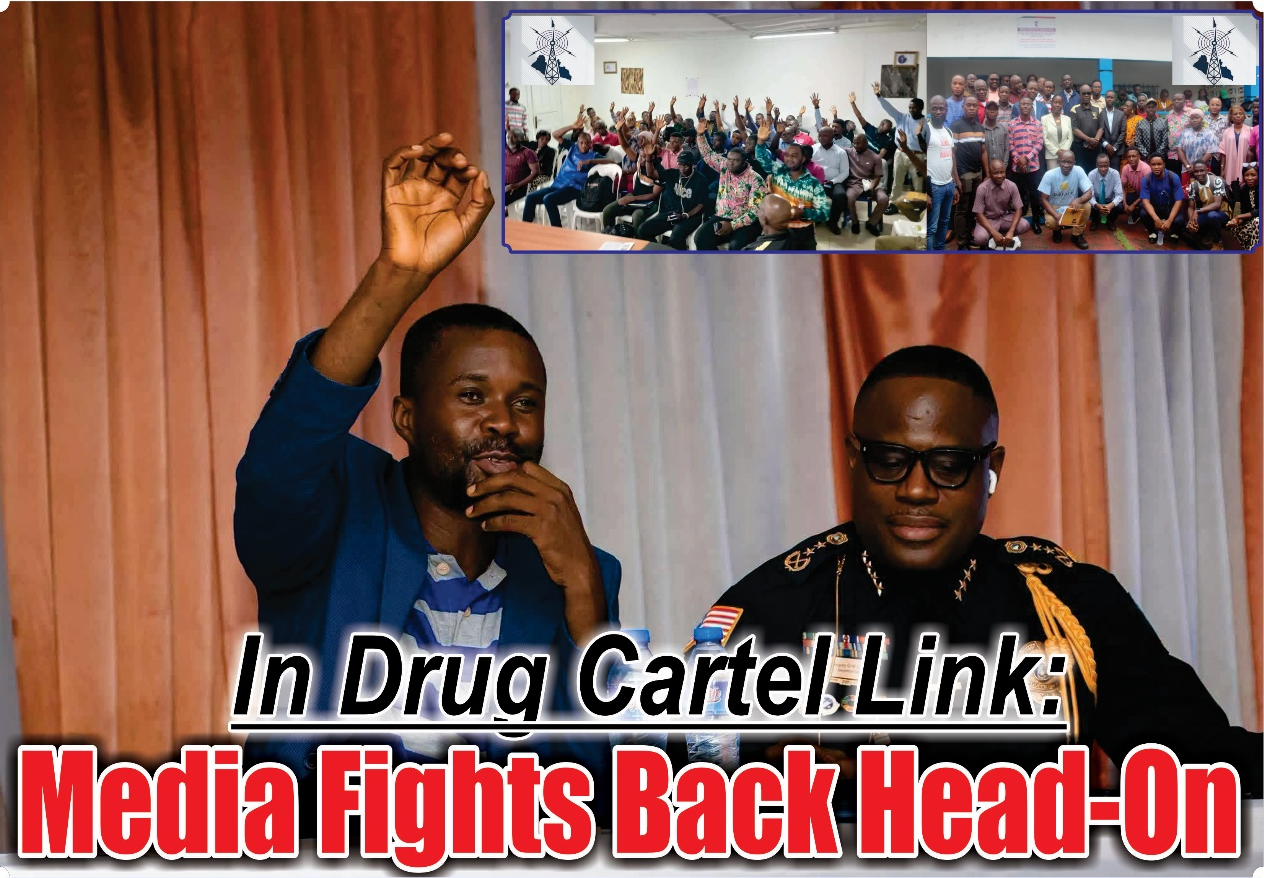
MONROVIA: Liberia's media community has declared an unprecedented legal battle against the central government after the Liberia National Police (LNP) failed to produce evidence, supporting explosive allegations that drug cartel money infiltrated the press, escalating an already volatile confrontation over the country's widening cocaine investigation.
Liberia's deepening cocaine crisis has opened a new and explosive front—not in the courtroom or at the nation’s borders, but between the government and the country's premier media umbrella organization, the Press Union of Liberia (PUL).
In an extraordinary show of unity, members of the Press Union of Liberia (PUL) have voted overwhelmingly to pursue legal action against the government after what it described as the authorities' failure to produce evidence supporting allegations that members of the Liberian media received money from an international drug cartel to influence public opinion and undermine government’s ongoing investigations.
The decision, reached during a specially convened mass membership meeting at the Union's headquarters in Monrovia on Monday, August 3, 2026, marks one of the strongest institutional responses by Liberia's media in recent years and signals an escalating confrontation over accusations that have sent shockwaves throughout the country's journalism community.
At the heart of the dispute are remarks made on July 30, 2026, by Inspector General of Police, Gregory O.W. Coleman, speaking on behalf of the government's Joint Security Investigative Taskforce, who publicly asserted that investigators had "verified and established" that proceeds from an international drug cartel had been injected into sections of the Liberian media to sway public discourse surrounding the seizure of more than four metric tons of cocaine.
The allegation immediately ignited outrage within media circles.
Days later, the Press Union says, the government has yet to present a single piece of evidence, identifying the alleged media institutions, journalists or organizations purportedly involved.
That silence, the Union argues, has inflicted serious reputational damage on an entire profession while exposing journalists to public suspicion and potential security threats.
Following more than an hour of deliberations, journalists unanimously mandated the PUL leadership to immediately retain legal counsel and seek judicial remedies, if the government fails to substantiate the allegations.
The motion was introduced by journalist Winston Blyden of Bana FM, whose proposal received overwhelming backing from members.
"Following more than an hour of discussions on the damaging statement from the Inspector General of Police Gregory Coleman, I move, if I can receive a second, that this body mandates the leadership of the Press Union of Liberia to contact our lawyers with immediate effect to seek appropriate remedies to this issue and report within one week," Blyden declared.
The motion was subsequently adopted, giving the Union's leadership a one-week mandate to initiate legal consultations and report back to the membership.
In a strongly worded resolution, the PUL said, the government's continued failure to produce evidence has transformed what could have been a criminal allegation into what it considers a direct assault on press freedom and the credibility and integrity of independent journalism.
"The membership of the Press Union of Liberia (PUL) has mandated its leadership to engage lawyers and seek appropriate remedies following the government's failure to provide evidence, linking the Liberian media to receiving monies from a drug cartel," the Union announced.
The organization warned that allegations of such magnitude cannot remain unsubstantiated without causing lasting institutional damage.
"The PUL warns that such unsubstantiated allegations erode public trust, endanger the safety of journalists, and undermine the credibility of the media," the release stated.
Beyond the legal implications, the Union questioned the motive behind the LNP Inspector General's statement, suggesting that it may have been intended to divert national attention from the growing body of reports surrounding the ongoing narcotics investigation.
The PUL members argued that the accusation emerged at a time when public scrutiny has intensified over allegations implicating senior government and security officials in the country's largest cocaine investigation.
According to the Union's resolution, the statement "should not go without challenge," adding that members believe it may have been made out of frustration and intended to distract attention from heightened security investigation reports, implicating several senior security and government officials in collaboration with the cartel.
Presiding over the meeting, PUL President Julius Kanubah praised journalists for what he described as an unwavering commitment to defending the integrity and independence of the Liberian media.
Kanubah emphasized that the Union's action should not be interpreted as hostility toward the government or opposition to the fight against narcotics trafficking.
Instead, he argued that the media remains an indispensable partner in exposing organized crime and informing the public.
According to Kanubah, if the government genuinely possesses evidence implicating any journalist or media institution, it has a duty to disclose that evidence through lawful channels rather than making sweeping public accusations.
He stressed that doing so would strengthen—not weaken—the national campaign against illicit drugs.
The dispute unfolds against the backdrop of one of the most consequential criminal investigations in Liberia's recent history.
The seizure of more than four metric tons of cocaine, valued at hundreds of millions of United States dollars, has already triggered the dismissal and suspension of senior public officials, intensified public scrutiny of the country's security architecture, and fueled demands for greater transparency in the investigation.
The Inspector General's allegation against the media has now expanded the controversy beyond law enforcement, drawing the country's press into the center of an already politically sensitive investigation.
Media advocates warn that broad allegations against journalists, when unsupported by evidence, risk undermining public confidence in independent reporting and could create a chilling effect on investigative journalism at a time when scrutiny of public institutions is at its highest.
Legal observers also note that if the dispute proceeds to court, it could become a landmark case testing the balance between national security pronouncements and constitutional protections for press freedom, reputation, and due process.
For now, the Press Union has given its leadership one week to begin legal action unless the government substantiates its claims.
The coming days may therefore determine whether the controversy is resolved through evidence and dialogue—or whether it evolves into a courtroom battle with far-reaching implications for press freedom, government accountability, and the public's right to credible information as Liberia confronts one of the gravest narcotics scandals in its history.
Towards Economic Empowerment And Reconciliation