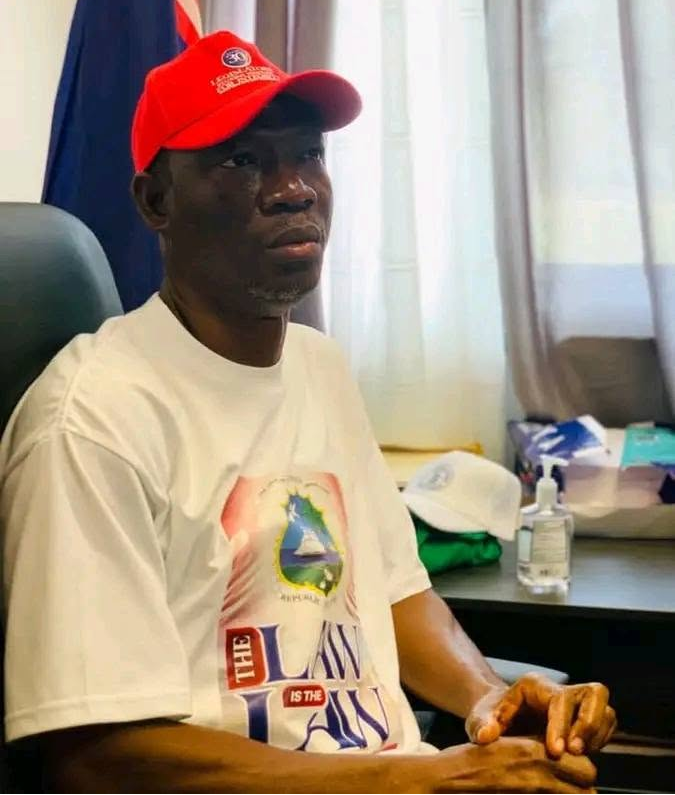
MONROVIA: Weeks after the Supreme Court of Liberia dismissed Montserrado County District #10 Representative Yekeh Kolubah’s appeal for a writ of prohibition against his expulsion from the House of Representatives, the Executive struck an intimidating note, signaling that President Boakai’s government would not relent in its pressure to gain more authority over one of its fiercest critics.
In the eyes of President Boakai and his security officials, the Supreme Court’s decision was not enough to silence Mr. Kolubah, even though the Constitution guarantees the fundamental rights of Free Speech and Movement.
On one hand, Justice in Chambers Yusuf D. Kaba ruled that Representative Kolubah’s petition to overturn his expulsion was legally defective because the House had not been properly served through the Sergeant-at-Arms.
Yet, the Supreme Court left much unresolved. The Justice did not clearly articulate the legal criteria that would allow state security officers to prevent Mr. Kolubah from paying a condolence visit to the Chief Mutif of Liberia, who recently passed away. Nor did the Court issue an opinion on the type of venue or occasion the dismissed District-#10 lawmaker should avoid when President Boakai is expected to attend.
The Executive quickly seized on this legal ambiguity. In a social media video that went viral on Saturday, August 1, 2026, state security protecting the President vowed to deny the lawmaker entry to the Chief Mutif’s residence.
Officials justified the decision as necessary to ensure that someone who had made remarks about Liberia’s territorial integrity would not be allowed to sit or attend any function where President Boakai was present.
The outcome shocked many supporters of democracy and good governance.
“This is completely wrong. Why stop the Honorable man when the President has not arrived yet?” said Prince Bill Yeaload, a social media commenter. “The only way he should have been stopped is if the president had already arrived.” He added: “This country does not belong to Boakai and the Unity Party.”
Mr. Kolubah still found reason to speak on Saturday, issuing a statement after the President’s bodyguards reportedly barred him.
“Joseph Boakai does not own this country. This country belongs to the Liberian people,” he said. “You’ve got some of us to contend with in 2029; you cannot be President of this country again because you are very reckless.”
Critics say in addition to infringing on his freedom of movement and association, the incident amplified arguments that public officials—once democrats—are now acting like dictators.
They maintain that it reinforced the premise that the President influenced the decision that led to Kolubah’s removal from office.
“This is not just about Kolubah,” one constitutional lawyer observed. “It is about the rule of law versus political power.”
The saga surrounding Mr. Kolubah began earlier this year after he publicly declared that disputed land between Liberia and Guinea actually belonged to the Republic of Guinea.
His remarks prompted the Boakai led government to demand his resignation as a lawmaker, before a two-thirds majority of the House of Representatives later voted to expel him.
Towards Economic Empowerment And Reconciliation