CJ Under Fire -For Call TO Abolish Jury Trian
Governance |
👁 3 Views
|
October 14, 2026
By: Frank P. Martin
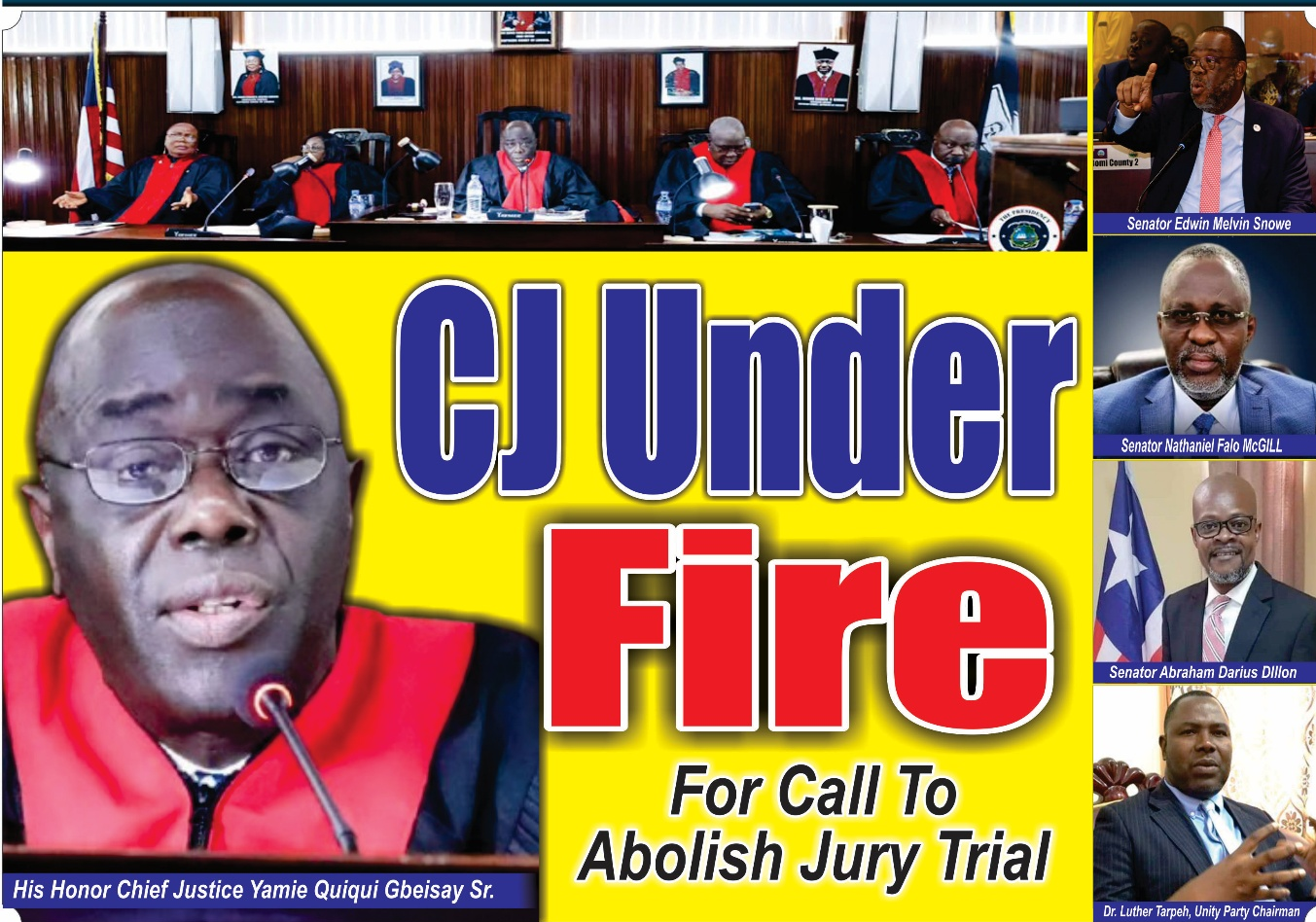
MONROVIA: A growing national debate over the future of Liberia’s trial jury system has intensified following Chief Justice Yamie Quiqui Gbeisay Sr. call for the abolition of jury trials.
Scores of lawmakers, the Chairman of the ruling Unity Party (UP), Liberia National Bar Association (LNBA), among many others have given their perspectives on how best to confront corruption and restore public confidence in the nation’s justice system.
The controversy, which emerged during the opening of the Supreme Court’s October Term, has placed constitutional rights, judicial accountability and the integrity of criminal proceedings at the center of a wider discussion about justice reform in Liberia.
While Chief Justice Gbeisay argues that repeated incidents of alleged jury manipulation have undermined the credibility of verdicts in civil and criminal cases, several senators contend that eliminating jury trials would risk weakening a constitutionally protected right without necessarily addressing the underlying causes of corruption.
Bomi County Senator, Edwin Melvin Snowe Jr., Senators A. Darius Dillon, Amara Mohammed Konneh and Nathaniel F. McGill have called for constitutional compliance and institutional reform, although their statements reflect different emphases on the scope and urgency of the necessary changes.
Unity Party Chairman, Dr. /Rev. Luther Tarpeh, has expressed support for the Chief Justice’s concerns, arguing that corruption within the justice system cannot be addressed through legal reforms alone without a broader change in public attitudes and personal responsibility.
At the heart of the disagreement is a fundamental question: Should Liberia abolish jury trials to prevent manipulation, or strengthen the existing system to protect its constitutional guarantees and hold those responsible for misconduct accountable?
Chief Justice Gbeisay’s proposal is rooted in concerns that jury tampering, bribery and improper interference have compromised the administration of justice.
At the opening of the Supreme Court’s October Term, the Chief Justice warned that the integrity of jury verdicts was increasingly threatened by alleged misconduct, prompting his call for a fundamental reconsideration of the system.
“A corrupt jury is worse than no jury at all,” he declared.
The Chief Justice cited reported incidents in Nimba, Grand Gedeh, Bomi and Margibi counties, involving cases ranging from rape to drug trafficking.
He also referenced suspected interference in proceedings before Criminal Court “C” in Monrovia.
Among the cases mentioned were Republic of Liberia v. David Nagbe, a rape trial in Grand Gedeh County during the May Term of 2025, in which alleged jury tampering emerged four days after an acquittal, and Republic of Liberia v. George Bongar, another rape case in Bomi County during the May Term of 2026, in which allegations reportedly surfaced 19 days after an acquittal.
In Margibi County, the Chief Justice cited Republic of Liberia v. Quita Dolo et al., a drug-related case in which suspected interference reportedly arose while proceedings were still pending.
He also referred to a US$100,000 drug-related case before Criminal Court “C” and a separate matter in which allegations of jury tampering and misconduct emerged seven days after an acquittal.
According to his account, Judge Ousman F. Fieka investigated the latter matter and established gross jury tampering.
The allegations have intensified concerns about the effectiveness of existing safeguards, particularly the selection, protection and supervision of jurors.
However, the reported incidents have also raised questions about whether the appropriate response is to dismantle the jury system or strengthen the institutions responsible for ensuring that trials are conducted fairly.
Senator Snowe has emerged as one of the prominent advocates of comprehensive jury reform, arguing that corruption within the administration of justice must be confronted without unnecessarily removing constitutional protections from Liberian citizens.
In a detailed statement addressing the positions of his Senate colleagues, Snowe said his two decades of legislative experience had reinforced his understanding of the legislature’s responsibility to protect the Constitution and exercise independent judgment on matters affecting fundamental rights.
“I am not a lawyer. I am, however, one of the 103 members of the Legislature entrusted with the constitutional responsibility to make laws and sworn to uphold the Constitution of the Republic of Liberia,” Senator Snowe said.
He stressed that the controversy deserved a serious national discussion free from partisan considerations and special interests.
According to Snowe, bribery, intimidation, interference and misconduct in the administration of justice pose genuine threats to public confidence in the courts.
He said he respected the Chief Justice’s determination to confront these problems but cautioned against confusing the misconduct of individuals with the constitutional value of jury trials.
“My position is clear: Liberia should undertake comprehensive jury reform while preserving the protections guaranteed by our constitution,” he stated.
“Corruption demands investigation, accountability, and institutional repair. Its existence does not, by itself, justify withdrawing a fundamental right from the Liberian people.”
Senator Snowe’s position rests on the distinction between correcting weaknesses in the administration of justice and eliminating a legal safeguard intended to protect citizens accused of crimes.
He argued that abolishing jury trials would not necessarily remove opportunities for improper influence because judges, prosecutors, investigators, court personnel and witnesses could also face bribery, intimidation or political pressure.
“Transferring responsibility for determining the facts entirely to a judge could concentrate the efforts of those seeking to manipulate the outcome,” Snowe warned.
He clarified that the concern was not an accusation against judges but a broader argument for institutional safeguards and accountability wherever public power is exercised.
Senator Snowe also cautioned against interpreting every acquittal as evidence of corruption, particularly in politically sensitive or controversial cases.
Referencing proceedings involving former Finance Minister, Samuel Tweah and Abdullah Kamara, he argued that public discussion must distinguish among verdicts, allegations of misconduct, subsequent judicial rulings and the evidence available in each case.
An acquittal, he noted, may result from insufficient evidence, unreliable testimony or the prosecution’s failure to establish guilt.
Where credible evidence of jury interference exists, Snowe said, it should be investigated and addressed through lawful procedures.
“Public frustration cannot become a substitute for proof, and political affiliation must never determine whose rights deserve protection,” he added.
Rather than dismantle the system, Snowe proposed a reform programme involving the legislature, the judiciary and other relevant institutions.
He pointed to the Office of Jury Management, established through legislative reform in 2013, as an institution whose performance and capacity should be assessed and strengthened.
The office is responsible for functions including jury selection, management of the central jury pool and the education of prospective and selected jurors.
Snowe argued that Liberia should examine whether the office has adequate resources, operational independence and the capacity to carry out its mandate effectively.
He also called for stronger enforcement of existing legal provisions prohibiting jurors from accepting bribes or rewards intended to influence their decisions.
His proposed reforms include transparent jury selection, auditable random selection procedures, stronger screening for conflicts of interest, improved juror compensation and protection, and credible investigations and prosecutions of those involved in jury tampering.
He further recommended better juror education, stronger witness protection, improved criminal investigations, more effective evidence collection and enhanced prosecution and legal representation.
Snowe said the legislature should require a costed implementation plan, clear institutional responsibilities and periodic reports to the relevant committees responsible for judicial affairs, appropriations and public accounts.
He also called for public hearings involving the Judiciary, the Ministry of Justice, the Liberian National Bar Association, jury administrators, civil society organizations and citizens with experience of jury service.
“The jury provides an important avenue for ordinary citizens to participate directly in the administration of justice,” Snowe said, arguing that preserving that role requires making the system worthy of public confidence.
He concluded with a call for accountability that does not sacrifice constitutional guarantees.
“Let us protect the right, punish those who corrupt it, and give the system the support it needs to work,” Snowe declared.
Senator A. Darius Dillon has taken a firm constitutional position against the proposed abolition of jury trials, arguing that the right cannot be removed through an ordinary legislative bill.
In a Facebook statement, Dillon maintained that trial by jury is protected under Liberia’s 1986 Constitution and that any attempt to abolish the system must comply with the applicable constitutional amendment procedures.
Citing Article 20(a), Dillon argued that the country cannot resolve failures in enforcing existing laws by simply removing the institution those laws are intended to regulate.
“We cannot simply seek to undo laws because of our failure to summon the courage to implement and enforce the laws,” Dillon wrote.
His position places emphasis on the responsibility of the Judiciary and other justice-sector institutions to enforce existing legal provisions against bribery, intimidation and interference.
Dillon’s argument also raises a broader constitutional question about the limits of legislative and judicial authority when proposals affect fundamental rights.
Article 20(a) addresses due process and fair hearings, while Article 21(h) provides for a speedy, public and impartial trial by a jury of the vicinity in the criminal cases it covers, subject to the constitution’s provisions.
Article 2 establishes the supremacy of the constitution over inconsistent laws and official actions.
The amendment procedures outlined in Articles 91 and 92 provide for legislative approval and popular ratification of constitutional amendments.
Under Article 91, a proposed amendment requires approval by two-thirds of the membership of each House of the Legislature and subsequent ratification by two-thirds of the registered voters voting in a referendum conducted no sooner than one year after legislative action. Article 92 provides additional requirements concerning publication, explanation and voting on proposed amendments.
These provisions have become central to the debate over whether the proposed abolition could be pursued through ordinary legislation or would require constitutional amendment.
The precise constitutional route would ultimately depend on authoritative legal interpretation of the relevant provisions and the scope of the proposed change.
Nevertheless, Dillon’s argument underscores the need for constitutional scrutiny before any measure affecting the right to jury trial is adopted.
Senator Amara Mohammed Konneh has acknowledged the seriousness of the Chief Justice’s concerns while rejecting abolition as the appropriate initial response.
In a statement titled “On the Chief Justice’s Call to Abolish Jury Trials: Respect the Diagnosis. Question the Remedy,” Konneh said the Chief Justice deserved recognition for placing weaknesses in the justice system at the centre of national discussion.
“When the Chief Justice of the Republic speaks, the nation must listen carefully,” Konneh said.
He described the reported problems of jury tampering and bribery as threats to the integrity of the justice system, warning that they could contribute to verdicts that undermine public confidence.
“The Chief Justice is right to demand a response,” Konneh stated, adding that his responsibility as a senator sworn to uphold the constitution required him to examine the proposal carefully.
However, he argued that the existence of corruption did not automatically justify removing jury trials from the justice system.
“But abolishing jury trials is not the answer. Before it is a policy question, it is a constitutional question,” Konneh declared.
He maintained that the constitutional guarantees surrounding jury trials could not simply be removed through a judicial directive or ordinary statute.
Konneh further warned that transferring all responsibility for determining the facts in criminal proceedings to individual judges would not eliminate the possibility of corruption.
“Removing juries from the courtroom would not remove corruption from the courtroom,” he argued.
He said concentrating decision-making power in a single judicial officer could create another point of vulnerability for individuals seeking to manipulate the outcome of a trial.
“Corruption follows power. Wherever verdicts are decided, corrupt actors will attempt to influence that process,” Konneh added.
The senator proposed a range of measures designed to protect jurors and strengthen the credibility of verdicts.
These include mandatory sequestration and anonymity for jurors in serious criminal cases, meaningful compensation and protection, a transparent and professionally managed selection system, and stronger penalties for those who interfere with jury proceedings.
He also called for jury tampering to be treated as a standalone offence carrying meaningful custodial penalties, subject to due process and the applicable law.
Konneh described the jury as an important mechanism through which ordinary Liberians participate in the administration of justice and help check the exercise of state power.
“The jury is the only institution where ordinary Liberian citizens directly check the state's power,” he said.
He argued that Liberia’s experience with unchecked power should encourage the country to strengthen institutional safeguards rather than eliminate them.
Senator Konneh also called on the Chief Justice to submit a comprehensive jury reform proposal to the Legislature.
“I therefore invite him to bring a comprehensive Jury Reform Act to the Legislature. Let us hold public hearings. Let us fix the system together,” he said.
He maintained that constitutional amendment procedures should remain available if the country eventually determines, after evidence-based assessment and public consultation, that more fundamental changes are necessary.
“But abolition cannot be our first answer,” Konneh stated. “Fix the system. Do not end the right.”
Senator Nathaniel F. McGill has also called for reform rather than an immediate move to abolish jury trials, arguing that the Chief Justice’s proposal reflects concerns about systemic corruption within the Judiciary.
Senator McGill acknowledged the need to confront misconduct but said abolishing the system could prove constitutionally difficult.
He therefore urged the Legislature, the Liberian National Bar Association and civil society organizations to work together to reform the existing jury law.
“I believe the Chief Justice’s call to abolish the jury system is driven by the need to combat systemic corruption within the judiciary,” Senator McGill said.
“However, abolishing the system may be difficult, as it could require a constitutional amendment.”
McGill said reforms should focus on transparency, accountability and fairness while preserving the constitutional principles underpinning jury trials.
He also challenged interpretations of the constitutional principle of a jury of the vicinity that would restrict jury service exclusively to civil servants.
“The constitutional principle of a jury of the vicinity was never intended to restrict jury service exclusively to civil servants,” he stated.
The senator further argued that both parties in a case should have an opportunity to participate in measures designed to protect jurors, subject to proper judicial supervision.
He said a reformed system should ensure that jurors are protected from improper influence without compromising the rights of the accused or the impartiality of proceedings.
For McGill, the objective should be to strengthen the existing framework and restore public confidence through cooperation among the institutions responsible for administering justice.
While the senators have concentrated largely on constitutional safeguards and institutional reform, Unity Party Chairman, Dr. Rev. Luther Tarpeh, placed greater emphasis on personal responsibility, patriotism and the wider social attitudes that influence the administration of justice.
Tarpeh acknowledged the mixed public reactions to the Chief Justice’s proposal but argued that judicial reform would remain difficult without a change in how citizens approach their responsibilities.
“I understand the mixed reactions and diverse perspectives on the Chief Justice call for abolition of jury trial,” Tarpeh said.
He maintained that corruption in jury proceedings cannot be separated from questions of fairness, personal gain and the willingness of individuals to place the national interest above private interests.
“Until citizens can learn to put country interest above personal gains, until we demonstrate true sense of patriotism and until Liberians accept personal responsibility knowing that even little subtle actions of fairness of judgment during trial void of biases, irrespective of a person's social affiliation and connections, our much-needed judiciary reform to tackle corruption will only be a mirage,” he stated.
Tarpeh also expressed concern that jury tampering had contributed to the failure of cases in which, in his view, the evidence warranted accountability.
“We have lost landmark cases due to juror tempering. There are some who should be languishing in jail if not for jurors tampering,” he said.
His remarks reflect a position that places public ethics and civic responsibility alongside legal and institutional reforms.
However, the allegations of jury tampering in individual cases must be established through credible evidence and lawful proceedings. An acquittal, by itself, does not establish that jurors acted improperly.
Tarpeh also called for a nationwide public education campaign on the role of an impartial judiciary in national development.
“The entire country needs national orientation the role fair judiciary plays in national development,” he said.
He argued that Liberia’s ambitions for development and international competitiveness require a shift in public attitudes and a demonstrated commitment to institutional modernization.
“If our country will compete in the global space, we need a radical paradigm shift and authentic demonstration that we are committed to the modernization of our country Liberia through words and actions,” Tarpeh stated.
Addressing the Chief Justice, the Unity Party chairman added: “Your Honor, I fully concur with your perspective on juror trial. I na talk my own!”
Tarpeh’s intervention adds a political and civic dimension to the debate, highlighting the view that legal safeguards alone may not be sufficient without broader public commitment to ethical conduct.
The Liberia National Bar Association (LNBA) has condemned jury tampering but stopped short of endorsing the Chief Justice’s call for abolition.
The association’s president, Cllr. Juah Lawson, said anyone who bribes a juror, attempts to corrupt one or acts as an intermediary in the process undermines the integrity of the justice system.
“Such conduct must have consequences,” Lawson said.
The Bar accepted the Chief Justice’s invitation to participate in discussions involving the Legislature, the legal profession, the Law Reform Commission and other stakeholders.
However, Cllr. Lawson made it clear that the association’s participation should not be interpreted as support for eliminating jury trials.
“The LNBA accepts the invitation to participate in this intervention,” he said. “However, our participation should not be understood as an endorsement of abolition.”
Lawson argued that trial by jury occupies an important place in Liberia’s constitutional framework and that the country should investigate the causes of specific failures before deciding whether the institution itself should be abandoned.
“Before we contemplate abandoning the institution itself, we should carefully examine why there is failure in particular instances and whether those failures may be corrected,” he stated.
The bar identified several areas requiring review, including juror selection and screening, security and sequestration, compensation and conditions of service, access to jurors and their intermediaries, the protection of juror information, the role of court personnel, and the investigation and prosecution of those responsible for interference.
The association said a meaningful national response must be based on evidence, constitutional compliance and consultation among the institutions affected by any proposed changes.
“Liberia must have this conversation,” Cllr. Lawson said, “but it must be a conversation grounded in evidence, constitutional fidelity and broad stakeholder consultation.”
The Bar’s position reflects a willingness to participate in structural reform while insisting that the case for abolition must be examined separately from the evidence of misconduct in individual proceedings.
Article 20(a) of the 1986 Constitution addresses due process and the right to a fair hearing. Article 21(h) provides for a speedy, public and impartial trial by a jury of the vicinity in the criminal cases it covers, subject to its terms and exceptions.
The constitution also provides a mechanism for amendment, meaning that proposals to remove or substantially alter protected rights raise questions beyond ordinary legislative policy.