By: Frank P. Martin
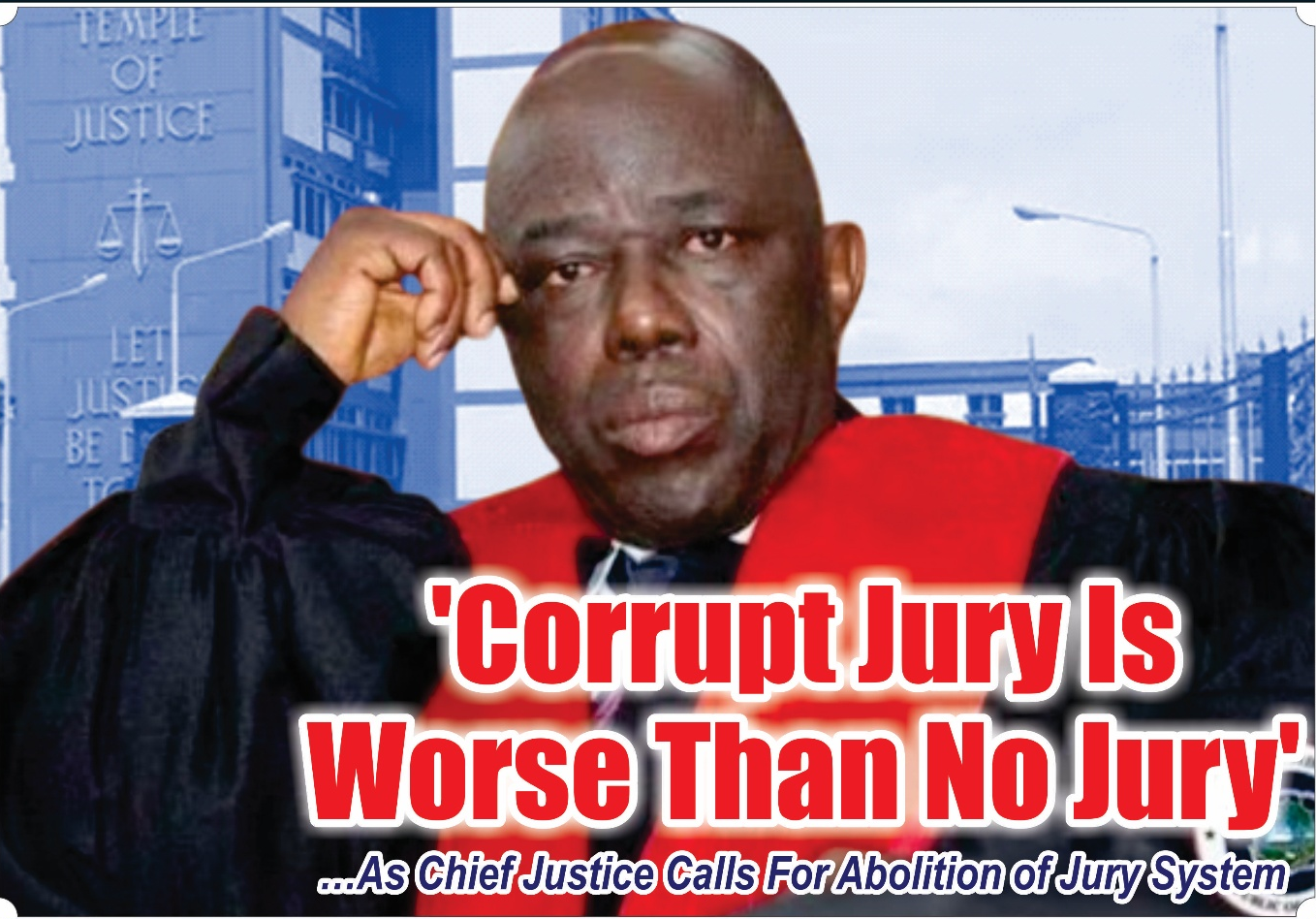
MONROVIA: Chief Justice of the Supreme Court of Liberia, Yamie Quiqui Gbeisay Sr. has raised serious concerns about the credibility of Liberia’s criminal justice system, citing findings of gross jury tampering in the high-profile corruption case involving former Finance Minister Samuel D. Tweah Jr. and calling for a national debate on whether the country should abolish its trial jury system.
Speaking during the opening of the October Term of the Supreme Court of Liberia, Chief Justice Gbeisay disclosed that an investigation conducted by Criminal Court “C” Judge Ousman F. Feika into allegations of jury interference in the US$6.2 million corruption case had established what he described as gross jury tampering.
The Chief Justice’s remarks have intensified scrutiny of a prosecution that has become one of Liberia’s most contentious legal battles, raising fundamental questions about the independence of jurors, the integrity of criminal proceedings, and the protection of constitutional rights.
According to Chief Justice Gbeisay, allegations of jury tampering and misconduct surfaced seven days after a jury returned a not-guilty verdict in favor of Tweah, prompting Judge Feika to investigate the circumstances surrounding the acquittal.
The resulting investigation, the Chief Justice said, established serious interference with the jury process.
“A corrupt jury is worse than no jury at all,” Chief Justice Gbeisay declared, underscoring the danger that compromised juries pose to the administration of justice in the country.
He warned that jury interference was not confined to the Tweah case, citing similar reported incidents in Nimba, Grand Gedeh, Bomi, and Margibi counties.
The Chief Justice's concerns suggest that alleged manipulation of juries could become a broader institutional challenge if left unaddressed, potentially weakening public confidence in the courts and undermining efforts to prosecute serious criminal offenses.
His proposal to reconsider or abolish the jury system has consequently placed the future of jury trials at the center of a national debate involving constitutional protections, judicial reform, and accountability.
The controversy stems from a July 21, 2026, decision by Criminal Court “C” at the Temple of Justice in Monrovia, where Judge Feika made public an investigation report concerning alleged jury tampering in the prosecution of Tweah and several co-defendants.
According to the information provided about the report, the investigation identified serious jury misconduct and alleged interference that the court considered sufficient to compromise the integrity of the proceedings.
Consequently, the court set aside Tweah’s May 8, 2026, not-guilty verdict and ordered a fresh trial before a different jury.
The prosecution concerns allegations surrounding the handling and management of approximately US$6.2 million in public funds during Tweah’s tenure as Minister of Finance and Development Planning under former President George Weah’s administration.
The allegations remain subject to judicial determination, and the decision to set aside the acquittal does not, by itself, establish Tweah’s guilt.
Before Judge Feika’s ruling, the jury had acquitted Tweah of the principal charges against him, while several co-defendants were convicted on various charges.
The subsequent investigation and decision to nullify the acquittal have reopened the legal dispute, raising questions about how courts should respond when allegations of jury misconduct emerge after a verdict has been returned.
The case is particularly sensitive because it follows an earlier retrial reportedly prompted by concerns about jury interference, placing renewed attention on the safeguards intended to protect the independence and impartiality of jurors.
In an extraordinary development following the court’s findings, all 15 jurors who participated in the proceedings were arrested and transferred to Monrovia Central Prison, commonly known as South Beach.
The jurors were also referred to the Ministry of Justice for possible prosecution.
Their arrest generated debate over the distinction between judicial action to protect the integrity of a trial and the separate question of whether individual jurors may be held criminally responsible for alleged misconduct.
Former Finance Minister Tweah has since rejected Judge Feika’s decision, describing it as a serious setback for Liberian justice and democracy.
In a forceful statement following the ruling, Tweah insisted that the original jury verdict remained the only legitimate outcome of his case and accused the court of undermining the rule of law.
“Today, Liberian justice and democracy took a gigantic step backwards. No judge, no justice and no President can ever change my NOT GUILTY verdict. It is etched in the history of our country,” Tweah declared.
He further dismissed the court’s decision as a “kangaroo ruling,” signaling his refusal to accept the judgment as a legitimate basis for reopening the case.
Tweah maintained that the initial acquittal had brought his legal battle to an end and disclosed that he had instructed his legal team not to pursue an appeal before the Supreme Court of Liberia.
“We have left the law and are now in the full realm of politics,” the former minister said, arguing that the controversy had moved beyond a conventional legal dispute.
He also declared that he remained a free man and vowed to resist what he characterized as a dangerous departure from constitutional governance.
Tweah’s position sets up a potentially difficult legal and constitutional confrontation should the trial court proceed with the new trial despite his stated refusal to participate in further proceedings.
His decision not to seek Supreme Court review does not, by itself, establish whether the trial court’s ruling is legally valid or whether other parties may pursue available legal remedies. Those questions depend on applicable law and any subsequent judicial proceedings.
The defense also questioned the legality of the decision to reopen the case after the jury had delivered its verdict.
Tweah’s Lead defense counsel Cllr. Arthur Johnson then described the ruling as unprecedented and argued that the court had acted outside established legal practice by recalling and investigating jurors after they had completed their service and returned to their communities.
“This ruling has destroyed our entire democracy and judicial system,” Johnson declared.
The defense maintains that overturning a jury’s verdict under these circumstances threatens the stability of criminal proceedings and could undermine public confidence in the administration of justice.
At the heart of the defense’s objection is the question of whether, and under what circumstances, a court may set aside an acquittal after allegations of jury misconduct emerge.
The defense indicated that it intends to challenge Judge Feika’s decision before the Supreme Court. Tweah, however, has separately stated that he has instructed his lawyers not to file any appeal.
The two positions illustrate the continuing uncertainty surrounding the case and the possibility of disagreement over the legal strategy to be pursued.
The Supreme Court’s eventual involvement, if the matter properly comes before it, could prove significant in clarifying the scope of judicial authority over allegations of jury misconduct and the legal protections surrounding jury verdicts.
However, the Chief Justice urged the Liberian people, the Legislature, the Liberian National Bar Association, and the Law Reform Commission to consider whether the jury system should be abolished in response to repeated allegations of jury interference.
However, abolishing the trial jury system would involve more than an administrative adjustment to court procedures.
Article 21(h) of the 1986 Constitution of Liberia protects an accused person’s right to a speedy, public, and impartial trial, including trial by jury in criminal cases where the constitutional guarantee applies.
Any proposal to eliminate or fundamentally restructure that right would therefore require careful constitutional analysis.
By citing reported incidents in Nimba, Grand Gedeh, Bomi, and Margibi counties, Chief Justice Gbeisay suggested that the allegations surrounding the Tweah case should not be viewed in isolation.
If substantiated, repeated interference with jury proceedings could threaten the credibility of criminal trials, weaken confidence in verdicts, and complicate efforts to hold individuals accountable for serious offenses.
Juries occupy an important position in Liberia’s criminal justice system because they provide a mechanism for citizens to participate directly in the determination of criminal cases.
That responsibility, however, depends on jurors being able to deliberate independently, assess the evidence presented in court, and reach decisions without improper influence.
With the acquittal set aside and a fresh trial reportedly ordered before a different jury, the US$6.2 million corruption case remains unresolved.
In a related judicial development, Chief Justice Yamie Quiqui Gbeisay Sr. sounded a renewed warning over jury tampering, urging collective action to protect Liberia’s courts as allegations surrounding high-profile corruption trials and reported misconduct threaten public confidence in the administration of justice.
Speaking Monday at the opening of the October Term of Court at the Supreme Court of Liberia, Chief Justice Gbeisay called on stakeholders across the justice system to unite against jury tampering, a practice capable of undermining fair trials and compromising the credibility of judicial decisions.
His appeal comes amid a troubling series of jury-misconduct allegations and court actions in recent months, including an investigation linked to the controversial US$6.2 million corruption case involving former senior government officials.
The developments have placed renewed attention on the safeguards protecting jurors, the conduct of judicial personnel and the ability of the courts to ensure that verdicts are determined by evidence rather than improper influence.
Although the Chief Justice’s call does not establish that jury tampering has occurred in every case attracting public attention, it underscores the seriousness of the threat and the need for a coordinated institutional response.
One of the most prominent recent controversies emerged from the corruption trial involving former Finance and Development Planning Minister, Samuel D. Tweah and four other former officials of the George Weah administration.
On May 19, 2026, the Liberia Broadcasting System reported that three jurors had submitted a complaint alleging misconduct by fellow jurors following the verdicts delivered in the case.
According to the report, the complainants alleged that some jurors had access to phones in restricted areas and communicated with associates of the defendants.
The jury had acquitted Tweah and former Financial Intelligence Agency Comptroller, D. Moses P. Cooper, found former Acting Justice Minister, Cllr. Nyenati Tuan and former National Security Adviser, Jefferson Karmoh guilty, and returned a hung verdict for former Financial Intelligence Agency Director Stanley S. Ford.
The allegations prompted Criminal Court “C” to initiate an inquiry into possible jury misconduct, including summoning jurors and relevant court personnel.
The proceedings raised questions about whether safeguards governing jurors’ access to outside communication had been adequately enforced.
However, the allegations must be distinguished from established findings of guilt. The reported complaint did not itself prove bribery or establish that any verdict had been purchased.
The Judiciary also issued a public denial in May after reports claimed that Chief Justice Gbeisay had personally ordered the investigation.
The Judiciary described those reports as false and stressed that the Chief Justice had not issued such an order. The inquiry reported at the time was a separate proceeding initiated by Criminal Court “C.”
That distinction is essential. Protecting the integrity of the courts requires both a willingness to investigate credible allegations and a commitment to avoid presenting unproven accusations as established facts.
The concerns are not confined to the high-profile corruption proceedings in the capital.
In July 2026, the Judiciary reported that a Bomi County official and jurors had received 30-day imprisonment sentences in a jury-tampering matter.
In August, the Judiciary reported that three additional jurors had been sent to prison in Margibi County, bringing the reported total there to nine.
These developments indicate that courts have taken action in multiple matters involving alleged or adjudicated interference with jury processes. They also reinforce the need for consistent safeguards across the judicial system, from the Temple of Justice in Monrovia to circuit courts in the counties.
The central concern is that any attempt to influence a juror through intimidation, inducement, unauthorized communication or other improper means can compromise the fairness of proceedings.
When such conduct is established, it can damage the credibility of the verdict and erode confidence in the institution responsible for administering justice.
Yet, the response must extend beyond punishment after misconduct occurs. Prevention, effective supervision, secure juror accommodation and communication controls are equally important in reducing opportunities for interference.
Chief Justice Gbeisay’s appeal places responsibility on the entire justice sector, not solely on judges or jurors.
Judges must enforce courtroom rules consistently and respond promptly to credible reports of interference.
The Office of Jury Management must ensure that jurors receive proper orientation, understand their obligations and are protected against unauthorized contact.
Court administrators, bailiffs and security personnel must diligently enforce restrictions governing access to jurors and report suspicious conduct through established channels.
Prosecutors and defense lawyers also have a responsibility to respect the jury process. Any concerns about misconduct should be raised through lawful procedures and supported by evidence, rather than circulated as unverified claims that could prejudice proceedings or expose jurors to public pressure.
Law enforcement authorities must investigate credible allegations impartially, while judicial officers must ensure that any resulting proceedings respect due process and the rights of those accused.
The judiciary should also consider whether existing procedures require stronger enforcement or additional safeguards, including secure juror accommodation, controlled phone access during service, documented visitor access and confidential reporting mechanisms for threats or attempted inducements.
Where evidence reveals weaknesses in the system, the appropriate authorities should address them through clear rules, staff training, effective supervision and consistent disciplinary or criminal proceedings where warranted.
For Liberia, the stakes extend beyond individual trials. Courts are expected to provide a lawful and impartial means of resolving disputes, determining criminal responsibility and protecting the rights of citizens.
But if members of the public believe that verdicts can be manipulated, confidence in the justice system may suffer even where misconduct has not been established.
High-profile corruption cases make the issue particularly sensitive, because they involve substantial public interest and questions of accountability for the management of national resources. The prominence of defendants must neither expose them to prejudgment nor shield any person from a fair and lawful investigation.
A credible judicial system must therefore protect both sides of the process: the right of every defendant to a fair trial and the public’s right to expect that verdicts are reached independently.
The Chief Justice’s call serves as an institutional reminder that safeguarding justice is a collective obligation. Judicial integrity cannot depend on the reputation of one judge, the conduct of one juror or the outcome of one celebrated case.
It requires a system in which rules are enforced, complaints are examined impartially, evidence is preserved and wrongdoing is addressed without fear or favor.
As the October Term begins, the challenge before Liberia’s justice sector is to turn that appeal into measurable action. Stronger juror protections, professional discipline, transparent investigations and consistent enforcement of the law would help ensure that allegations of interference are addressed through evidence rather than speculation.
Ultimately, the credibility of Liberia’s courts rests not merely on the judgments they deliver, but on the fairness of the process through which those judgments are reached.
Protecting that process is a responsibility shared by every judicial officer, lawyer, court employee, law enforcement official and juror entrusted with the administration of justice.
Meanwhile, DN NEWS quotes Chief Justice Yamie Quiqui Gbeisay Sr., as calling on Liberians and the People of Nimba County to remain united and respect the rule of Law.
Speaking during the opening of the Supreme Court October Term on Monday, October 12, 2026, he said, "I want to use this occasion to call on all Liberians, especially my fellow Citizens in Gompa City, Nimba County, to unite irrespective of tribe or ethnic background."
Tribalism destroys national unity and peace, and further triggers violence and war. Liberia has traveled down that road before, and we know where it led us. We must not go there again. The Gbeisay’s Bench will enforce all legitimate judgments without fear or favor and irrespective of its consequences.”
DN NEWS further quoted the Chief Justice as saying the law is blind and the only tribe recognized before a court of competent jurisdiction is Justice.
He expanded on the court's enforcement of judgments, particularly in Montserrado and Nimba Counties.
He said that, as the court works to expand access to justice across the country, enforcing court judgments remains a daunting challenge.
According to DN NEWS, the Chief Justice pointed to an incident of the court’s final judgment at the 8th Judicial Circuit Court in 2018, wherein some members of the Mandingo ethnic group in Gompa mobilized and violently obstructed the enforcement of judgment against a member of their tribe.
Speaking further, he said the spokesperson of the group, Mark Jabateh, took to the media and openly declared that he could kill the former Chief Justice, Francis Korkpor, if he had laid eyes on him.
“The past government took no action; instead, the present government rewarded him with a ministerial position in government.
On the recent incident in Gompa City, he said that, in an effort to enforce the final judgment, the former Gompa City Mayor used tribal sentiment, claiming that Mandingo people have no land rights in that city.
Accordingly, the former Mayor of Gompa City mobilized some members of the Mano and Gio communities against the court and especially against him as Chief Justice.
Chief Justice Gbeisay: “Up to and including today, my family remains under threat and subject to constant attacks. Some individuals have vowed to kill me for allegedly giving their land to Mandingo people.”
Among other things, he said, “The Judgments of our courts are based on evidence and the applicable laws. This is the oath I took and continue to hold,” he indicated.

Towards Economic Empowerment And Reconciliation