GREENVILLE: After more than 30 years without reliable electricity, Greenville, Sinoe County, is finally entering a new era as solar power infrastructure reaches the city, raising hopes for stronger businesses, healthcare, education and economic growth.
For generations, residents of Liberia’s southeastern commercial hub have depended largely on generators, kerosene lamps and other costly alternatives for basic lighting and business operations.
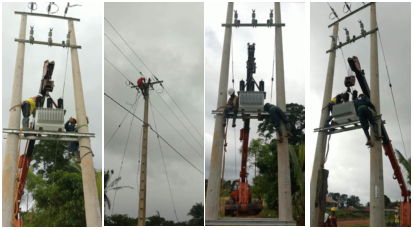
That reality is now beginning to change. Power lines are being extended from Murrayville into Greenville, while transformers are being mounted on utility poles as part of the Light-Up Southeast initiative, signaling the start of what officials describe as a major transformation in the region’s energy landscape.
The project is being implemented by the Rural and Renewable Energy Agency (RREA) with financial support from the European Union (EU) in partnership with the Government of Liberia.
For Greenville residents, the arrival of electricity represents more than the installation of poles, transformers and solar infrastructure. It offers the prospect of keeping businesses open longer, improving public services and reducing the heavy dependence on expensive generators.
The initial solar component is already advancing, with installation work underway to connect homes, schools, health facilities and businesses.
RREA says, the solar system is expected to provide immediate relief to communities that have spent decades coping with limited access to modern electricity.
For small businesses, the impact could be particularly significant. Electricity can allow shops, cold-storage operators, restaurants, phone-charging businesses, workshops and other enterprises to operate more efficiently while reducing dependence on fuel-powered generators.
The benefits are also expected to extend beyond commerce. Schools will have greater opportunities to use computers, digital learning tools and other electrical equipment, while health facilities could improve services through reliable lighting, refrigeration for medicines and vaccines, and operation of essential equipment.
For households, access to electricity is expected to provide safer lighting, improve communication and create better conditions for evening study and family activities.
But the solar rollout, is only the first stage of Greenville’s broader energy transformation.
At Saywoo Town on the Sinoe River, the Greenville Mini Hydropower Project, with an installed capacity of 2.0 megawatts, is progressing toward completion.
The hydropower facility is expected to become operational by 2027, providing a longer-term renewable energy source designed to complement the solar system and strengthen electricity supply in Greenville and surrounding communities.
The combination of solar and hydropower could give Sinoe a more diversified renewable-energy system while creating opportunities for businesses and public institutions that have historically operated under severe power constraints.
For a county whose economic potential has long been limited by inadequate infrastructure, reliable electricity could also become a catalyst for broader development.
Access to power can support agro-processing, fisheries, hospitality, telecommunications, small manufacturing and other businesses that require dependable electricity to expand.
It could also help attract new investment by reducing one of the longstanding infrastructure barriers confronting businesses outside Monrovia.
RREA has expressed appreciation to residents for their patience as the project moves forward, emphasizing the potential for electricity to stimulate economic activity and create new opportunities across Sinoe County.
The challenge now is, ensuring that the infrastructure is completed on schedule, maintained properly and expanded to reach communities beyond the immediate project areas.
For Greenville, however, the significance is already being felt. After more than three decades of darkness, the lights are finally coming on—and with them, residents are beginning to see the possibility of a different economic future for southeastern Liberia.

Towards Economic Empowerment And Reconciliation