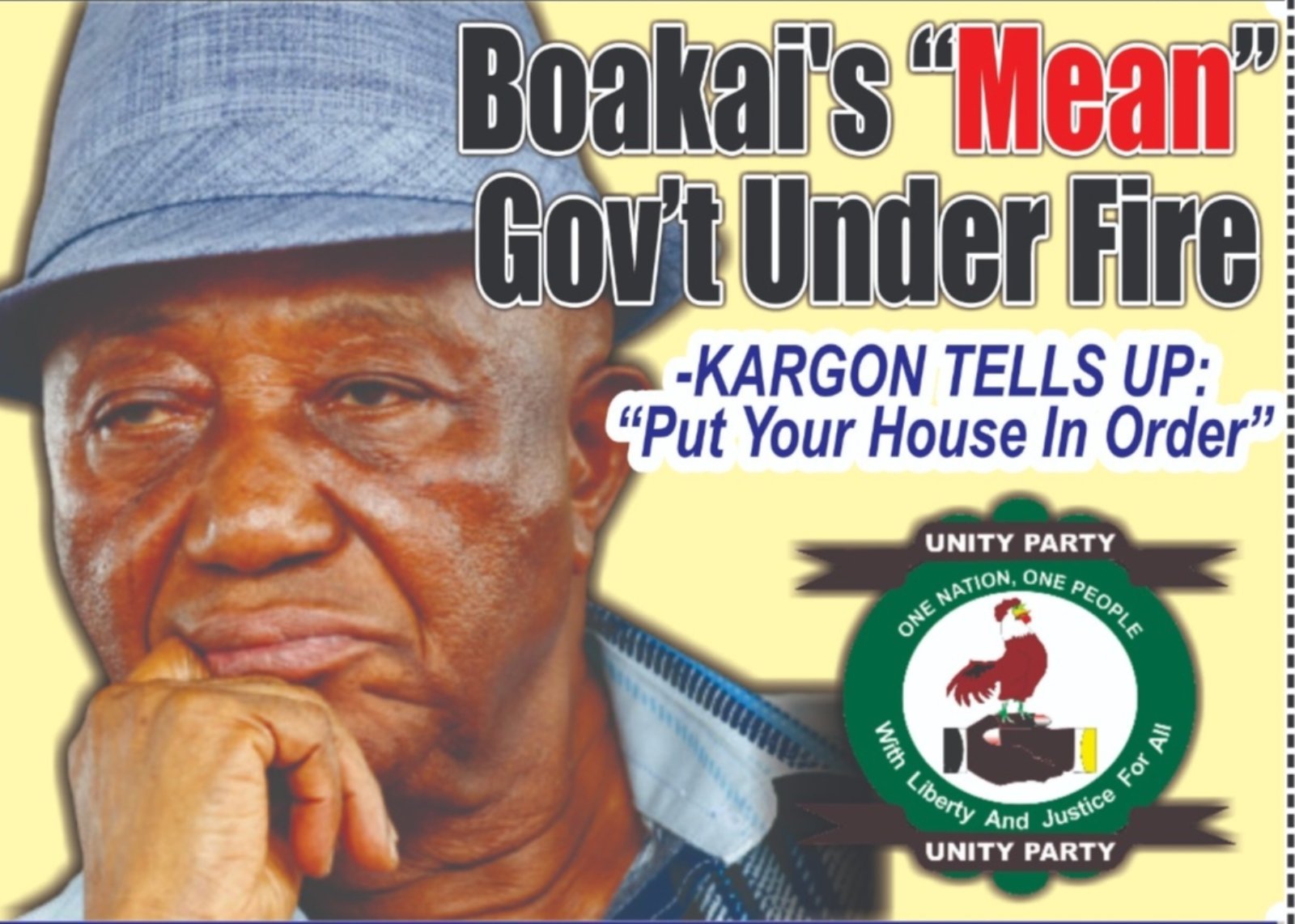
MONROVIA: Rising living costs, shrinking purchasing power and growing frustration over government responsiveness have triggered a fresh political backlash, with Nimba County Representative, Gunpue L. Kargon, accusing the Boakai administration officials of becoming detached from struggling Liberians.
The lawmaker’s blunt criticism has opened a new political front for the Unity Party-led government, coming at a time when many ordinary Liberians are struggling to cope with the cost of food, transportation, housing, healthcare and other basic necessities.
For families already living from hand to mouth, the economic reality is increasingly unforgiving: a small income is stretched across school expenses, market bills, transportation fares, rent, electricity, medical needs and other daily obligations.
For many households, what once covered a week’s necessities, now barely survives several days.
It is against this backdrop that Representative Kargon has publicly challenged officials of the governing Unity Party, warning that officials must reconnect with the people if they expect to retain public confidence and compete successfully in 2029.
“Unity Party, put your house in order. I said it before. CDC is realizing her mistake and trying to correct the mistake. And the same mistake that got them out, you are doing the same mistake,” Kargon declared.
His comments amount to one of the sharper public criticisms from within the political environment surrounding the current administration, particularly because he framed the problem not simply as economic hardship but as a failure of political connection between government officials and ordinary citizens.
Kargon specifically accused some officials of being inaccessible and disconnected from the communities they are supposed to serve.
“People living around you don’t know you are a minister. We need to come out to tell you the truth. You sit there with your mean self and you want to win 2029?” he asked rhetorically.
The Nimba lawmaker drew a direct comparison between the Boakai administration and the former Coalition for Democratic Change (CDC) government, arguing that the political mistakes that contributed to the CDC’s defeat could now be repeated by the Unity Party.
According to Kargon, the lesson of the previous administration should be clear: political power becomes vulnerable when ordinary people believe their government has stopped listening to them.
He argued that one reason some Liberians remain deeply loyal to former President George Weah is that they believe, they personally benefited from his administration or felt a closer connection to its officials.
“One thing I want for Unity Party people to know is, the reason for which some citizens in Liberia, they will die for George Weah—even when you cut their necks, they will not go—because they benefited from George Weah personally. But Unity Party people, you are damn mean,” Kargon said.
While his language has generated controversy, the substance of his argument has resonated with a broader public conversation about whether government officials are sufficiently visible and responsive to the people.
The criticism has also drawn a response from Unity Party stalwart, Mo Ali, who has rejected what he considers an unfair characterization of government officials as indifferent or unwilling to assist citizens.
In a post responding to the growing criticism, Ali said, the government’s assistance to citizens should be documented rather than left to competing political narratives.
“The narrative that we are ‘mean’ cannot simply be dismissed with a quick fix,” Ali acknowledged, while announcing a move toward documenting assistance provided by government officials.
He said that, going forward, individuals seeking assistance would be required to acknowledge receipt of the support, with the records made public as evidence of government intervention.
“From now on, anyone who seeks our help or assistance will sign a receipt, which we will publicly share as proof of the support we’ve provided,” Ali wrote.
According to Ali, the proposed documentation is intended to establish transparency and demonstrate that government officials are assisting citizens rather than simply allowing political opponents to define the administration’s record.
“This ensures transparency and allows us to demonstrate, beyond dispute, that we are assisting countless people, directly countering the false claims being spread by the naysayers,” he added.
Ali’s response effectively shifts the argument from whether officials are helping Liberians to whether the government can prove the assistance it says, it is providing.
But the growing debate cannot be separated from the economic realities confronting ordinary Liberians.
Across Monrovia and other parts of the country, economic pressure is felt most sharply by low-income workers, petty traders, commercial drivers, students, single-income households and families dependent on irregular earnings.
Market prices, transportation costs and household expenses have become daily calculations. For many Liberians, the question is no longer whether life is expensive, but which necessity can be sacrificed to pay for another.
A parent forced to choose between school expenses and food, a trader struggling to replenish stock, or a worker whose salary disappears before the month ends, experiences government performance differently from officials sitting in air-conditioned offices.
That disconnect is precisely what the Nimba County Lawmaker appears to be challenging.
His criticism suggests that political communication alone will not be sufficient to calm public frustration. Liberians want to see tangible improvements in their daily lives—and they want government officials to be accessible when those difficulties become unbearable.
Ali’s proposal to document government assistance could therefore become an important test of the administration’s claim that it is responding to citizens’ needs.
If implemented transparently, receipts, records and publicly verifiable assistance could provide evidence of government’s intervention. But it could also expose the scale of unmet needs if the number of people seeking help continues to far exceed the government’s capacity to respond.
The debate is consequently becoming bigger than Kargon versus the Unity Party.
It is becoming a debate over whether the Boakai administration is sufficiently connected to the people whose votes placed it in power.
Kargon’s warning is particularly significant because, it invokes 2029, suggesting that the political consequences of today’s economic frustrations could become tomorrow’s electoral reckoning.
His central message to the Unity Party is unmistakable: do not repeat the mistakes that brought the CDC out of power.
And for ordinary Liberians confronting the daily pressure of economic survival, the debate may ultimately be judged not by political statements, Facebook posts or promises—but by whether the price of living becomes bearable and whether government can be felt beyond the walls of ministries and government offices.
Some loyalists of President Boakai have privately expressed concern that his decision to entrust key economic portfolios to officials from the same county has contributed to growing public frustration over the administration’s economic management.
They argue that the officials, whom critics portray as financially unfriendly and inaccessible, are increasingly projecting an image of an administration disconnected from the economic struggles of ordinary Liberians.
Towards Economic Empowerment And Reconciliation