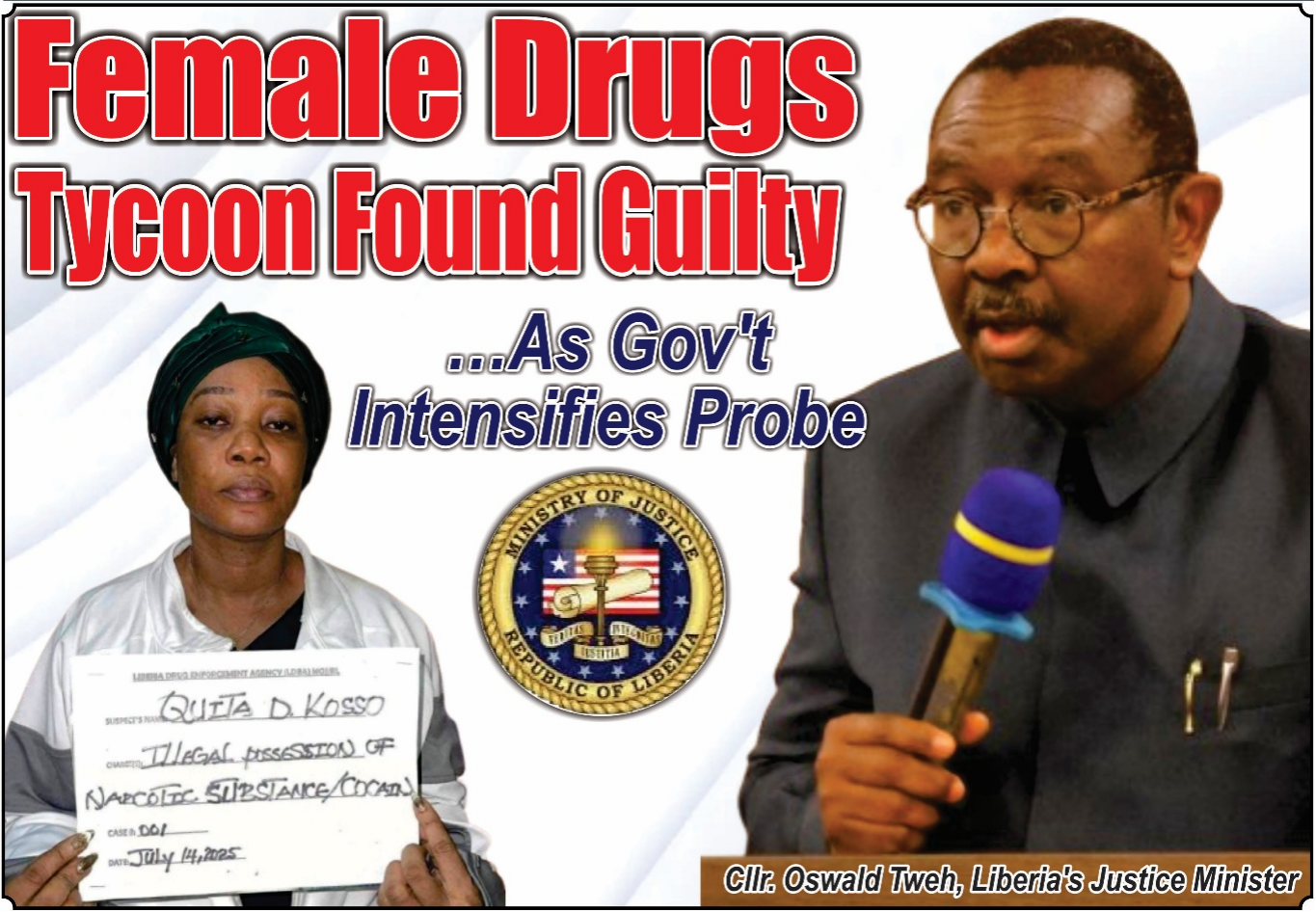
MONROVIA: The conviction of airport female cocaine courier, Quita Dolo Kosso, has reignited Liberia's war against narcotics, but public attention is rapidly shifting from convicted courier to powerful suspects still under investigation, testing whether justice will ultimately reach every level of the alleged criminal network.
The five-year prison sentence given convicted cocaine trafficker, Quita Dolo Kosso, has closed one chapter in Liberia's escalating battle against transnational narcotics syndicates. Yet, it has simultaneously opened a far more consequential national question: Who will be next to face justice?
For many Liberians, the issue is no longer whether cocaine traffickers can be arrested or convicted. That has already been demonstrated.
The greater test now confronting the Boakai administration is whether the same resolve displayed in prosecuting Kosso will be applied to the growing list of influential individuals and public officials whose names have surfaced during separate high-profile drug investigations.
Across the country, public expectations have reached unprecedented levels.
Liberians are no longer satisfied with the conviction of couriers alone. Increasingly, citizens are demanding accountability for all those suspected of financing, facilitating and protecting the sophisticated criminal enterprises responsible for turning Liberia into what many now call, ‘transit corridor’ for international drug cartels.
The sentence, handed down Wednesday, August 5, 2026, by Resident Judge Victoria Worlobah Duncan, of the 13th Judicial Circuit Court in Kakata, Margibi County, was therefore more than the conclusion of an individual prosecution, according to one civil society commentator.
“It became another defining moment in the country's widening anti-drug campaign,” the commentator who prefers anonymity for this story said, minutes after the court’s verdict was announced.
After accepting a negotiated plea agreement between state prosecutors and the defense, Judge Duncan sentenced Kosso to five-year imprisonment after satisfying herself that the guilty plea had been entered knowingly, voluntarily and without coercion.
Kosso's conviction stemmed from her dramatic arrest on July 12, 2025, at the Roberts International Airport, where officers of the Liberia Drug Enforcement Agency (LDEA) intercepted 3.355 kilograms of cocaine concealed in her luggage after she arrived aboard Kenya Airways Flight KQ887 from Bangkok, Thailand.
Authorities valued the narcotics at approximately US$181,008.
She was subsequently indicted on multiple violations of Liberia's Controlled Drugs and Substances Act, including trafficking, importation, possession and criminal conspiracy.
The trafficking offenses were non-bailable under Liberian law. Although Kosso's conviction represents another success for state prosecutors, the investigation has evolved far beyond the woman who carried the drugs.
The courtroom spotlight has now shifted toward a much broader conspiracy that continues unfolding before the courts.
Several defendants, including former officers of the Liberia Drug Enforcement Agency (LDEA), remain on trial after pleading not guilty to charges arising from the same investigation.
Their prosecution has attracted enormous public attention because, it raises troubling questions about alleged institutional compromise within the very agency responsible for combating narcotics trafficking.
The proceedings became even more controversial after allegations surfaced that an LDEA officer improperly attempted to influence jurors during trial.
Judge Duncan immediately suspended the proceedings and ordered a formal investigation, describing the accusations as serious enough to undermine public confidence in the integrity of the judicial process.
That development reinforced growing concerns that Liberia's anti-drug fight is no longer confined to drug couriers. It now touches law enforcement institutions themselves.
The Kosso conviction also comes against the backdrop of an unprecedented national narcotics crisis, characterized my many citizens as ‘Cocaine Gate 2026.’
Within recent weeks, Liberia has witnessed the seizure of more than 4.2 metric tons of cocaine, valued at approximately US$317 million, exposing what investigators describe as one of the largest transnational drug trafficking operations ever uncovered in the country's history.
Those seizures have triggered sweeping investigations that have already resulted in the dismissal, suspension, arrest and prosecution of several government officials and security personnel allegedly linked to the expanding drug network.
Authorities have repeatedly assured the public that no individual will be shielded from investigation because of political office, security rank or social status.
Yet, many Liberians remain cautious. Their skepticism is rooted in history. For years, major narcotics cases have generated sensational headlines before gradually disappearing from public discussion, often without clear explanations regarding prosecutions, convictions or the dismantling of the criminal organizations behind them.
That history explains why the public reaction to Kosso's sentencing has been mixed. Many citizens have welcomed the conviction as evidence that Liberia's courts remain capable of holding traffickers accountable.
Others, however, insist that the country's anti-drug campaign cannot be judged solely by the conviction of couriers.
Instead, they argue that the true measure of success will be whether investigators identify those who financed the shipments, coordinated international logistics, provided protection and allegedly infiltrated state institutions.
The central question dominating public discourse is straightforward: Will the government summon the same courage when investigations reach politically connected figures or senior public officials?
That question has become even more significant as state prosecutors continue expanding investigations into Liberia's largest-ever cocaine seizures.
As the anti-drug battle intensifies, the Boakai administration has repeatedly declared that its fight against narcotics is inseparable from its campaign against corruption.
If that commitment remains consistent, investigators will be expected to follow evidence wherever it leads, regardless of political affiliation or institutional influence, another civil society activist said.
Legal analysts caution, however, that public expectations must remain anchored in the rule of law. Investigations require evidence. Arrests require probable cause. Convictions require proof beyond all reasonable doubts.
The presumption of innocence remains a constitutional guarantee for every accused person until proven otherwise in a court of competent jurisdiction.
Nevertheless, Liberians are demanding transparency. They want regular updates. They want investigations completed professionally. They want cases speedily prosecuted without any interference.
Most importantly, they want assurance that justice will not stop with the weakest links in the trafficking chain while more powerful actors escape accountability.
The government's credibility now rests less on the quantity of cocaine seized than on the quality of the prosecutions that follow.
‘Destroying narcotics is important. Destroying the criminal networks behind them is the greater challenge,’ one of Liberia’s legal luminaries added his voice to the discourse.
The sentencing of Quita Dolo Kosso therefore represents both an achievement and a challenge. It demonstrates that Liberia's courts can punish convicted traffickers.
But it also raises expectations that the country's anti-drug campaign will not end with a single conviction.
As investigations continue to widen and more suspects remain under scrutiny, one question echoes across courtrooms, communities and the corridors of government: After Quita Dolo Kosso, who is next?
The answer will determine not only the future of the ongoing investigations but also whether Liberia's renewed war against narcotics becomes another forgotten campaign—or the beginning of a sustained national effort to dismantle the cartels threatening the country's security, institutions and future.

Towards Economic Empowerment And Reconciliation