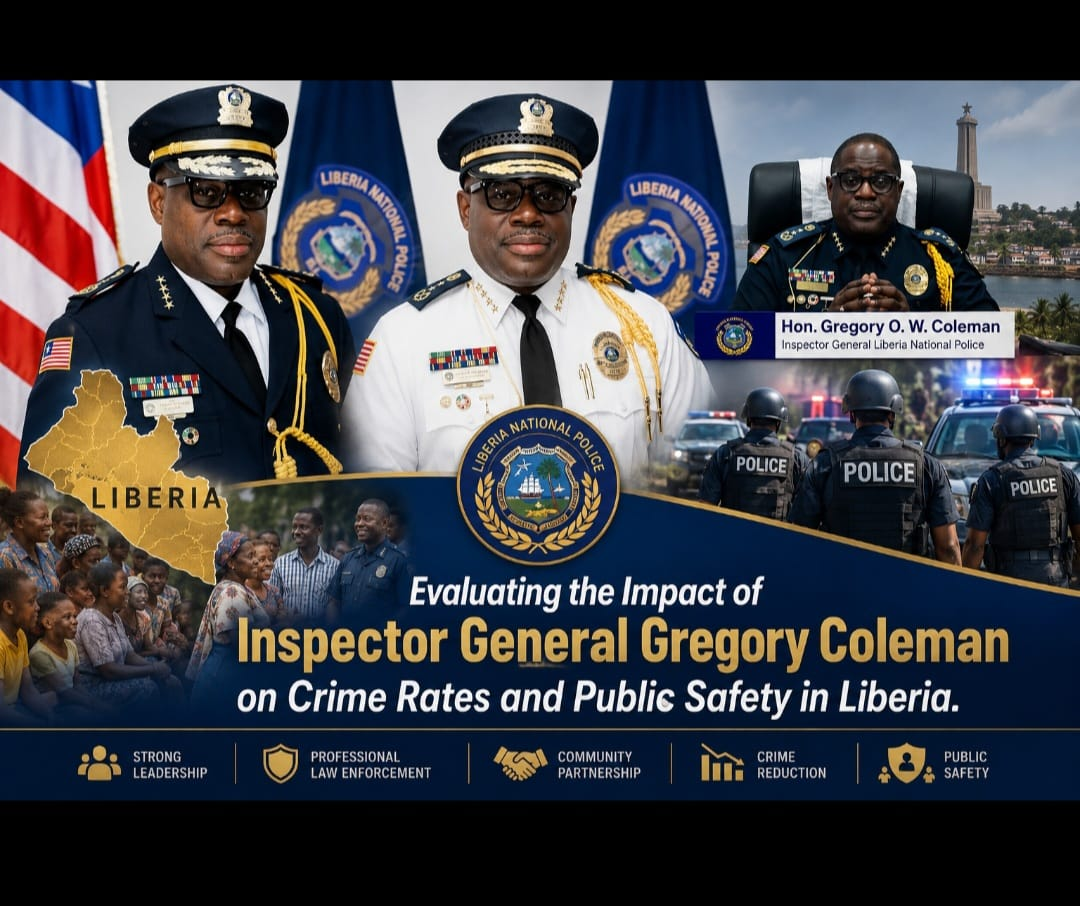
Evaluating the Impact of Inspector General Gregory Coleman on Crime Rates and Public Safety in Liberia
Guest Opinion |
👁 4 Views
|
July 22, 2026
Given one flower while they are still alive and in the service of humanity.
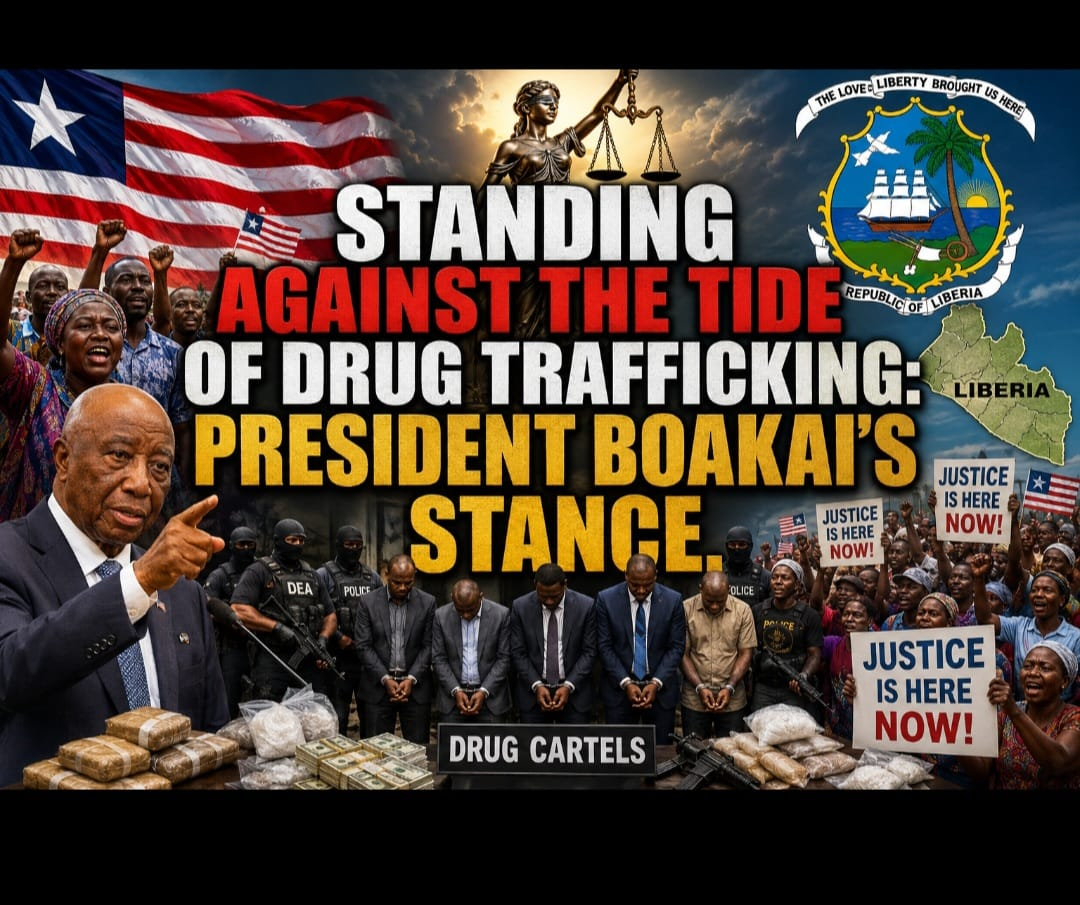
President Joseph Nyuma Boakai: On combating transnational crime: "Liberia is not open for the business of drug trafficking. Liberia will not be used as a safe haven, transit point, warehouse, financial center, or operational base by criminal networks engaged in narcotics trafficking." News Public Trust.
On corruption and public safety: "We all have what it takes to overcome all the burdens we have imposed on ourselves through greed and corruption." — Annual Message to the Legislature, January 29, 2024.
Liberian Embassy USA: On accountability and impunity:
President Boakai stated that those who bear the greatest responsibility for crimes must account for their actions and admit their wrongs as a means of ending impunity and promoting reconciliation. The Executive Mansion.
Former President George Manneh Weah: On security as a national priority: "The security of our citizens remains one of the cardinal responsibilities of Government." This theme appears repeatedly in President Weah's national addresses and security-related speeches.
The Executive Mansion.
On peace and the rule of law: "Peace and security remain the foundation upon which national development can be achieved."
Drawn from official presidential addresses emphasizing law, peace, and national development. The Executive Mansion.
Former President Ellen Johnson Sirleaf: On justice and the rule of law:
"There can be no lasting peace without justice."
A consistent theme throughout President Sirleaf's post-war governance and reconciliation speeches. Journal of Democracy
On democratic governance:
"The peaceful and orderly transfer of political power and authority reflects the enduring character of the democratic tradition." — Inaugural Address, January 16, 2006.
Former South African President
Nelson Mandela: "Safety and security don't just happen; they are the result of collective consensus and public investment."
Former US President Barack Obama: "The rule of law is not merely a government policy; it is the foundation for a just society."
Former UN Secretary-General Kofi Annan: "There is no development without security, and no security without development."
Former US President Ronald Reagan: "Freedom prospers when religion is vibrant, and the rule of law under God is acknowledged."
Former US Attorney General Robert F. Kennedy: "Every society gets the kind of criminal it deserves. What is equally true is that every community gets the kind of law enforcement it insists on."
Former British Leader Winston Churchill: "The first duty of a government is the safety and well-being of its people."
Novelist Victor Hugo: "He who opens a school door, closes a prison."
Novelist Fyodor Dostoevsky: "The degree of civilization in a society can be judged by entering its prisons."
Poet Maya Angelou: "Prejudice is a burden that confuses the past, threatens the future, and renders the present inaccessible."
Poet John Donne: "No man is an island." This quotation underscores that crime affects the entire community.
Physician Rudolf Virchow: "Medicine is a social science, and politics is nothing else but medicine on a large scale."
Physician Paul Farmer: "The idea that some lives matter less is the root of all that is wrong with the world."
United Nations:
"The rule of law is fundamental to international peace and security, political stability, economic and social progress, development, and the protection of people's rights and freedoms." Journal of Democracy.
United Nations Office on Drugs and Crime (UNODC):
"Crime undermines sustainable development, weakens the rule of law, and threatens peace and security."
INTERPOL: "Effective international police cooperation helps make the world a safer place."
World Bank: "Security, justice, and jobs are essential to breaking cycles of violence."
These quotations collectively support the argument that effective policing, respect for the rule of law, accountability, and public cooperation are indispensable in reducing crime and improving public safety, making them suitable supporting references for an assessment of Inspector General Gregory Coleman's impact on crime and security in Liberia.
By: Austin S Fallah- A True Son of the Planet Earth Soil: fallahas@yahoo.com
In the modern age, effective policing is crucial for maintaining public safety and fostering community trust.
In Liberia, law enforcement has been central to the nation’s recovery and stability, especially in the wake of a tumultuous past marked by civil unrest.
Under the leadership of Inspector General Gregory Coleman, recent reports indicate significant reductions in crime rates and improvements in public safety. Eyewitness accounts, such as those of Pastor Victor Barbour from Midwest, Minnesota, and Coleman's own words, paint a picture of a dedicated police force committed to serving its citizens.
While some detractors may raise objections, a comprehensive analysis reveals that Inspector General Coleman’s 21st-century approach to policing has positively influenced safety dynamics in Liberia.
As I argue in this korero, IG Coleman's leadership has not only reduced crime rates but also fostered a culture of accountability, professionalism, and service within the Liberian National Police.
Historical Context: Liberia's Struggle with Crime and Instability:
Before delving into the analysis of Inspector General Coleman's impact from a distance (social media, discussions with returned Liberians to the US, etc.), one must understand the historical context of crime in Liberia.
The country endured a devastating civil war from 1989 to 2003, which significantly weakened governmental structures and left a legacy of distrust towards law enforcement.
Post-conflict, the re-establishment of a functional police force has been critical in rebuilding national unity and public confidence in governance.
During the transitional period, Liberia faced rampant crime, including robbery, assault, and corruption, leading to an environment of fear among ordinary citizens.
As a result, the police force’s efficacy was called into question, and many viewed officers with skepticism.
The trajectory of public safety in Liberia was marred by the perception that law enforcement was ineffective, unaccountable, and politicized.
Yet, in this climate, Inspector General Coleman emerged as a pivotal figure, offering hope for reform.
Inspector General Gregory Coleman’s Vision for Policing:
Coleman’s vision for the Liberian National Police (LNP) is predicated on the principles of professionalism, integrity, and service. His assertion, "Police Officers are not wearing uniforms for themselves, but for service to the nation," speaks volumes about his perspective on law enforcement's responsibilities.
Coleman champions a model of policing that emphasizes community engagement, transparency, and respect for human rights.
This vision aligns with international best practices in policing and supports the notion that effective policing is grounded in community trust rather than fear.
According to Pastor Barbour’s observations following his return from Liberia, there has indeed been a noticeable shift in the interaction between police officers and the community.
The reduction in crime rates under Coleman’s leadership can be attributed to several key initiatives that foster collaboration between the police and the public.
These include rigorous training programs, community outreach initiatives, and a commitment to accountability and ethical conduct within the force.
Reduction in Crime Rates: Evidence of Progress:
Statistical data support the assertion that crime rates in Liberia have declined under Coleman’s directorship.
While comprehensive crime reports may be complex and sometimes challenging to obtain, anecdotal evidence, coupled with available statistics, indicates a shift towards safer communities.
Reports from local organizations and government sources point to decreases in the prevalence of violent crime and property offenses since Coleman took charge.
For instance, credible sources cite a marked reduction in robbery and theft incidents, encouraging a renewed sense of security among citizens.
Detractors may argue that these statistics are influenced by various factors, including socioeconomic changes or external assistance programs; however, the perception of improved safety resonates with the lived experiences of many Liberians.
Pastor Victor Barbour's firsthand account underlies the positive shift he observed, reinforcing the belief that Coleman's police force is genuinely committed to safeguarding lives.
Moreover, Coleman’s police force has taken proactive measures to prevent crime, including increased patrols in high-crime areas and the establishment of community policing units that prioritize open dialogue with residents.
Such initiatives not only reduce crime but also empower community members to take an active role in their own safety.
The Professionalism and Accountability of Law Enforcement:
Another significant aspect of Coleman’s impact on the Liberian police force is the emphasis on professionalism.
By promoting a culture of accountability, Coleman has instilled in his officers the understanding that their role extends beyond merely enforcing the law; they are also protectors of rights and advocates for justice.
The fruits of this cultural shift are evident in the reduced instances of police misconduct and corruption, which have historically plagued law enforcement in Liberia.
Pastor Victor Barbour’s observations affirm that, under Coleman’s leadership, police officers are guided by a renewed sense of duty and professional ethics.
IG Coleman does not allow political affiliations to influence his department's operations; rather, he prioritizes the welfare and safety of all Liberians, irrespective of their background.
This approach has fostered public trust and encouraged citizens to report crimes and collaborate with law enforcement, a crucial element for community-oriented policing to flourish.
Furthermore, research shows that the International Criminal Investigative Training Assistance Program (ICITAP) has partnered with the LNP to provide training and resources aligned with Coleman’s reform goals.
These collaborative efforts have enhanced the LNP's capacity to operate effectively and ethically, contributing to the positive trajectory of crime rates and public safety in Liberia.
Challenges and Detractors:
Despite the progress under Coleman’s leadership, it is essential to acknowledge the challenges that persist.
Detractors of Coleman may argue that while there is a crime reduction, systemic issues such as inadequate funding, resource scarcity, and underlying socioeconomic problems still plague the nation.
These factors must be addressed holistically to ensure sustained improvements in public safety.
Critics may also point to the slow pace of reform within the police force and the need for more robust policies addressing issues such as gender-based violence and domestic abuse.
Although Coleman’s direction marks a positive step towards progress, the road ahead requires persistent commitment from both law enforcement and the nation.
The Role of Community Engagement in Sustainable Safety:
One of the hallmarks of effective policing is community engagement, a principle that Coleman has embraced wholeheartedly.
By actively involving local communities in discussions about safety and policing strategies, Coleman has fostered a collaborative environment that enables shared responsibility for maintaining public order.
This partnership is crucial for developing trust between citizens and law enforcement and ensuring that policing strategies are culturally sensitive and effective.
Programs that educate citizens about their rights and provide platforms for feedback foster an atmosphere in which the community feels empowered to voice concerns and collaborate with police.
Pastor Barbour’s account exemplifies the impact of such initiatives, reflecting a growing recognition among Liberians that their safety is a collective responsibility rather than solely the police's.
A Case for Optimism in Liberian Policing:
Inspector General Gregory Coleman’s leadership has manifested in tangible improvements in crime rates and public safety in Liberia.
By championing principles of professionalism, community engagement, and accountability, IG Coleman has been instrumental in reshaping the image of the Liberian National Police.
As expressed by Pastor Victor Barbour, the ethos “We do not take lives, but we protect them” underscores the LNP's commitment to serve the people of Liberia diligently.
While challenges remain, the progress achieved under IG Coleman’s leadership offers a compelling narrative of hope and promise for the future of policing in Liberia.
The collaboration between the police and the community is essential for sustained safety and security.
As President Joseph Nyuma Boakai's decision to appoint Coleman is examined, it is evident that Liberia is on a path toward a safer, more cooperative future, one where the intentions of law enforcement align with the aspirations of the nation’s citizens.
In light of this fundamental shift, Liberians should express gratitude for such leadership, as it reflects a broader commitment to building a society grounded in safety, resilience, and respect for all.